Where comets emit dust
Apr 26, 2010
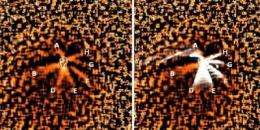
This is a look at the comet Tempel 1 through a telescope. The active regions are responsible for the bright jets (left). With the help of their computer simulation the MPS-scientists can reconstruct the image seen from Earth (right). Credit: Image: Instituto de Astrofisica de Andalucia (Luisa Maria Lara)/Max Planck Institute for Solar System Research

Studying comets can be quite dangerous - especially from close up. Because the tiny particles of dust emitted into space from the so-called active regions on a comet's surface can damage space probes.

Scientists from the Max Planck Institute for Solar System Research in Germany have now developed a that can locate these regions using only the information available from Earth. The new method could help calculate a safe flight route for ESA's Rosetta, which is scheduled to arrive at the Churyumov-Gerasimenko in 2014. (Astronomy & Astrophysics, 512, A60, 2010)

A comet's nucleus is much more than an unvarying chunk of ice and dust. Under the Sun's influence, volatile substances such as water, carbon dioxide, and carbon monoxide are emitted from certain regions on its surface - the so-called active regions - carrying with a diameter of up to a few centimetres into space. Seen from Earth, these fountains of dust can be discerned as jets or spiral arms that surround the comet (see figure 1). These structures are embedded in a sheath of gas and dust called the coma that is produced by the more uniform activity of the overall surface.

"Pictures taken from Earth show the comet and its jets as a two-dimensional projection", explains Hermann Böhnhardt from the Max Planck Institute for Solar System Research (MPS). Where exactly the dust particles and gases originate from can not therefore be well identified.

In order to localize the active regions despite this problem, the MPS-researchers chose an indirect approach that for the first time also accounts for the three dimensional shape of the comet. "Until now, computer programs trying to find the active regions assumed the comet as a sphere or ellipsoid", explains Jean-Baptiste Vincent from MPS. Since in reality comets often have quite bizarre shapes, for many applications this approach is not good enough. The researchers therefore decided to take a standard approach: While watching a comet for an entire rotation period, changes in its luminance allow its true form to be calculated.

In a next step, the researchers fed their program with an initial assumption where the active regions might be located. Additionally they made an "educated guess" concerning the physical properties of the dust particles like size and initial velocity upon emission from the nucleus. As a result, the computer simulation delivers an image as it would be seen through a telescope on Earth. By comparing this with the actual image through a telescope the model can be refined step by step until simulation and actual image agree.

Already, the new method has passed its first test: The scientists could successfully apply it to the comet Tempel 1 that was the destination of NASA's Deep Impact Mission in 2005. "Even though ever since this mission we know where Tempel1's active regions are, we pretended not to", explains Vincent. For their computer program the scientists only used information that was available from Earth-base observations - apart from the nucleus shape model that was adopted from the mission results.

Next, the researchers intend to calculate the active regions of the comet Churyumov-Gerasimenko, the rendezvous target for ESA's Rosetta mission on which the Rosetta lander Philae will touch down in late 2014. The mission, to which MPS contributed many scientific instruments, has been on route to its destination beyond the orbit of Mars and the asteroid belt since 2004. In the crucial phase of the mission, the new method could help to determine a safe route for Rosetta through the cometary coma and maybe even find a suitable landing site.

Explore further: Collisions of coronal mass ejections can be super-elastic

More information: J.-B. Vincent, H. Böhnhardt, and L.M. Lara, A numerical model of cometary dust coma structures - Application to comet 9P/Tempel 1, Astronomy&Astrophysics 512, A60 (2010) DOI: 10.1051/0004-6361/200913418

Related Stories

Evidence for more dust than ice in comets

Oct 13, 2005

Observations of Comet 9P/Tempel 1 made by ESA’s Rosetta spacecraft after the Deep Impact collision suggest that comets are ‘icy dirtballs’, rather than ‘dirty snowballs’ as previously believed.

Rosetta monitors Deep Impact

Jun 20, 2005

ESA’s comet chaser Rosetta will take part in one of the world’s largest astronomical observation campaigns - the Deep Impact event - while on its cruise to Comet 69P/Churyumov-Gerasimenko. Rosetta will be ...

Rosetta's final Earth boost

Nov 04, 2009

ESA's comet chaser Rosetta will swing by Earth for the last time on 13 November to pick up energy and begin the final leg of its 10-year journey to comet 67P/Churyumov-Gerasimenko. ESA's European Space Operations ...

Boosting the accuracy of Rosetta's Earth approach

Oct 19, 2007

Yesterday, 18 October at 18:06 CEST, the thrusters of ESA’s comet chaser, Rosetta, were fired in a planned, 42-second trajectory correction manoeuvre designed to 'fine tune' the spacecraft's approach to ...

Rosetta closes in on Earth -- a second time

Nov 08, 2007

ESA’s comet chaser, Rosetta, is on its way to its second close encounter with Earth on 13 November. The spacecraft’s operators are leaving no stones unturned to make sure Earth’s gravity gives it the ...

Recommended for you

NASA head views progress on asteroid lasso mission

14 hours ago

Surrounded by engineers, NASA chief Charles Bolden inspected a prototype spacecraft engine that could power an audacious mission to lasso an asteroid and tow it closer to Earth for astronauts to explore.

Ecuador satellite collides with Russian space junk

14 hours ago

A small Ecuadoran satellite collided in orbit with the remains of a Russian rocket, but it is too soon to know how much damage it might have sustained, Quito's space agency said Thursday.

Forecast for Titan: Wild weather could be ahead

May 22, 2013

(Phys.org) —Saturn's moon Titan might be in for some wild weather as it heads into its spring and summer, if two new models are correct. Scientists think that as the seasons change in Titan's northern hemisphere, ...

SDO observes mid-level solar flare

May 22, 2013

UPDATE 16:30 p.m. EDT: The M7-class flare was also associated with a coronal mass ejection or CME, another solar phenomenon that can send billions of tons of particles into space. While this CME was not Ea ...

User comments : 0

More news stories

A hidden population of exotic neutron stars

(Phys.org) —Magnetars – the dense remains of dead stars that erupt sporadically with bursts of high-energy radiation - are some of the most extreme objects known in the Universe. A major campaign using ...

Century-old science helps confirm global warming

(Phys.org) —Ocean measurements taken more than 135 years ago during the scientific expedition of HMS Challenger have provided further confirmation of human-produced global warming over the past century.

Hubble reveals the ring nebula's true shape

(Phys.org) —The Ring Nebula's distinctive shape makes it a popular illustration for astronomy books. But new observations by NASA's Hubble Space Telescope of the glowing gas shroud around an old, dying, ...

Controlling mood through the motions of mitochondria

(Medical Xpress)—Regulating the distribution of power in neurons is done by a system that makes the national electric grid look simple by comparison. Each neuron has several thousand mitochondria confined ...

Hormone replacement therapy—clarity at last

The British Menopause Society and Women's Health Concern have today released updated guidelines on Hormone Replacement Therapy (HRT) to provide clarity around the role of HRT, the benefits and the risks. The new guidelines ...