Whale poo could aid climate, say Aussie scientists
Apr 23, 2010
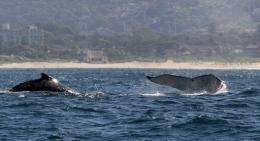
Humpback whales (C) rise out of the water off the coast near Sydney in 2008. Experts from the Australian Antarctic Division have found that whale excrement -- much of which is derived from the huge mammals' consumption of krill -- effectively places a plant-friendly fertilizer into ocean waters.

Australian scientists have discovered an unlikely element in the fight against climate change -- whale poo.

Experts from the Australian Antarctic Division have found that whale excrement -- much of which is derived from the huge mammals' consumption of krill -- effectively places a plant-friendly fertilizer into ocean waters.

"When consume the iron-rich krill, they excrete most of the iron back into the water, therefore fertilising the ocean and starting the whole food cycle again," scientist Steve Nicol said.

The research suggests that if whale numbers grow, their droppings could help marine plant life flourish, thereby improving the ocean's ability to absorb carbon dioxide blamed for global warming.

Iron is a vital element in the production of marine plants, known as algae, which suck up carbon dioxide as they grow, although it is a scarce element in the "anaemic" , said chemical oceanographer Andrew Bowie.

"One-third of the world's oceans are low in trace element iron," the researcher at the Antarctic Climate and Ecosystems Cooperative Research Centre told AFP.

Bowie said whales consumed several tonnes of krill, small shrimp-like crustaceans, each day and this found its way back into the via liquid-form, reddish brown emissions from the giant mammals.

He said while the researchers were pretty confident that whale poo would contain iron, they were surprised at the high concentration, about 10 million times that of Antarctic .

Explore further: Chinese, Indian airlines face EU pollution fines

add to favorites email to friend print save as pdf

Related Stories

Antarctic krill provide carbon sink in Southern Ocean

Feb 06, 2006

New research on Antarctic krill (Euphausia superba), a shrimp-like animal at the heart of the Southern Ocean food chain, reveals behaviour that shows that they absorb and transfer more carbon from the Earth’s surface than ...

Antarctic’s signature dish under threat

Apr 20, 2006

Scientists have begun work to help explain the population decline of the Southern Ocean's most important species — Antarctic krill. The small shrimp-like creatures underpin the Antarctic marine world as the ...

Ocean iron and CO2 interaction studied

Apr 26, 2007

A French study suggested that iron supply changes from deep water to the ocean's surface might have a greater effect on atmospheric CO2 than thought.

Study Solves Ocean Plant Mystery

Aug 31, 2006

A NASA-sponsored study shows that by using a new technique, scientists can determine what limits the growth of ocean algae, or phytoplankton, and how this affects Earth's climate.

Recommended for you

China 'will not accept' carbon tax on EU flights: report

26 minutes ago

China will not pay for CO2 emissions by its airlines on flights within Europe, a top civil aviation official reportedly said after the European Commission warned eight Chinese firms face fines for nonpayment.

Chinese, Indian airlines face EU pollution fines

May 18, 2013

Eight Chinese and two Indian airlines face fines of up to several million euros for not paying for their greenhouse gas emissions during flights within the bloc, the European Commission said on Friday.

Fracking risks to ground water assessed

May 17, 2013

(Phys.org) —Extraction of "unconventional" gas from sedimentary rocks such as shale could provide a clean energy source and help some regions to become energy independent, but concerns have been raised ...

User comments : 3

Adjust slider to filter visible comments by rank

Display comments: newest first

TegiriNenashi
1 / 5 (2) Apr 23, 2010
Whale excrement? Taking any subject, no matter how negligible, and study it's effect onto global warming -- that would be science defecation.
JonJer
2.3 / 5 (3) Apr 25, 2010
Yep -- just put 'global warming' in the title and watch them fast-track your grant application. Always wanted to study how chameleons change colour? 'How Global Warming Affects Chameleon Pigmentation' is a sure-fire winner. Want a trip to Hawaii? 'Global Warming Effects on Wave Heights in the Central Pacific'. Anyone can play!
rwinners
3 / 5 (1) Apr 25, 2010
If only there were enough whales....
and someone really gave a 'poop'.

More news stories

Russia retrieves mice, newts from space

A Russian capsule filled with 45 mice and 15 newts along with other small animals returned from a month's mission in orbit on Sunday with data scientists hope will pave the way for a manned flight to Mars.

Galaxy's Ring of Fire

Johnny Cash may have preferred this galaxy's burning ring of fire to the one he sang about falling into in his popular song. The "starburst ring" seen at center in red and yellow hues is not the product of ...

German energy shift faces headwinds

Tense engineers have their eyes peeled on complex colour-coded diagrams on a wall-sized screen that makes their control room look like the inside of a spaceship.

China police billions spell profit opportunity

Mannequins in riot gear, armoured cars and drones line a police equipment and "anti-terrorism technology" trade fair in Beijing as vendors seek to profit from China's huge internal security budget.

Honeybees trained in Croatia to find land mines

(AP)—Mirjana Filipovic is still haunted by the land mine blast that killed her boyfriend and blew off her left leg while on a fishing trip nearly a decade ago. It happened in a field that was supposedly ...

Internet in 'coma' as Iran election looms

Iran is tightening control of the Internet ahead of next month's presidential election, mindful of violent street protests that social networkers inspired last time around over claims of fraud, users and ...