Forensics' evidence could be bruised
Apr 22, 2010

(PhysOrg.com) -- Criminal cases where forensic experts determine the age of bruises on victims from photographs could be flawed, according to scientific research.

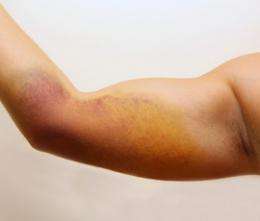
Researchers from Barts and The London School of Medicine and Dentistry at Queen Mary, University of London found experts made significant errors when they used photographs to determine the time bruises were inflicted on people.

One of the study’s authors, Professor of Forensic Medical Sciences, Peter Vanezis, at the William Harvey Research Institute, Barts and the London School of Medicine and Dentistry, said: “Forensics are often asked to give their expert opinion as to when bruising had occurred on a victim based on photographic images, yet we now realise they can’t accurately determine when the bruise occurred.”

Forensic experts are frequently asked to comment on the age of bruises, in cases concerning child abuse, assault and sexual assault.

In this study, forensic experts looked at 132 photographic images of bruises, ranging from 0 to 209 hours in age.

Bruises were produced on the upper arms of 11 Caucasian subjects by a suction pump. Daily sequential photographs were taken until they were no longer visible to the naked eye. Fifteen forensic experts were asked to estimate the age of the bruises and also place them in chronological order.

Lead author, Margaret Pilling, an Honours Medical Student at Barts and the London School of Medicine and Dentistry, said: “The greatest accuracy, from forensic experts, occurred in very fresh bruises (between 0 and 12 hours) however there were still a number of significant misjudgements in this age range.

“The median difference between the estimated age and the real age was 26 hours - a considerable disparity. We conclude that forensic experts’ estimates of bruise age from photographs are, at best, unreliable.”

Explore further: US scientist not involved in classified research: witnesses

More information: “Visual assessment of the timing of bruising by forensic experts” Pilling M.L., et al, Journal of Forensic and Legal Medicine 17, 2010, 143-149.

add to favorites email to friend print save as pdf

Related Stories

Study probes impact of CSI-style programming on jurors

Sep 24, 2008

(PhysOrg.com) -- A new psychological study from the University of Leicester aims to investigate how accurate people's perceptions about forensic science are, where these beliefs come from, and how this forensic awareness ...

Texts to reveal 'Whodunnit'

Aug 10, 2006

Psychologists at the University of Leicester are to investigate texting language to provide new tools for criminal investigation.

New technology puts biomedical imaging in palm of hands

May 20, 2008

Researchers at Georgia Tech have developed a narrowband filter mosaic that will expand the uses and functionality of multispectral imaging—a technology that enables subsurface characterization. The new, ...

Whose Tattoo Is It Anyway?

Dec 14, 2009

(PhysOrg.com) -- An infra-red digital camera could be a crucial tool in the fight against crime when trying to identify suspects by their tattoos, according to new University of Derby research.

Recommended for you

US scientist not involved in classified research: witnesses

20 hours ago

Colleagues of a US scientist found hanged in Singapore last year told a coroner's inquiry Friday he was not involved in projects with military applications and was never asked to compromise any country's national security.

Bonaparte family letter to return to France

May 16, 2013

(Phys.org) —A handwritten letter dated April 27, 1792, signed by Joseph Bonaparte and referring to a skirmish in Corsica involving Napoleon, the writer's then 22-year-old brother, will be returned to its ...

New research method aims to unlock academia's biggest problem

May 16, 2013

Scientists at Keele University have found a solution to one of life's great mysteries: Why people often fail to see the answer to a problem when the solution is right in front of them. The researchers have created a new method, ...

User comments : 2

Adjust slider to filter visible comments by rank

Display comments: newest first

gwrede
3 / 5 (4) Apr 22, 2010
Bruises from suction cups are more like hickeys than bruises. They have a different method of origin, and the volume and variety of tissue types affected is different.

For example, anyone who's had a bruise similar to the above picture, will tell you that the bruise behaves very differently from that of hickeys or smaller bruises. Often this is the result of deep tissue damage, which lets blood seep through to the skin more slowly than surface damage alone -- which suction mainly produces.

It would have been prudent to show pictures of actual bruises (of athletes and crime victims) where the scientists knew the age of the bruise. I'm certain the scores would have been better.

Temple
5 / 5 (1) Apr 22, 2010
I'm certain the scores would have been better.


I agree with everything you wrote except the above. It's completely undetermined whether the scores would have been better.

More news stories

Alaska volcano shoots ash 15,000 feet into the air

(AP)—One of Alaska's most restless volcanoes has shot an ash cloud 15,000 feet into the air in an ongoing eruption that has drawn attention from a nearby community but isn't expected to threaten air traffic.

US seizes Bitcoin operator accounts

US authorities seized the accounts of a Bitcoin digital currency exchange operator, claiming it was functioning as an "unlicensed money service business," court documents showed Friday.

Chinese, Indian airlines face EU pollution fines

Eight Chinese and two Indian airlines face fines of up to several million euros for not paying for their greenhouse gas emissions during flights within the bloc, the European Commission said on Friday.