Surfing an alien atmosphere
Apr 21, 2010
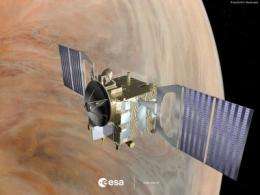
Venus Express has two solar cell panels per wing comprising alternating rows of standard triple junction solar cells as well as highly reflective mirrors to reduce the operating temperatures. There is twice as much sunlight in Venusian orbit as there is in Earth orbit, plus additional thermal input from the Venusian surface and atmosphere -- 75 percent of sunlight being reflected up from it. In a worst case, this results in worst case to an equivalent of the thermal input from 3.5 suns. Credit: ESA

Venus Express has completed an 'aerodrag' campaign that used its solar wings as sails to catch faint wisps of the planet's atmosphere. The test used the orbiter as an exquisitely accurate sensor to measure atmospheric density barely 180 km above the hot planet.

During five aerodrag measurements last week, Venus Express' solar arrays and control systems were operated as one big flying sensor, with the rotated at various angles to the direction of flight.

The special configuration exposed the wings to the vanishingly faint wisps of atmosphere that reach to the boundary of space around Venus, generating a tiny but measurable aerodynamic torque, or rotation, on the satellite.

This torque can be measured very accurately based on the amount of correction that must be applied by reaction wheels, which counter-rotate inside the spacecraft to maintain its orientation in space.

Mimicking the vanes of a windmill

Starting on Monday, the rotated through five daily-changing sets of orientations. While one panel remained perpendicular to the direction of flight, the other rotated in steps, gradually increasing the torque to be counter-balanced by the reaction wheels.

On the last day, 16 April, the were rotated at plus and minus 45° to the atmospheric flow, mimicking the vanes of a windmill, in order to gather additional information on the behaviour of the molecules of the atmosphere bouncing off the .

A very capable satellite

"The aerodrag campaign went without problem, and conclusively demonstrated that Venus Express can be securely and accurately used to sense the density of the planet's atmosphere. Venus Express has shown once again that it is a very capable satellite," said Operations Manager Octavio Camino.

Camino explained that the mission operations team will study last week's results to develop an optimised configuration for aerodrag campaigns in October and in 2011. Aerodrag testing was also conducted in 2008, 2009 and February 2010.

Continued positive results may enable Venus Express to conduct more sophisticated investigations deeper in the , which would be of immense interest to planetary scientists.

The solar array on comprise two symmetrical wings supporting gallium-arsenide solar cells. Their combined 5.7 sq m can generate up to 1400 W of power in Venus orbit.

Explore further: Research team explains 'Lazarus' comets

add to favorites email to friend print save as pdf

Related Stories

Venus Express Completes Integration And Testing

Sep 21, 2005

The Venus Express spacecraft is nearing completion now as the Gallium Arsenide Triple Junction Solar Arrays are integrated and tested, which will provide the required 1100 Watts of power to the spacecraft systems.

Spacecraft Tandem Provide New Views of Venus

Jul 19, 2007

NASA's Mercury Surface, Space Environment, Geochemistry, and Ranging spacecraft, known as Messenger, and the European Space Agency's Venus Express recently provided the most detailed multi-point images of ...

Venus Express launch campaign starts

Aug 04, 2005

ESA’s Venus Express spacecraft has just completed its last phase of testing in Europe and is ready to be shipped to its launch site at the Baikonur Cosmodrome in Kazakhstan.

Venus Express spacecraft fires main engine

Feb 20, 2006

One hundred days after its launch to Venus, the European Space Agency's Venus Express has successfully tested its main engine for the first time in space.

Recommended for you

Dark, massive asteroid to fly by Earth on May 31

9 hours ago

It's 1.7 miles long. Its surface is covered in a sticky black substance similar to the gunk at the bottom of a barbecue. If it impacted Earth it would probably result in global extinction. Good thing it is ...

Research team explains 'Lazarus' comets

12 hours ago

Astronomers from the University of Antioquia have discovered a graveyard of comets. These once-dormant comets, dubbed by astronomers as "The Lazarus comets," are now rejuvenated.

NASA ships sensors for seafaring satellite to France

13 hours ago

(Phys.org) —Three NASA-built instruments that are integral components of the next in a series of U.S./European ocean altimetry satellites have arrived in France for integration with their spacecraft in ...

Trip into space with DiCaprio costs $1.55m

13 hours ago

Leonardo DiCaprio is going to get closer to stars of a different kind as he heads into space aboard the Virgin Galactic, and a well-heeled bidder at the Cannes Film Festival has paid 1.2 million euros (1.5 million) to be ...

User comments : 0

More news stories

Galaxies fed by funnels of fuel

(Phys.org) —Computer simulations of galaxies growing over billions of years have revealed a likely scenario for how they feed: a cosmic version of swirly straws.

Dark, massive asteroid to fly by Earth on May 31

It's 1.7 miles long. Its surface is covered in a sticky black substance similar to the gunk at the bottom of a barbecue. If it impacted Earth it would probably result in global extinction. Good thing it is ...

Source of life running out: water scientists

The majority of people on Earth people will face severe water shortages within a generation or two if pollution and waste continues unabated, scientists warned at a conference in Bonn Friday.

Google eyes emerging markets networks

Google has become deeply involved in a series of projects to build and operate wireless networks in emerging markets including sub-Saharan Africa and Southeast Asia, a report said Friday.