Giant natural particle accelerator discovered above thunderclouds
Apr 14, 2010
Giant natural particle accelerator discovered above thunderclouds
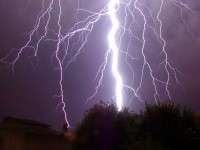
Dr Füllekrug and colleagues have discovered that natural particle accelerators can be formed by lightning storms (Photo by Axel Rouvin)

(PhysOrg.com) -- A lightning researcher at the University of Bath has discovered that during thunderstorms, giant natural particle accelerators can form 40 km above the surface of the Earth.

Dr Martin Füllekrug from the University’s Department of Electronic & Electrical Engineering presented his new work on Wednesday 14 April at the Royal Astronomical Society National Astronomy Meeting (RAS NAM 2010) in Glasgow.

His findings show that when particularly intense lightning discharges in thunderstorms coincide with high-energy particles coming in from space (cosmic rays), nature provides the right conditions to form a giant particle accelerator above the thunderclouds.

The cosmic rays strip off electrons from air molecules and these electrons are accelerated upwards by the electric field of the lightning discharge. The free electrons and the lightning electric field then make up a natural particle accelerator.

The accelerated electrons then develop into a narrow particle beam which can propagate from the lowest level of the atmosphere (the troposphere), through the middle atmosphere and into near-Earth space, where the energetic electrons are trapped in the ’s radiation belt and can eventually cause problems for orbiting satellites.

These are energetic events and for the blink of an eye, the power of the electron beam can be as large as the power of a small nuclear power plant.

Dr Füllekrug explained: “The trick to determining the height of one of the natural particle accelerators is to use the radio waves emitted by the particle beam.”

These radio waves were predicted by his co-worker Dr Robert Roussel-Dupré using computer simulations at the Los Alamos National Laboratory supercomputer facility.
Giant natural particle accelerator discovered above thunderclouds
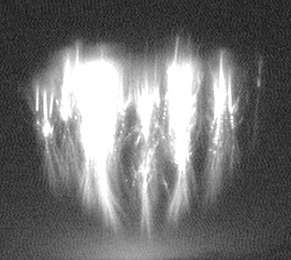
A sprite formed by an intense thunderstorm (Credit: Oscar van der Velde, Universitat de Catalunya, Spain and Serge Soula, Laboratoire d'Aerologie, France)

A team of European scientists, from Denmark, France, Spain and the UK helped to detect the intense lightning discharges in southern France which set up the particle accelerator.

They monitored the area above thunderstorms with video cameras and reported lightning discharges which were strong enough to produce transient airglows above thunderstorms known as sprites. A small fraction of these sprites were found to coincide with the particle beams.

The zone above thunderstorms has been a suspected natural since the Scottish physicist and Nobel Prize winner Charles Thomson Rees Wilson speculated about discharges above these storms in 1925.

In the next few years five different planned space missions (the TARANIS, ASIM, CHIBIS, IBUKI and FIREFLY satellites) will be able to measure the energetic particle beams directly.

Dr Füllekrug commented: “It’s intriguing to see that nature creates particle accelerators just a few miles above our heads. Once these new missions study them in more detail from space we should get a far better idea of how they actually work.

“They provide a fascinating example of the interaction between the Earth and the wider Universe.”

Explore further: Origins of human culture linked to rapid climate change

add to favorites email to friend print save as pdf

Related Stories

Firefly Mission to Study Terrestrial Gamma-ray Flashes

Feb 02, 2010

High-energy bursts of gamma rays typically occur far out in space, perhaps near black holes or other high-energy cosmic phenomena. So imagine scientists' surprise in the mid-1990s when they found these powerful ...

ALICE particle accelerator achieves energy recovery

Dec 15, 2008

(PhysOrg.com) -- UK scientists have successfully demonstrated energy recovery on the ALICE advanced particle accelerator design, potentially paving the way for new accelerators using a fraction of the energy ...

A space station view on giant lightning

Oct 03, 2005

Do giant flashes of lightning striking upwards from thunder clouds merely pose an extraordinarily spectacular view? Or do they actually alter the chemical composition of the atmosphere, playing a role in ozone ...

Recommended for you

NASA's BARREL mission launches 20 balloons

12 hours ago

(Phys.org) —In Antarctica in January, 2013 – the summer at the South Pole – scientists released 20 balloons, each eight stories tall, into the air to help answer an enduring space weather question: ...

Power of US tornado dwarfs Hiroshima bomb

12 hours ago

Wind, humidity and rainfall combined precisely to create Monday's massive killer tornado in Oklahoma. The awesome amount of energy released dwarfed the power of the atomic bomb that leveled Hiroshima.

Origins of human culture linked to rapid climate change

19 hours ago

Rapid climate change during the Middle Stone Age, between 80,000 and 40,000 years ago, during the Middle Stone Age, sparked surges in cultural innovation in early modern human populations, according to new research.

User comments : 3

Adjust slider to filter visible comments by rank

Display comments: newest first

michaelick
1 / 5 (4) Apr 14, 2010
What about black holes?
Doug_Huffman
5 / 5 (2) Apr 14, 2010
A mere electric field is a particle accelerator, that's what the terms mean. Put a charged particle in an electric field and it's going down potential!
brant
not rated yet Apr 14, 2010
"A small fraction of these sprites were found to coincide with the particle beams."

Lightning is known to produce gamma and x-rays. Is it possible that some of the discharges are strong enough to produce cosmic ray energy particles?

"Shock-wave and plasma-pinch mechanisms of galactic cosmic-ray production "
http://www.spring...2h82412/

More news stories

Power of US tornado dwarfs Hiroshima bomb

Wind, humidity and rainfall combined precisely to create Monday's massive killer tornado in Oklahoma. The awesome amount of energy released dwarfed the power of the atomic bomb that leveled Hiroshima.

Moore tornado a rarity, experts say

Tornados, among the most violent of atmospheric storms, rarely reach the size and brutality of the twister that swept through an Oklahoma City suburb on Monday, experts say.

First Look: New Xbox elegant, but much unknown

Will gamers want One? After four years of development, Microsoft unveiled the Xbox One entertainment console and touted it as an all-in-one solution for playing games, watching TV and doing everything in ...

Apple case seen as possible spur to tax action

Now that tech favorite Apple Inc. has been dragged front and center into the debate over the U.S. tax code, lawmakers are hoping that the spotlight on such a high-profile company could be the catalyst for ...

Study says empathy plays a key role in moral judgments

Is it permissible to harm one to save many? Those who tend to say "yes" when faced with this classic dilemma are likely to be deficient in a specific kind of empathy, according to a report published in the scientific journal ...