Germany holds Europe's first '4G' auction
Apr 11, 2010
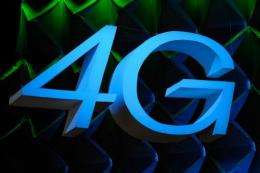
A sign for 4G (for fourth generation of cellular wireless standards). In Europe's first 4G auction, a large part of what is up for grabs is the so-called "digital dividend", a chunk of frequencies left unwanted by television companies following their switch from analogue to digital broadcasting.

In 2000, at the height of the tech bubble, telecom operators fell over themselves to snap up 3G or third generation mobile licenses in an auction in Germany.

In the hangover that followed, successful bidders were left drowning in a sea of debt, and 3G, once it eventually got off the ground, proved something of a disappointment.

Ten years on, it is the turn of 4G frequencies to go under the hammer in the western city of Mainz on Monday. The German government expects to reap only a fraction of the 50 billion euros (67 billion dollars) it received last time.

But with the new technology promising nothing less than a revolution, interest among firms like Britain's Vodafone and T-Mobile is strong, with analysts pencilling in a windfall of 5-10 billion euros for Berlin.

This time around, operators are confident too that the technology will not disappoint and that it will be in the hands of consumers a lot sooner.

"Demand is well ahead of supply," said Matthias Kurth, head of the German telecoms regulator running the auction, with "severe competition" among operators like Vodafone and to grab a piece of the 4G pie.

In Europe's first 4G auction, a large part of what is up for grabs is the so-called "digital dividend", a chunk of frequencies left unwanted by television companies following their switch from analogue to digital broadcasting.

The , known as Long Term Evolution (LTE), will mean that using your mobile handset just to phone people will become old hat since it will allow data to be transferred at breakneck speeds.

The resulting downloading capacities will make the mobile phone a powerful tool for surfing the Internet. Phone calls, too, will occur by Internet telephony, as happens on PCs now with programmes like Skype.

Another advantage for both firms and users of the new technology will be that remote areas currently with little or no high-speed Internet will soon be covered.

And with experts predicting a price war among operators, consumers may start to wonder whether they still need a mobile phone operator as well as a fixed net provider, since home computers could use the networks too.

"With LTE, networks will become a real alternative to cable or DSL (broadband telephone connections)," said Herbert Merz, head of the German hightech association Bitkom.

Explore further: As online video thrives, TV companies push back

add to favorites email to friend print save as pdf

Related Stories

Top mobile operators unite against 4G fees

Jun 22, 2006

Six European mobile operators have joined forces to ensure that introducing fourth-generation cell phones will not cost as much as 3G's $184 billion rollout.

Finland allocates new 4G mobile frequencies

Apr 24, 2009

The Finnish government said Friday it has allocated extra frequencies to telecom firms TeliaSonera, Elisa and DNA to run the country's new, faster fourth-generation (4G) mobile network.

India's billion-dollar 3G auction set to open

Apr 08, 2010

In an auction set to open Friday, India's mobile firms will bid billions of dollars to provide superfast third generation (3G) service in the country's booming cellular market.

Recommended for you

As online video thrives, TV companies push back

May 14, 2013

The evolving TV and video industry faces uncertainty as it embraces new technology like wireless streaming, as traditional US broadcasters urged lawmakers Tuesday to help preserve their marketplace primacy.

Improving communication during disasters

May 13, 2013

A small armband which can be attached to the injured. An information board containing a complete visual record of events. This is technology helping to improve communications during major national disasters.

Samsung announces 5G data breakthrough

May 13, 2013

Samsung Electronics said Monday it had successfully tested super-fast fifth-generation (5G) wireless technology that would eventually allow users to download an entire movie in one second.

User comments : 1

Adjust slider to filter visible comments by rank

Display comments: newest first

emilknievel
not rated yet Apr 11, 2010
Really interesting article. Thanks for sharing and I hope to find out more about this subject soon. Have a nice day.

More news stories

US seizes Bitcoin operator accounts

US authorities seized the accounts of a Bitcoin digital currency exchange operator, claiming it was functioning as an "unlicensed money service business," court documents showed Friday.

Chinese, Indian airlines face EU pollution fines

Eight Chinese and two Indian airlines face fines of up to several million euros for not paying for their greenhouse gas emissions during flights within the bloc, the European Commission said on Friday.

Alaska volcano shoots ash 15,000 feet into the air

(AP)—One of Alaska's most restless volcanoes has shot an ash cloud 15,000 feet into the air in an ongoing eruption that has drawn attention from a nearby community but isn't expected to threaten air traffic.

Temporal processing in the olfactory system

The neural machinery underlying our olfactory sense continues to be an enigma for neuroscience. A recent review in Neuron seeks to expand traditional ideas about how neurons in the olfactory bulb might encode information about ...