Juno Taking Shape in Denver
Apr 06, 2010
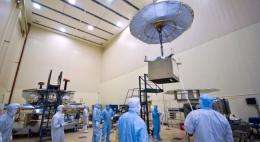
Workers move into place the vault that will protect Juno's sensitive electronics from Jupiter's intense radiation belts. Image credit: NASA/JPL/Lockheed Martin

(PhysOrg.com) -- Assembly has begun on NASA's Juno spacecraft, which will help scientists understand the origin and evolution of Jupiter. The mission, whose principal investigator is Scott Bolton of Southwest Research Institute in San Antonio, Tex., is expected to launch in August 2011 and reach Jupiter in 2016.

The assembly, testing and launch operations phase began April 1 in a high-bay clean room at Lockheed Martin Space Systems in Denver. Engineers and technicians will spend the next few months fitting instruments and navigation equipment onto the spacecraft.

"We're excited the puzzle pieces are coming together," Bolton said. "We're one important step closer to getting to Jupiter."

Jupiter is the largest planet in our solar system. Underneath its dense cloud cover, the planet safeguards secrets to the fundamental processes and conditions that governed our solar system during its formation. As our primary example of a giant planet, Jupiter can also provide critical knowledge for understanding the planetary systems being discovered around other stars.

Juno will have nine science instruments on board to investigate the existence of a solid planetary core, map Jupiter's intense magnetic field, measure the amount of water and ammonia in the deep atmosphere, and observe the planet's auroras.

"We plan to be doing a lot of testing in the next few months," said Jan Chodas, the project manager based at NASA's Jet Propulsion Laboratory in Pasadena, Calif. "We want to make sure the spacecraft is ready for the long journey to Jupiter and the harsh environment it will encounter there."

JPL manages the Juno mission for the principal investigator, Scott Bolton. Space Systems is building the . The Italian Space Agency, Rome, is contributing an infrared spectrometer instrument and a portion of the radio .

Explore further: Mice, gerbils perish in Russia space flight

More information: For more information about Juno, visit www.nasa.gov/juno

add to favorites email to friend print save as pdf

Related Stories

NASA awards Juno Jupiter mission contract

Oct 04, 2007

The National Aeronautics and Space Administration has picked Lockheed Martin Commercial Launch Services of Littleton, Colo., for the Juno mission to Jupiter.

Spacecraft to Pluto Prepares for Jupiter Encounter

Jan 18, 2007

NASA's New Horizons spacecraft is on the doorstep of the solar system's largest planet. The spacecraft will study and swing past Jupiter, increasing speed on its voyage toward Pluto, the Kuiper Belt and beyond.

Rosetta, New Horizons team up

Mar 02, 2007

ESA and NASA are mounting a joint campaign to observe Jupiter over the next few weeks with two different spacecraft. Rosetta will watch the big picture from its current position near Mars, whilst New Horizons ...

Recommended for you

Mice, gerbils perish in Russia space flight

10 hours ago

A number of mice and eight gerbils sent into space in a Russian capsule destined to find out how well organisms can withstand extended flights perished during their journey, scientists said Sunday as the ...

Mars rover Opportunity examines clay clues in rock

May 18, 2013

(Phys.org) —NASA's senior Mars rover, Opportunity, is driving to a new study area after a dramatic finish to 20 months on "Cape York" with examination of a rock intensely altered by water.

NASA's STEREO detects a CME from the sun

May 17, 2013

On 5:24 a.m. EDT on May 17, 2013, the sun erupted with an Earth-directed coronal mass ejection or CME, a solar phenomenon that can send billions of tons of solar particles into space that can reach Earth ...

Nine-year-old Mars rover passes 40-year-old record

May 17, 2013

While Apollo 17 astronauts Eugene Cernan and Harrison Schmitt visited Earth's moon for three days in December 1972, they drove their mission's Lunar Roving Vehicle 19.3 nautical miles (22.210 statute miles ...

Bright explosion on the Moon

May 17, 2013

For the past 8 years, NASA astronomers have been monitoring the Moon for signs of explosions caused by meteoroids hitting the lunar surface. "Lunar meteor showers" have turned out to be more common than anyone ...

User comments : 1

Adjust slider to filter visible comments by rank

Display comments: newest first

gunslingor1
not rated yet Apr 06, 2010
Geez, article is pretty skimp on information about the instrument.

More news stories

Heat-related deaths in Manhattan projected to rise

Residents of Manhattan will not just sweat harder from rising temperatures in the future, says a new study; many may die. Researchers say deaths linked to warming climate may rise some 20 percent by the 2020s, ...

Bold action, big money needed to curb Asia floods

Asia's flood-prone megacities should fund major drainage, water recycling and waste reduction projects to stem deluges and secure clean supply for their booming populations, experts said Sunday.

Mice, gerbils perish in Russia space flight

A number of mice and eight gerbils sent into space in a Russian capsule destined to find out how well organisms can withstand extended flights perished during their journey, scientists said Sunday as the ...

Kinks and curves at the nanoscale

One of the basic principles of nanotechnology is that when you make things extremely small—one nanometer is about five atoms wide, 100,000 times smaller than the diameter of a human hair—they are going ...

Honeybees trained in Croatia to find land mines

(AP)—Mirjana Filipovic is still haunted by the land mine blast that killed her boyfriend and blew off her left leg while on a fishing trip nearly a decade ago. It happened in a field that was supposedly ...