Cassini Doubleheader: Flying By Titan and Dione
Apr 05, 2010
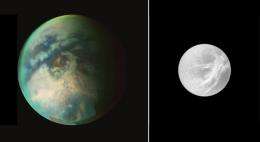
Composite of two images from NASA's Cassini spacecraft of Saturn's moons Titan (left) and Dione (right). Image credits: NASA/JPL/University of Arizona/Space Science Institute

(PhysOrg.com) -- In a special double flyby early next week, NASA's Cassini spacecraft will visit Saturn's moons Titan and Dione within a period of about a day and a half, with no maneuvers in between. A fortuitous cosmic alignment allows Cassini to attempt this doubleheader, and the interest in swinging by Dione influenced the design of its extended mission.

The Titan flyby, planned for Monday, April 5, will take Cassini to within about 7,500 kilometers (4,700 miles) of the moon's surface. The distance is relatively long as far as encounters go, but it works to the advantage of Cassini's imaging science subsystem. Cassini's cameras will be able to stare at Titan's haze-shrouded surface for a longer time and capture high-resolution pictures of the Belet and Senkyo areas, dark regions around the equator that ripple with .

In the early morning of Wednesday, April 7 in UTC time zones, which is around 9 p.m. on Tuesday, April 6 in California, Cassini will make its closest approach to the medium-sized icy moon Dione. Cassini will plunge to within about 500 kilometers (300 miles) of Dione's surface.

This is only Cassini's second close encounter with Dione. The first flyby in October 2005, and findings from the in the 1990s, hinted that the moon could be sending out a wisp of charged particles into the magnetic field around Saturn and potentially exhaling a diffuse plume that contributes material to one of the planet's rings. Like Enceladus, Saturn's more famous moon with a plume, Dione features bright, fresh fractures. But if there were a plume on Dione, it would certainly be subtler and produce less material.
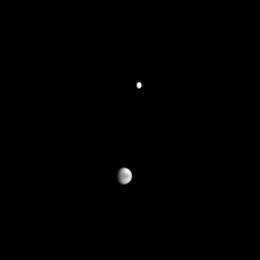
The orbits of Dione and Titan bring them together in one frame in this distant glimpse from the Cassini spacecraft. Image credit: NASA/JPL/Space Science Institute

Cassini plans to use its and fields and particles instruments to see if it can find evidence of activity at Dione. Thermal mapping by the composite infrared spectrometer will also help in that search. In addition, the visual and will examine dark material found on Dione. Scientists would like to understand the source of this dark material.

Cassini has made three previous double flybys and another two are planned in the years ahead. The mission is nearing the end of its first extension, known as the Equinox mission. It will begin its second mission extension, known as the Solstice Mission, in October 2010.

Explore further: First Gagarin film turns Soviet idol into new Russian hero

Related Stories

Cassini's Photo Album From a Season of Icy Moons

Dec 07, 2005

Wrapping up a phenomenally successful year of observing Saturn's icy moons, the Cassini mission is releasing a flood of new views of the moons Enceladus, Dione, Rhea, Hyperion and Iapetus.

Route 66: Cassini's Next Look at Titan

Jan 27, 2010

(PhysOrg.com) -- Sixteen days after last visiting Saturn's largest moon, NASA's Cassini spacecraft returns for another look-see of the cloud-shrouded moon - this time from on high. The flyby on Thursday, Jan. ...

Cassini Shows Before and After Look at Titan

Dec 20, 2004

Cassini's second close flyby of Titan completes a 'before' and 'after' look at the fuzzy moon and provides the first direct evidence of changing weather patterns in the skies over Titan. Cassini has found Titan's ...

Cassini Goes On

Aug 24, 2004

The Cassini spacecraft successfully completed a 51-minute engine burn that will raise its next closest approach distance to Saturn by nearly 300,000 kilometers (186,000 miles). The maneuver was necessary to keep the spacec ...

Recommended for you

Super-hurricane-force winds on Venus are getting stronger

23 hours ago

(Phys.org) —As the closest planet to Earth, Venus is a relatively easy object to observe. However, many mysteries remain, not least the super-rotation of Venus' atmosphere, which enables high altitude winds ...

ExoMars 2016 set to complete construction

Jun 18, 2013

ESA's mission to Mars in 2016 has entered the final stage of construction with the signature of a contract today with Thales Alenia Space at the Paris Air & Space Show.

Australian team maps Moon's hidden craters

Jun 18, 2013

Australian scientists Tuesday said they had identified a possible 280 additional craters on the Moon, a finding they said could shed light on the history of the Earth's natural satellite.

User comments : 0

More news stories

No danger of cancer through gene therapy virus

In fall 2012, the European Medicines Agency (EMA) approved the modified adeno-associated virus AAV-LPL S447X as the first ever gene therapy for clinical use in the Western world. uniQure, a Dutch biotech company, had developed ...

Antioxidant shows promise in Parkinson's disease

Diapocynin, a synthetic molecule derived from a naturally occurring compound (apocynin), has been found to protect neurobehavioral function in mice with Parkinson's Disease symptoms by preventing deficits in motor coordination.