Fly us to the Moon... south pole to be precise
Mar 31, 2010
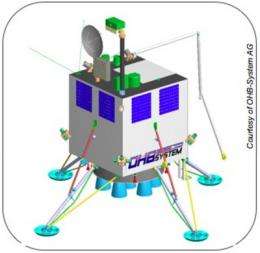
CAD-drawing of the Lunar Lander concept from OHB-System AG. Credits: ESA / OHB Technology

(PhysOrg.com) -- The south polar region of the Moon, with dark craters and high ridges, is a world away from the relatively smooth terrain visited by Apollo astronauts four decades ago. This rugged moonscape is the target for Europe's next leap into space.

The possible deposits of water ice, heavily cratered terrain and long periods of sunlight make the lunar south pole and areas around it extremely interesting for explorers and scientists. It is therefore a prime target for future human missions to the Moon.

Europe is now looking at a lander mission to pave the way for astronauts. This precursor would be the first European Moonlander and the first to visit the south polar region.

ESA is now asking industry to submit proposals for this mission.

This video is not supported by your browser at this time.

Preparing for human exploration

ESA’s Lunar Lander would pave the way for future human exploration on the . There are two core goals.

The first requires that it uses the latest navigation technology to fly a precise course from to the surface and touch down safely and accurately. On the way down, it must image the surface and recognise dangerous features by itself, using its own ‘intelligence’.

Then the Lander shall investigate this unique region with a suite of instruments. It will investigate the properties and possible health effects of radiation and lunar dust on future astronauts, and it will examine the soil for signs of resources that could be used by human explorers.

Several European industrial teams have already assessed the various mission options and designs. The next step is ‘Phase-B1’, which will mature the mission and spacecraft design and examine in detail the demands of landing and working at specific southern sites.
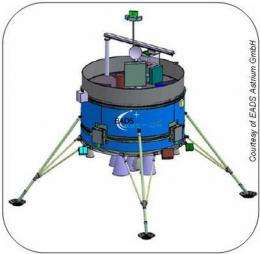
CAD deawing of the Lunar Lander concept from Astrium GmbH. Credits: ESA / EADS Astrium

This 18-month phase will begin this summer, taking the Lunar Lander from a design concept to hardware reality. The goal is for launch by the end of this decade.

Involving European researchers and industry is crucial for defining the detailed mission objectives and identifying instruments to address them. For instance, a request for information in 2009 produced more than 200 responses.

As part of the process of involving European researchers and industry in the project, an information day will be held at ESA’s space research and technology centre (ESTEC) in the Netherlands on 14 April.

The day is aimed at those who responded to the 2009 request and will include an update on the mission outline, mission objectives and the model payload to be used for Phase-B1.

Explore further: Research team explains 'Lazarus' comets

add to favorites email to friend print save as pdf

Related Stories

NASA Selects Team To Build Lunar Lander

Oct 03, 2005

NASA's Deputy Associate Administrator for the Exploration Systems Mission Directorate Doug Cooke announced Friday the selection of NASA's Marshall Space Flight Center, Huntsville, Ala., and Goddard Space Flight Center, Greenbelt, ...

NASA Moon-Impactor Mission Passes Major Review

Feb 02, 2007

NASA's drive to return astronauts to the moon and later probe deeper into space achieved a key milestone recently when agency officials approved critical elements of a moon impact mission scheduled to launch in October 2008. ...

Send Your Name to the Moon Aboard LRO

May 01, 2008

NASA invites people of all ages to join the lunar exploration journey with an opportunity to send their names to the moon aboard the Lunar Reconnaissance Orbiter, or LRO, spacecraft.

Recommended for you

Research team explains 'Lazarus' comets

1 hour ago

Astronomers from the University of Antioquia have discovered a graveyard of comets. These once-dormant comets, dubbed by astronomers as "The Lazarus comets," are now rejuvenated.

NASA ships sensors for seafaring satellite to France

1 hour ago

(Phys.org) —Three NASA-built instruments that are integral components of the next in a series of U.S./European ocean altimetry satellites have arrived in France for integration with their spacecraft in ...

Trip into space with DiCaprio costs $1.55m

2 hours ago

Leonardo DiCaprio is going to get closer to stars of a different kind as he heads into space aboard the Virgin Galactic, and a well-heeled bidder at the Cannes Film Festival has paid 1.2 million euros (1.5 million) to be ...

User comments : 1

Adjust slider to filter visible comments by rank

Display comments: newest first

yyz
not rated yet Mar 31, 2010
I see no mention of possible launch vehicles being considered. Would this utilize Ariane 5 or a new launch system?

More news stories

Source of life running out: water scientists

The majority of people on Earth people will face severe water shortages within a generation or two if pollution and waste continues unabated, scientists warned at a conference in Bonn Friday.

Research team explains 'Lazarus' comets

Astronomers from the University of Antioquia have discovered a graveyard of comets. These once-dormant comets, dubbed by astronomers as "The Lazarus comets," are now rejuvenated.