Grocery shoppers who try harder to track costs do worse, study finds
Mar 30, 2010
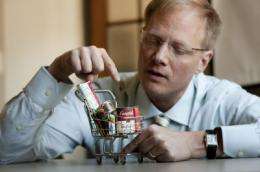
Professor Brian Wansink shares tips on how shoppers can more accurately estimate grocery costs. A recently published study indicates that the more shoppers try to track their expenses, the worse they do -- overspending by as much as 19 percent. Credit: Jason Koski/Cornell University Photography

Almost one in three U.S. households shop on a budget -- and one in six can only afford basic necessities. So it's no wonder that 78 percent of budget shoppers -- twice as many as those who shop without a budget (37 percent) -- try to track how much their groceries are likely to cost as they roll through the aisles.

But the harder they try, the worse they do — overspending by as much as 19 percent, according to a new study, which was conducted by a Cornell professor and colleagues and is published in this month's .

In general, the researchers found that all consumers tend to underestimate how much their groceries are going to cost.

"But those who try to calculate the exact total price almost always do worse than those who just estimate approximate ," said Brian Wansink, Cornell's John S. Dyson Professor of Marketing, who co-authored the series of studies with Koert van Ittersum of the Georgia Institute of Technology and Joost M.E. Pennings of Maastricht University, the Netherlands. Their work included two field studies and two laboratory studies.

It is low-income shoppers who try most to calculate, rather than estimate, Wansink said.

That means that those on the tightest budgets — those most motivated to track their spending — may be at greatest risk for spending more than their budget allows, said Wansink, forcing them to cut back in other areas, which "could cause shoppers unexpected financial distress." This chain of events can also cause these shoppers to develop toward the store they patronize because they spent more than they planned.

The researchers also found that the most accurate based their estimates on the dominant range of price endings in their baskets — such as the 99 cents in $4.99. In other words, if the price endings of most of the grocers are between $.50 and $.99, people rounded up to the nearest dollar. "When people don't round up, it leads to some unpleasant surprises at the cash register," said van Ittersum.

Wansink suggests that the retailers might help consumers estimate the cost of their groceries with cart scanners, by changing their price-setting strategies or by providing shopper trainings in the principles of decision making, statistics, and mental computation.

In the meantime, the researchers offer these tips:

  • Round each item to the nearest dollar — $2.25 becomes $2 and $5.50 becomes $6.
  • If you lose track, estimate the total number of items, then guess the price of the average item and multiply them together.
  • If you really want to calculate the exact total price, use a calculator.

Explore further: Challenging the public's view of gender and science

add to favorites email to friend print save as pdf

Related Stories

Shoppers who try harder to estimate spend more

Mar 02, 2010

(PhysOrg.com) -- The harder consumers try to track how much their groceries will cost, the worse they do, according to a new study co-authored by Brian Wansink in the March issue of the Journal of Marketing.

Pricing practices cost consumers

Apr 12, 2007

You may be paying more for that can of soup or loaf of bread, depending on whether they have an individual price sticker or not. A new study from the DeGroote School of Business finds grocery items individually ...

Can kitchen spoons be dangerous spoons?

Jan 04, 2010

\A new study published in the Jan. 5 issue of the Annals of Internal Medicine illustrates the dangers of using kitchen spoons to measure liquid medicine.

'Healthy' restaurants help make us fat, says a newl study

Sep 24, 2007

If you're like most, you eat worst at healthy restaurants. The "health halos" of healthy restaurants often prompt consumers to treat themselves to higher-calorie side dishes, drinks or desserts than when they eat at fast-food ...

Recommended for you

Challenging the public's view of gender and science

May 24, 2013

According to She Figures 2012, which analyses gender equality in research, in 2010 women accounted for only 10 % of university rectors in Europe and 15.5 % were heads of institutions of the higher education ...

New study offers insight into how to best manage workaholics

May 22, 2013

(Phys.org) —Workaholics tend to live in extremes, with great job satisfaction and creativity on the one hand and high levels of frustration and exhaustion on the other hand. Now, a new Florida State University study offers ...

The tea party and the politics of paranoia

May 22, 2013

Members of tea party claim the movement springs from and promotes basic American conservative principles such as limited government and fiscal responsibility.

The new retirement: No retirement?

May 22, 2013

For growing numbers of Americans, the new retirement may really mean no retirement. That's the conclusion of an article in the current issue of the ISR Sampler, the annual magazine of the University of Michigan Institute ...

User comments : 0

More news stories

Submerged structure stumps Israeli archaeologists

The massive circular structure appears to be an archaeologists dream: a recently discovered antiquity that could reveal secrets of ancient life in the Middle East and is just waiting to be excavated.

Mais non! French universities may teach in English

In France, there's a brewing debate over whether to speak anglais in universite. The National Assembly on Wednesday was taking up an education reform bill that would allow public universities to hold some courses—like science ...