UK police asks Internet cafes to monitor customers
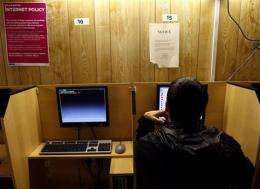
(AP) -- Internet cafe users in the British capital may want to watch what they download. Scotland Yard is advising administrators of public Web spaces to periodically poke through their customers' files and keep an eye out for suspicious activity.
The Metropolitan Police said Thursday that the initiative - which has been rolled out over the past weeks under the auspices of the government's counterterrorism strategy - is aimed at reminding cafe owners that authorities are ready to hear from them if they have concerns about their Internet users.
Posters and computer desktop images emblazoned with Scotland Yard's logo are also being distributed.
"It's not about asking owners to spy on their customers, it's about raising awareness," a police spokesman said, speaking anonymously in line with force policy. "We don't ask them to pass on data for us."
Still, he said, police were "encouraging people to check on hard drives." He did not elaborate, saying it would be up to cafe owners to decide if or how to monitor what customers left on their computers.
It would be fairly easy to trace the activities of a careless user, according to Graham Cluley of software security company Sophos. For example, an owner could examine a browser's Internet history or sift through the programs or documents the customer downloaded - although distinguishing which user did what might be difficult in a busy cafe.
Cluley also noted that a computer-savvy criminal could make their activities invisible in a few simple steps.
"You would expect any cybercriminal who had made the decision to use an Internet cafe to pretty much dust off their fingerprints," he said.
Still, Cluley said "there's no harm in keeping an eye open."
While the program is voluntary - owners can ignore police advice if they so choose - civil libertarians aren't happy. One said it risked creating an atmosphere of fear while undermining Internet users' privacy.
"What you're going to end up with is a lot of people reporting Muslims in Internet cafes," said Simon Davies, the director of U.K.-based Privacy International. Although he acknowledged that people might have lower expectations of privacy in an Internet cafe than at home, he said their communications should nonetheless be kept to themselves.
"We don't expect that our calls from a public phone would be monitored, anymore than we should expect our e-mails to be monitored," he said. "As citizens we have to hold the line that there is a fundamental right of privacy of communications."
Police say Internet cafe owners should remain vigilant in part because the venues have often been used by terrorists and other criminals in an attempt to evade detection. The police spokesman noted that the men behind the plot to blow up U.S.-bound passengers jets with liquid explosives secreted into soft drink containers used an Internet cafe to coordinate their plot.
So far the only visible sign of the police's initiative were some sternly worded posters warning customers against accessing "inappropriate or offensive content" posted at Internet cafes in various areas of London. The desktop images promoted by Scotland Yard - which would have the warning staring out from every computer screen - were absent from the few north London cafes seen by The Associated Press.
In other EU nations Internet cafes generally go about their business with a minimum of official interference.
Germany's federal police agency Bundeskriminalamt has no similar program, spokeswoman Barbara Huebner said, while French Internet cafes do not generally monitor users' activity.
At a Paris Internet cafe that is part of the Cybercafe Milk chain, employees are not allowed to view what their customers are researching on the Internet.
"It's private, thankfully," said employee Pierre Larroque, 31.
Back in Britain, K. Jama of IFKA Tele.com in the Camden area of north London said his cafe couldn't be bothered to monitor its customers' downloads or Internet history - which he said were wiped from the computers every day in any case. Still, the 34-year-old said the police's posters were a useful way of deterring criminals from his shop.
"When they see the poster hanging there, they will think twice, that's the main thing," Jama said.
But Arash Assam, an 18-year-old student who was browsing Facebook in the basement of the shop - just beneath the bright purple police warning - wasn't impressed.
"I didn't even notice it," he said.
More information: A Metropolitan Police desktop image: http://bit.ly/a4Oqqy
©2010 The Associated Press. All rights reserved. This material may not be published, broadcast, rewritten or redistributed.


