The world's fastest supersonic car's lift problem fixed
Mar 22, 2010

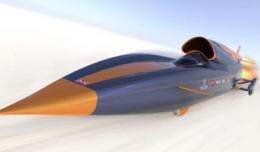
Engineers designing the world's fastest car believe they have found a solution to stop the car taking-off.

EPSRC funded research is helping Bloodhound SSC to smash the 1,000 mph barrier.

Previous design iterations had produced dangerous amounts of lift meaning the car would literally take-off.

The latest modelling work indicates these problems have now been fixed allowing the Bloodhound team to push ahead with other design areas.

To claim the world land speed record, Bloodhound will have to better the mark of 763mph (1,228km/h) set by the Thrust SuperSonic in 1997. It will be powered by a combination of a hybrid rocket and a jet engine from a Eurofighter-Typhoon.

This video is not supported by your browser at this time.

They plan to mount their assault on the record in late 2011, driving across a dried up lakebed known as Hakskeen Pan, in the Northern Cape of South Africa.

Explore further: Four microphones, computer algorithm enough to produce 3-D model of simple, convex room

add to favorites email to friend print save as pdf

Related Stories

Design chosen for British 1,000 mph car (w/ Video)

Nov 25, 2009

(PhysOrg.com) -- A British team hoping to be the first to get a car to 1,000 mph (1,610 km/h) has made its final design selection. The six-tonne car, known as the Bloodhound, will be powered by a Eurofighter ...

Scientists unveil chocolate-fueled race car

May 05, 2009

(AP) -- Scientists unveiled on Tuesday what they hope will be one of the world's fastest biofuel vehicles, powered by waste from chocolate factories and made partly from plant fibers.

The technology to make 'Speed Racer' cars

May 01, 2008

The opening of the new “Speed Racer” movie coming out nationally on May 9 has meant weeks of fast-paced fun for 8 juniors in the University of Cincinnati’s internationally recognized School of Design, part of UC’s ...

Car Buyers Say Silence Isn't Golden

Jul 12, 2005

The technology improvements that are giving us ever quieter cars are not proving popular with many car drivers. Car manufacturers now want to restore to the inside of a car the sounds their customers want ...

Recommended for you

Mathematical algorithms cut train delays

15 hours ago

Commuters are already seeing a reduction in delays and waiting times thanks to new software able to adapt railway schedules in real time following unforeseen disruptions.

Faster, more precise airstrikes within reach

Jun 17, 2013

Air-ground fire coordination—also known as Close Air Support or CAS—is a dangerous and difficult business. Pilots and dismounted ground agents must ensure they hit only the intended target using just ...

How smart technology could change public transit

Jun 17, 2013

Joseph Chow has an ambitious goal: to transform how urban transportation systems are managed and designed, using mobile computing, information technology and the analysis of massive data sets.

User comments : 6

Adjust slider to filter visible comments by rank

Display comments: newest first

jerryd
1 / 5 (2) Mar 22, 2010
Dropping the nose and narrowing the body in front would help a lot.
Temple
5 / 5 (1) Mar 23, 2010
Dropping the nose and narrowing the body in front would help a lot.


Yeah, because you know better about the aerodynamic properties of that vehicle than they do.

--

The unasked question is: why are they doing this?

"Smash the 1,000MPH barrier" Oh please. There's no such barrier. Imagine if all the money and energy spent keeping a jet touching the earth while going faster and faster (really that's all it is), were spent on smashing the 1,000MPG 'barrier'.
VOR
4 / 5 (1) Mar 23, 2010
I'd guess that there's little research value. If any of the designs and tech solutions have any, that would be interesting. Too bad the article doesnt go into such detail.
jonnyboy
2.3 / 5 (3) Mar 23, 2010
ATTENTION AGW "researchers"..............This shows how modeling is supposed to be done, first you model and then you PROVE that your model isn't worthless, it's not enough to create a model, you need to prove that it is right.
CarolinaScotsman
not rated yet Mar 28, 2010
Uh..way back in the 1960s, Art Arfons put a wing on his jet powered "Green Monster" world land speed record car to produce down force and keep it from going airborn. So what's so difficult about doing that?
Skeptic_Heretic
not rated yet Mar 28, 2010
I'd guess that there's little research value. If any of the designs and tech solutions have any, that would be interesting. Too bad the article doesnt go into such detail.

The aerodynamics research alone is going to bring us forward in rail and road technology by years if not decades otherwise.

More news stories

Mozilla lab wants scientists to step out of analog age

(Phys.org) —Talk about big ideas. Not satisfied to rest on laurels of having brought forth the open source browser Firefox, Mozilla—defined by some as a global project, by others as one of the key open-source ...

Qatar bails out Germany's Solarworld

German solar panel manufacturer Solarworld announced Tuesday a capital injection by Qatar, a move which will save the company from bankruptcy as the German sector struggles against Asian competition.

3D printing tiny batteries

(Phys.org) —3D printing can now be used to print lithium-ion microbatteries the size of a grain of sand. The printed microbatteries could supply electricity to tiny devices in fields from medicine to communications, ...