Discovery could pave the way for quantum computing
Mar 18, 2010
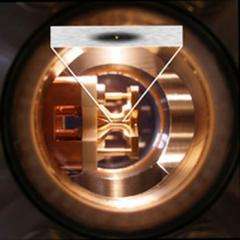
The picture shows the team's experimental apparatus comprising of the ion trap inside the vacuum chamber. The inset shows schematically the single ion (red) in the Bose-Einstein condensate (dark grey).

(PhysOrg.com) -- Two experimental systems at the forefront of modern physics research -- a single trapped ion and a quantum atomic gas -- have been combined for the first time by researchers at Cambridge.

The successful creation of this hybrid system opens the way to new types of experiment, in which the precise controllability of trapped ions can be used to study and manipulate quantum gases with nanometre precision.

In recent years, the ultracold quantum gases known as Bose-Einstein condensates and single ions confined in electromagnetic traps have both been used to explore a wide range of problems in fundamental physics.

Writing in this week's Nature, the team from the Department of Physics at the University of Cambridge describe the immersion of a single trapped ytterbium ion in a Bose-Einstein condensate of neutral atoms.

They showed that they can control the two systems independently, and study their interactions. They also observe 'sympathetic cooling' of the ion by the condensate - an effect that might ultimately prove useful in .

According to Dr Michael Köhl: "We placed a single charged Ytterbium atom into a Bose-Einstein condensate, which at only a few billionths of a degree above is the coldest thing in the universe."

The results could be used to cool quantum computers - devices that, by employing the laws of , can solve certain computational tasks much faster than any existing computer. Basic quantum processors already exist but they are not yet surpassing the fastest normal computers.

"Today's most powerful quantum computers are made from single atoms, like our Ytterbium, trapped in vacuum, but they need to be refrigerated in order to compute correctly. Usually this is done with laser light, which is quite complicated, expensive, and it interrupts the computing process. With our new technique, quantum computers could be cooled continuously in the future which could pave the way to a more widespread application," says Dr Köhl.

Explore further: Experiment investigates how classical physics may emerge from quantum physics

Related Stories

Entangled Light in Bose-Einstein Condensates

Apr 08, 2009

(PhysOrg.com) -- When physicists entangle light, they usually use nonlinear crystals as the source. However, it’s difficult to control the entanglement generation process in a bulk crystal, and so scientists ...

First Bose-Einstein condensation of strontium

Nov 09, 2009

In an international first, scientists from the Institute of Quantum Optics and Quantum Information (IQOQI, Austria) produced a Bose-Einstein condensate of the alkaline-earth element strontium, thus narrowly ...

Recommended for you

A quantum simulator for magnetic materials

May 23, 2013

Physicists understand perfectly well why a fridge magnet sticks to certain metallic surfaces. But there are more exotic forms of magnetism whose properties remain unclear, despite decades of intense research. ...

Researchers forward quest for quantum computing

May 23, 2013

Research teams from UW-Milwaukee and the University of York investigating the properties of ultra-thin films of new materials are helping bring quantum computing one step closer to reality.

Hydrogen atoms under the magnifying glass

May 22, 2013

To describe the microscopic properties of matter and its interaction with the external world, quantum mechanics uses wave functions, whose structure and time dependence is governed by the Schrödinger equation. ...

Making quantum encryption practical

May 21, 2013

One of the many promising applications of quantum mechanics in the information sciences is quantum key distribution (QKD), in which the counterintuitive behavior of quantum particles guarantees that no one can eavesdrop on ...

Lab sets a new record for creating heralded photons

May 20, 2013

(Phys.org) —Entanglement, by general consensus of physicists, is the weirdest part of quantum science. To say that two particles, A and B, are entangled means that they are actually two parts of an inseparable ...

User comments : 0

More news stories

Lab sets a new record for creating heralded photons

(Phys.org) —Entanglement, by general consensus of physicists, is the weirdest part of quantum science. To say that two particles, A and B, are entangled means that they are actually two parts of an inseparable ...

Theorists weigh in on where to hunt dark matter

(Phys.org) —Now that it looks like the hunt for the Higgs boson is over, particles of dark matter are at the top of the physics "Most Wanted" list. Dozens of experiments have been searching for them, but ...