Hubert's remnants still raining on southern Madagascar
Mar 11, 2010
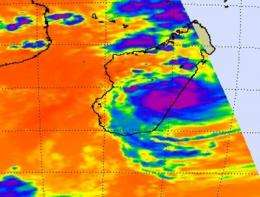
NASA's AIRS instrument captured this infrared view of Hubert's frigid clouds, seen here in blue and purple. Purple indicates high and strong thunderstorms with cloud-top temperatures as cold is -63 Fahrenheit. Credit: NASA JPL, Ed Olsen

Hubert may not be a tropical storm now that it has made landfall in southeastern Madagascar, but it's still a formidable and large storm system. NASA's Aqua satellite revealed that there are still some very high, strong thunderstorms in Hubert's remnants as it continues to bring rains and gusty winds to southeast and south-central Madagascar.

NASA's Aqua infrared satellite imagery from the Atmospheric Infrared Sounder (AIRS) instrument confirmed that some deep convection (rapidly rising air that creates the thunderstorms that power ) is still occurring in the storm, even though the center is over land.

The of Hubert captured on March 11 at 1053 UTC (5:53 a.m. ET) and showed some high, cold thunderstorms around the center of the storm, and that the eastern edge of Hubert was still over the Southern Indian Ocean. Hubert is expected to continue moving inland and grow weaker.

At 1 p.m. ET, March 11, heavier rains stretched from the city of Vavtenina southward through the cities of Mahanoro, Nosy Varika, Mananjary and Fianarantsoa. Most of the heaviest rains remained to the east and south of the capital city of Antananarivo.

Residents in southern and central Madagascar can continue to expect some moderate to heavy from this system over the next couple of days.

Explore further: Volcanoes cause climate gas concentrations to vary

add to favorites email to friend print save as pdf

Related Stories

Tropical cyclone formation likely near Madagascar

Mar 09, 2010

Forecasters are watching a low pressure area located off the east coast of Madagascar that appears ripe for development in the Southern Indian Ocean. If it becomes a tropical storm, it would be named Hubert.

Tropical Storm Oli kicking up waves in south Pacific

Feb 02, 2010

Tropical Storm Oli is headed between the islands of Bora Bora and Raratonga in the South Pacific, while maintaining its intensity as a tropical storm. Infrared satellite data from NASA's Aqua satellite reveals ...

Recommended for you

Volcanoes cause climate gas concentrations to vary

1 hour ago

Trace gases and aerosols are major factors influencing the climate. With the help of highly complex installations, such as MIPAS on board of the ENVISAT satellite, researchers try to better understand the ...

Explainer: Why are tornadoes so destructive?

2 hours ago

Tornadoes are a part of life for people living in the Great Plains of the United States. In Oklahoma, a state that averages 62 tornadoes a year, people are prepared as best as they can be and are well warned.

NASA's BARREL mission launches 20 balloons

16 hours ago

(Phys.org) —In Antarctica in January, 2013 – the summer at the South Pole – scientists released 20 balloons, each eight stories tall, into the air to help answer an enduring space weather question: ...

Power of US tornado dwarfs Hiroshima bomb

17 hours ago

Wind, humidity and rainfall combined precisely to create Monday's massive killer tornado in Oklahoma. The awesome amount of energy released dwarfed the power of the atomic bomb that leveled Hiroshima.

User comments : 0

More news stories

Volcanoes cause climate gas concentrations to vary

Trace gases and aerosols are major factors influencing the climate. With the help of highly complex installations, such as MIPAS on board of the ENVISAT satellite, researchers try to better understand the ...