NASA Mars Orbiter Speeds Past Data Milestone
Mar 03, 2010
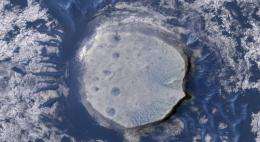
This view of an inverted crater in the Arabia Terra region of Mars is among the images taken by NASA's Mars Reconnaissance Orbiter in early 2010 as the spacecraft approached the 100-terabit milestone in total data returned. Image Credit: NASA/JPL-Caltech/University of Arizona

(PhysOrg.com) -- NASA's newest Mars orbiter, completing its fourth year at the Red Planet next week, has just passed a data-volume milestone unimaginable a generation ago and still difficult to fathom: 100 terabits.

That 100 trillion bits of information is more data than in 35 hours of uncompressed high-definition video. It's also more than three times the amount of data from all other deep-space missions combined -- not just the ones to Mars, but every mission that has flown past the orbit of Earth's moon.

"What is most impressive about all these data is not the sheer quantity, but the quality of what they tell us about our neighbor planet," said Mars Reconnaissance Orbiter Project Scientist Rich Zurek, of NASA's Jet Propulsion Laboratory, Pasadena, Calif. "The data from the orbiter's six instruments have given us a much deeper understanding of the diversity of environments on Mars today and how they have changed over time."

The spacecraft entered orbit around Mars on March 10, 2006, following an Aug. 12, 2005, launch from Florida. It completed its primary science phase in 2008 and continues investigations of Mars' surface, subsurface and atmosphere.

The orbiter sports a dish antenna 3 meters (10 feet) in diameter and uses it to pour data Earthward at up to 6 megabits per second. Its science instruments are three cameras, a spectrometer for identifying minerals, a ground-penetrating radar and an atmosphere sounder.

The capability to return enormous volumes of data enables these instruments to view Mars at unprecedented spatial resolutions. Half the planet has been covered at 6 meters (20 feet) per pixel, and nearly 1 percent of the planet has been observed at about 30 centimeters (1 foot) per pixel, sharp enough to discern objects the size of a desk. The radar, provided by Italy, has looked beneath the surface in 6,500 observing strips, sampling about half the planet.

Among the mission's major findings is that the action of water on and near the surface of Mars occurred for hundreds of millions of years. This activity was at least regional and possibly global in extent, though possibly intermittent. The spacecraft has also observed that signatures of a variety of watery environments, some acidic, some alkaline, increase the possibility that there are places on that could reveal evidence of past life, if it ever existed.

Explore further: Collisions of coronal mass ejections can be super-elastic

Related Stories

Mars Orbiter Completes First Phase of Science Mission

Dec 12, 2008

(PhysOrg.com) -- NASA's Mars Reconnaissance Orbiter has completed its primary, two-year science phase. The spacecraft has found signs of a complex Martian history of climate change that produced a diversity ...

New Mars orbiter to launch next month

Jul 22, 2005

NASA says the Mars orbiter set to launch next month will study the planet in unprecedented detail, providing more data than all previous missions combined.

Pace Quickens for NASA Spacecraft Orbiting Mars

Jun 19, 2006

NASA's newest spacecraft at Mars has already cut the size and duration of each orbit by more than half, just 11 weeks into a 23-week process of shrinking its orbit. By other indicators, the lion's share of ...

Mars orbiter makes a grab for red planet

Mar 10, 2006

NASA's Mars Reconnaissance Orbiter was going through maneuvers to place itself into orbit around the red planet Friday, scientists in California said.

Recommended for you

Forecast for Titan: Wild weather could be ahead

21 hours ago

(Phys.org) —Saturn's moon Titan might be in for some wild weather as it heads into its spring and summer, if two new models are correct. Scientists think that as the seasons change in Titan's northern hemisphere, ...

SDO observes mid-level solar flare

21 hours ago

UPDATE 16:30 p.m. EDT: The M7-class flare was also associated with a coronal mass ejection or CME, another solar phenomenon that can send billions of tons of particles into space. While this CME was not Ea ...

NASA's IRIS mission readies for a new challenge

May 22, 2013

(Phys.org) —The time draws near. NASA is getting ready to launch a new mission, a mission to observe a largely unexplored region of the solar atmosphere that powers its dynamic million-degree outer atmosphere and drives ...

User comments : 4

Adjust slider to filter visible comments by rank

Display comments: newest first

deatopmg
1 / 5 (1) Mar 03, 2010
can the 1% of the planet mapped at 30 cm/pixl be accessed by the public or is the quality downgraded before release?
ThanderMAX
not rated yet Mar 04, 2010
can the 1% of the planet mapped at 30 cm/pixl be accessed by the public or is the quality downgraded before release?


We don't have gigabit internet connection at home , so we can't even view those gigabytes of data as in google earth
baudrunner
2 / 5 (1) Mar 04, 2010
There are so many great images of Mars, and not just by the Mars Orbiter, there are better hi-res cameras orbiting the red planet, that the average person actually gets bored looking at them all, if looking at them all were actually possible.
Hungry4info2
not rated yet Mar 06, 2010
can the 1% of the planet mapped at 30 cm/pixl be accessed by the public or is the quality downgraded before release?


Yes.
http://hirise.lpl.arizona.edu/

More news stories

A hidden population of exotic neutron stars

(Phys.org) —Magnetars – the dense remains of dead stars that erupt sporadically with bursts of high-energy radiation - are some of the most extreme objects known in the Universe. A major campaign using ...

Russia evacuates drifting Arctic research station

Russia has ordered the urgent evacuation of the 16-strong crew of a drifting Arctic research station after ice floe that hosts the floating laboratory began to disintegrate, officials said Thursday.

Century-old science helps confirm global warming

(Phys.org) —Ocean measurements taken more than 135 years ago during the scientific expedition of HMS Challenger have provided further confirmation of human-produced global warming over the past century.

Bacterium from Canadian High Arctic and life on Mars

(Phys.org) —The temperature in the permafrost on Ellesmere Island in the Canadian high Arctic is nearly as cold as that of the surface of Mars. So the recent discovery by a McGill University led team of ...

Review: Google music plan solid, serendipitous

Google's new music service offers a lot of eye candy to go with the tunes. The song selection of around 18 million tracks is comparable to popular services such as Spotify and Rhapsody, and a myriad of playlists ...