Robot provides 3-D images of dangerous locations
Feb 19, 2010

(PhysOrg.com) -- Soldiers and first responders may soon have a better way to evaluate the interior of dangerous structures, thanks to a joint project between Missouri University of Science and Technology and the University of Missouri-Columbia.

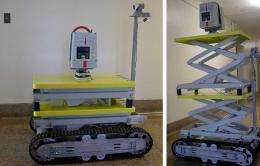
As part of the project, which began in 2008, students at Missouri S&T have built a remote-controlled robot that is equipped with an infrared camera and LIDAR (light detection and ranging) technology. Like radar, LIDAR sends out signals, in this case millions of laser points, to bounce off objects and provide feedback. The LIDAR-equipped robot then wirelessly relays detailed images to a laptop computer.

"We can get a 3-D map of rooms by sending the robot inside or having it look through a window," says Dr. Norbert Maerz, associate professor of geological engineering at Missouri S&T. "Even when you can't see through windows, you can still scan through them with LIDAR. Using this information, soldiers or first responders could evaluate safety issues and determine strategies."

Maerz and Dr. Ye Duan, an associate professor of computer science at MU, are the primary investigators on the research project, which was funded at a total cost of $400,000 by the Leonard Wood Institute.
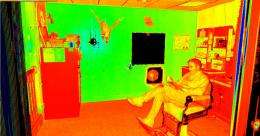
Maerz and his students have used their prototype to map the inside of houses, businesses, Missouri S&T buildings, chambers in S&T's Experimental Mine and cave passages in the Mark Twain National Forest.

"In theory, you could deploy this technology inside caves where terrorists might be hiding," Maerz says.

Maerz sends sample images to Duan in Columbia for advanced data analysis and 3-D reconstruction. The technology is capable of revealing detailed information regarding floorplans, for instance, but it can also "see" people and objects inside a space. "Once you have the images, you can zoom in on objects and look at things from different angles," Maerz says. "You can make precise measurements of any object and assess dimensions."

The technology is further capable of detecting structural damage like cracks in beams, which would allow engineers to make safety recommendations following natural disasters.
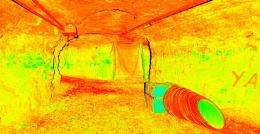
"This could definitely be used in disaster relief situations," Maerz says. "The main idea is to assess safety in dangerous areas."

The student-built at S&T resembles the rovers NASA has sent to Mars. But the S&T prototype, which weighs approximately 200 pounds, only cost about $25,000 to assemble. Maerz envisions commercial models being smaller, lighter and more flexible.

Explore further: PNNL-developed injection molding process recognized with emerging technologies award

add to favorites email to friend print save as pdf

Related Stories

Smallest salamander in U.S. discovered

Jul 07, 2009

(PhysOrg.com) -- Researchers from the University of Georgia Warnell School of Forestry and Natural Resources weren’t looking for anything new when they went exploring in the northeast part of the state. ...

New research brings 'invisible' into view (w/ Video)

Oct 06, 2009

(PhysOrg.com) -- A group of researchers at Missouri University of Science and Technology has developed a handheld camera that uses microwave signals to non-destructively peek inside materials and structures ...

New sensors capable of measuring damage to infrastructure

Jan 05, 2009

(PhysOrg.com) -- Dr. Genda Chen, professor of civil, architectural and environmental engineering at Missouri University of Science and Technology, was recently awarded a patent for "Strain Sensitive Coax Cable Sensors for ...

Using Lasers to Map Bird Habitat

Sep 29, 2009

(PhysOrg.com) -- Lasers are providing scientists with new tools for mapping, protecting, and restoring bird habitat along rivers. In a paper published in the October issue of Ecological Applications, scientists from PRBO C ...

New approach to measuring carbon in forests

Mar 26, 2008

CSIRO is collaborating in a NASA-funded project, using a CSIRO-designed instrument, to help develop new methods of measuring forest carbon stores on a large scale.

Recommended for you

How soon could car seats enter the 3-D comfort zone?

16 hours ago

New 3D textiles made of recyclable polyester fibres could contribute help cars be easier to recycle. But recycling technology has yet to progress in separating seat material from other car components.

NASA: Austin, calling Austin. 3-D pizzas to go

May 22, 2013

(Phys.org) —The idea of living with 3-D printed food is neither unthinkable nor new; designers and futurists have been looking to 3-D printing as food's next frontier. In 2012, there was news that the Thiel ...

User comments : 0

More news stories

Google Drive sports new view and scan enhancements

(Phys.org) —Google Drive has a new look and functions. The makeover in Google Drive features scanning and interface enhancements that put the user into "card" mode. The enhancements make it easy for the ...

Solar Kettle allows for boiling water off the grid

(Phys.org) —A company called Contemporary Energy has unveiled a new device it calls the Solar Kettle. It looks very much like a normal coffee thermos, but has flaps on one side that open to allow for collecting ...

Review: Google music plan solid, serendipitous

Google's new music service offers a lot of eye candy to go with the tunes. The song selection of around 18 million tracks is comparable to popular services such as Spotify and Rhapsody, and a myriad of playlists ...

Controlling mood through the motions of mitochondria

(Medical Xpress)—Regulating the distribution of power in neurons is done by a system that makes the national electric grid look simple by comparison. Each neuron has several thousand mitochondria confined ...