CryoSat to observe Earth's ice cover (w/ Video)
Feb 15, 2010
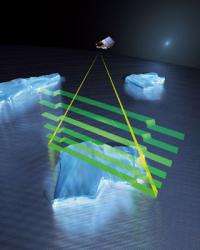
Using a sophisticated radar altimeter called SIRAL (Synthetic Aperture Radar Interferometric Radar Altimetry), CryoSat-2 will make accurate measurements of the thickness of floating sea-ice so that seasonal to inter-annual variations can be detected. It will also survey the surface of continental ice sheets to detect small elevation changes. Credits: ESA - AOES Medialab

(PhysOrg.com) -- The European Space Agency is about to launch the most sophisticated satellite ever to investigate the Earth's ice fields and map ice thickness over water and land: lift-off scheduled for 25 February.

Lift-off is scheduled to take place at 14:57 CET (13:57 UTC) on Thursday 25 February 2010. The launcher is operated by the international space company Kosmotras.

CryoSat will be the third of ESA’s Earth Explorer satellites in orbit, following on from GOCE (launched in March 2009) and SMOS (launched in November 2009). It was originally due to be the first in the Earth Explorer series, but the first satellite was lost as a result of a launcher failure in October 2005.

This video is not supported by your browser at this time.
CryoSat will determine variations in the thickness of floating sea-ice so that seasonal and interannual variations can be detected. The satellite will also survey the surface of continental ice sheets to detect small elevation changes. Information on precise variations in ice thickness will further our understanding of the relationship between ice and climate change. Credits: ESA /AOES Medialab

The 700 kg CryoSat spacecraft - whose name comes from the Greek kruos meaning icy cold - carries the first all-weather microwave radar altimeter. The instrument has been optimised for determining changes in the thickness of both floating sea , which can be up to several metres, and polar land ice sheets, which in Antarctica can be up to five kilometres. The mission will deliver data on the rate of change of the ice thickness accurate to within one centimetre.

Recent record-lows in the extent of summer Arctic sea-ice cover demonstrate that significant changes are occurring in the polar regions. Ice cover has been mapped from space for many years by satellites such as . But to understand more about how climate change is affecting these sensitive regions, there is also an urgent need to determine how ice thickness is changing. Data from will lead to a better understanding of the dynamics of ice mass, provide the scientific community with valuable information on this variable and contribute to climate change studies.

Explore further: Mice, gerbils perish in Russia space flight

add to favorites email to friend print save as pdf

Related Stories

ESA's ice mission arrives safely at launch site

Jan 14, 2010

(PhysOrg.com) -- In what might seem rather appropriate weather conditions, the CryoSat-2 Earth Explorer satellite has completed its journey to the Baikonur launch site in Kazakhstan, where it will be prepared ...

February launch for ESA's CryoSat ice mission

Sep 14, 2009

(PhysOrg.com) -- As members of the media visit IABG’s spacecraft test centre in Germany to learn more about ESA’s CryoSat mission and view the satellite, a new target launch date of 28 February 2010 has ...

British climate satellite to be launched

Oct 05, 2005

A British satellite designed to give an extremely accurate picture of climate changes at the Earth's poles is set for launch Saturday from Plesetsk, Russia.

CryoSat set for launch

Oct 08, 2005

It's all systems go for the CryoSat spacecraft launch from Russia, European Space Agency officials said Friday.

Arctic sea ice thinning at record rate

Oct 28, 2008

(PhysOrg.com) -- The thickness of sea ice in large parts of the Arctic declined by as much as 19% last winter compared to the previous five winters, according to data from ESA's Envisat satellite.

Countdown to satellite launch

Oct 06, 2005

The first satellite to accurately measure how fast the Earth's polar ice caps are shrinking will be launched this weekend (on Saturday, October 8) and one of the lead researchers is from the University of Aberdeen.

Recommended for you

Mice, gerbils perish in Russia space flight

17 hours ago

A number of mice and eight gerbils sent into space in a Russian capsule destined to find out how well organisms can withstand extended flights perished during their journey, scientists said Sunday as the ...

Mars rover Opportunity examines clay clues in rock

May 18, 2013

(Phys.org) —NASA's senior Mars rover, Opportunity, is driving to a new study area after a dramatic finish to 20 months on "Cape York" with examination of a rock intensely altered by water.

NASA's STEREO detects a CME from the sun

May 17, 2013

On 5:24 a.m. EDT on May 17, 2013, the sun erupted with an Earth-directed coronal mass ejection or CME, a solar phenomenon that can send billions of tons of solar particles into space that can reach Earth ...

Nine-year-old Mars rover passes 40-year-old record

May 17, 2013

While Apollo 17 astronauts Eugene Cernan and Harrison Schmitt visited Earth's moon for three days in December 1972, they drove their mission's Lunar Roving Vehicle 19.3 nautical miles (22.210 statute miles ...

Bright explosion on the Moon

May 17, 2013

For the past 8 years, NASA astronomers have been monitoring the Moon for signs of explosions caused by meteoroids hitting the lunar surface. "Lunar meteor showers" have turned out to be more common than anyone ...

User comments : 0

More news stories

Heat-related deaths in Manhattan projected to rise

Residents of Manhattan will not just sweat harder from rising temperatures in the future, says a new study; many may die. Researchers say deaths linked to warming climate may rise some 20 percent by the 2020s, ...

Mice, gerbils perish in Russia space flight

A number of mice and eight gerbils sent into space in a Russian capsule destined to find out how well organisms can withstand extended flights perished during their journey, scientists said Sunday as the ...

Honeybees trained in Croatia to find land mines

(AP)—Mirjana Filipovic is still haunted by the land mine blast that killed her boyfriend and blew off her left leg while on a fishing trip nearly a decade ago. It happened in a field that was supposedly ...

Kinks and curves at the nanoscale

One of the basic principles of nanotechnology is that when you make things extremely small—one nanometer is about five atoms wide, 100,000 times smaller than the diameter of a human hair—they are going ...