Gene discovery to increase biomass needed for green fuel
Feb 10, 2010

(PhysOrg.com) -- Manchester scientists have identified the genes that make plants grow fatter and plan to use their research to increase plant biomass in trees and other species - thus helping meet the need for renewable resources.

“The US has set the ambitious goal of generating a third of all from by the year 2025. Estimates suggest to reach their goal they would need 1 billion tonnes of biomass, which is a lot,” says Professor Simon Turner, one of the University of Manchester researchers whose BBSRC-funded study is published in Development today.

“Our work has identified the two genes that make grow outwards. The long, thin cells growing down the length of a plant divide outwards, giving that nice radial pattern of characteristic growth rings in trees. So you get a solid ring of wood in the centre surrounded by growing cells. Now we have identified the process by which the cells know how to grow outwards, we hope to find a way of making that plants grow thicker quicker, giving us the increased wood production that could be used for biofuels or other uses.

“And there is an added benefit. There are concerns that the growing of biofuel products competes with essential food production. However, the part of the plant we have studied is the stalk - not the grain - so there will be no competition with food production.”

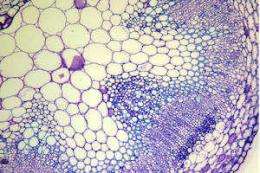
Professor Turner and Dr Peter Etchells, at the Faculty of Life Sciences, studied the which does not look like a tree but has a similar , (which carries water and sugar around the plant). They investigated growth in the vascular bundles and found that the genes PXY and CLE41 directed the amount and direction of cell division. Furthermore, they found over-expression of CLE41 caused a greater amount of growth in a well-ordered fashion, thus increasing wood production.

Professor Turner explained: “We wanted to know how the cells divided to produce this pattern, how they ‘knew’ which side to divide along, and we found that it was down to the interaction of these two genes.

“Trees are responsive to a lot of things. They stop growing in winter and start again in spring and this changes according to the amount of light and the day length. It might take a tree 150 years to grow in Finland and only ten years in Portugal.

“Now we know what genes are dictating the growth process, we can develop a system of increasing growth so that it is orientated to produce more wood - increasing the essential biomass needed for our future.”

The team are now growing poplar trees in the lab - to see if they fit the Arabidopsis model. They will use these results to develop a system of increasing wood production.

Explore further: Researchers identify new target to boost plant resistance to insects and pathogens

Related Stories

Scientists Identify Bacteria That Increase Plant Growth

Jan 26, 2009

(PhysOrg.com) -- Through work originally designed to remove contaminants from soil, scientists at the U.S. Department of Energy's Brookhaven National Laboratory and their Belgium colleagues at Hasselt University ...

Annuals converted into perennials

Nov 10, 2008

Scientists from VIB at Ghent University, Belgium, have succeeded in converting annual plants into perennials. They discovered that the deactivation of two genes in annuals led to the formation of structures that converted ...

Sweet success for sustainable biofuel research

Jan 25, 2010

Scientists have found a way to increase fermentable sugar stores in plants which could lead to plant biomass being easier to convert into eco-friendly sustainable biofuels. Their research is highlighted in the latest issue ...

Antagonistic genes control rice growth

Dec 15, 2009

Scientists at the Carnegie Institution, with colleagues, have found that a plant steroid prompts two genes to battle each other—one suppresses the other to ensure that leaves grow normally in rice and the ...

Recommended for you

Fast new, one-step genetic engineering technology

May 22, 2013

A new, streamlined approach to genetic engineering drastically reduces the time and effort needed to insert new genes into bacteria, the workhorses of biotechnology, scientists are reporting. Published in ...

100K Pathogen Genome Project maps first genomes

May 22, 2013

(Phys.org) —Striking a blow at foodborne diseases, the 100K Pathogen Genome Project at the University of California, Davis, today announced that it has sequenced the genomes of its first 10 infectious microorganisms, including ...

User comments : 2

Adjust slider to filter visible comments by rank

Display comments: newest first

Rick69
5 / 5 (1) Feb 10, 2010
Although I'm not even close to being an agronomist, I would think farmers would be concerned in a dry year if more moisture is being used for bigger cornstalks rather than for grain production. This concern would apply to almost any agricultural product when moisture availability was marginal or worse.
Caliban
1 / 5 (2) Feb 10, 2010
That seems likely, Rick.
What I find interesting is this notion that we have to genetically modify plants to make them useful to produce biomass, when perfectly good candidates already exist- algae, hemp, several grasses- for example. In the case of Hemp and many of the grasses- they can be grown in a broad range of soil and moisture conditions, which makes them particularly useful, in that they can be cultured on marginal land otherwise unsuited for food-crop cultivation. Algae, of course, can be cultivated in more or less closed-system tank farms, that don't require the continuaal addition of water to sustain. I'm all for research, but we've got to be wise about developing and deploying this technology.

More news stories

White tiger mystery solved

White tigers today are only seen in zoos, but they belong in nature, say researchers reporting new evidence about what makes those tigers white. Their spectacular white coats are produced by a single change ...

Controlling mood through the motions of mitochondria

(Medical Xpress)—Regulating the distribution of power in neurons is done by a system that makes the national electric grid look simple by comparison. Each neuron has several thousand mitochondria confined ...