Anti-whalers, Japanese fleet fire water cannons
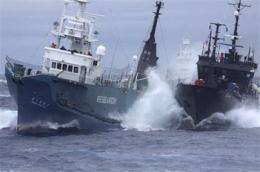
(AP) -- Activists vowing to stop the killing of whales exchanged water-cannon fire with a Japanese whaling fleet they are tailing in the Antarctic Ocean, as sea confrontations that have led to collisions and a sunken vessel continue.
The Sea Shepherd conservation group said its ships, the Steve Irwin and the Bob Barker, confronted the Japanese factory ship Nisshin Maru early Monday.
"The factory ship turned on their water cannons and were surprised when the Steve Irwin responded with a more powerful water cannon that had a couple of the whalers diving for the bridge doors," said a Monday statement from the group.
On Saturday, the Bob Barker and a Japanese harpoon boat collided in icy Antarctic waters, causing minor damage to both vessels. A Japanese whaler struck Sea Shepherd's high-tech speed boat Ady Gil and sheared off its nose on Jan. 6. The Bob Barker then came to rescue the crew of the Ady Gil, which sank a day later.
Japanese Fisheries Agency official Shigeki Takaya condemned the use of water cannons after Monday's confrontation. "As we have always said, we condemn the act. It is totally unforgivable," he said.
A Japanese foreign ministry official said Japan lodged a protest with the Netherlands and Togo over the water cannon fire in the Antarctic Ocean - the countries where the Steve Irwin and Bob Barker are registered.
"We asked the respective governments to stop the ships from obstructing our whaling activities," the official said, speaking anonymously, citing departmental policy. He declined to elaborate further.
Sea Shepherd, a U.S.-based activist group, sends vessels to confront the Japanese fleet each year. Two major clashes have already occurred this year, one a collision that destroyed a Sea Shepherd vessel.
Sea Shepherd founder Paul Watson said his activists have prevented the whalers from catching any whales since Saturday.
"We intend to turn these three whaling-free days into three whaling-free weeks," Watson said in the statement. "I am confident that once again we will severely cut their kill quotas and we will once again negate their profits."
Japan has a six-vessel whaling fleet in Antarctic waters as part of its scientific whaling program, an allowed exception to the International Whaling Commission's 1986 ban on commercial whaling. It hunts hundreds of mostly minke whales, which are not an endangered species. Whale meat not used for study is sold for consumption in Japan, which critics say is the real reason for the hunts.
Watson estimated the whaling fleet has so far killed about 350 minke whales.
Sea Shepherd activists try to block the whalers from firing harpoons, and they dangle ropes in the water to try to snarl the Japanese ships' propellers. They also hurl packets of stinking rancid butter at their rivals.
The whalers have responded by firing water cannons and sonar devices meant to disorient the activists. Collisions have occurred occasionally.
The Sea Shepherd statement said its two vessels have enough fuel to pursue the whaling fleet for another month.
"It does not matter where they go, east or west along the Antarctic Coast," said Steve Irwin 1st Officer Locky MacLean. "We intend to stick to their rear like glue and we will not allow a single whale to be loaded onto the decks of that foul floating abattoir."
©2010 The Associated Press. All rights reserved. This material may not be published, broadcast, rewritten or redistributed.


