Conductive eTextiles: Researchers move from making batteries from paper to making batteries from cloth
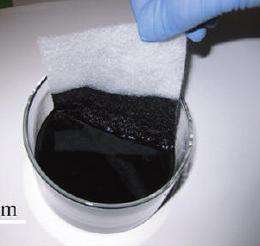
(PhysOrg.com) -- Stanford researchers have moved from making batteries from paper to making batteries from cloth. Your-T-shirt could become a lighted, moving display.
A team of Stanford researchers is producing batteries and simple capacitors from ordinary textiles dipped in nanoparticle-infused ink. The conductive textiles - dubbed "eTextiles" - represent a new class of integrated energy storage device, born from the synthesis of prehistoric technology with cutting-edge materials science.
"We have been developing all kinds of materials, trying to revolutionize battery performance," said Yi Cui, assistant professor of materials science and engineering at Stanford. "Recently, we started to think about how to make batteries in a very different way from before."
While conventional batteries are made by coating metallic foil in a particle slurry and rolling it into compact form - a capital-intensive process - the new energy textiles were manufactured using a simple "dipping and drying" procedure, whereby a strip of fabric is coated with a special ink formula and dehydrated in the oven.
The procedure works for manufacturing batteries or supercapacitors, depending on the contents of the ink - oxide particles such as LiCoO2 for batteries; conductive carbon molecules (single-walled carbon nanotubes, or SWNTs) for supercapacitors. Up to now, the team has only used black ink, but Cui said it is possible to produce a range of colors by adding different dyes to the carbon nanotubes.
Efficient energy storage
What's more, the lightweight, flexible and porous character of natural and synthetic fibers has proven to be an ideal platform for absorbing conductive ink particles, according to postdoctoral scholar Liangbing Hu, who led the energy textile research. That helps explain why treated textiles make such efficient energy storage devices, he said.
Cui's team had previously developed paper batteries and supercapacitors using a similar process, but the new energy textiles exhibited some clear advantages over their paper predecessors. With a reported energy density of 20 Watt-hours per kilogram, a piece of eTextile weighing 0.3 kilograms (about an ounce, the approximate weight of a T-shirt) could hold up to three times more energy than a cell phone battery.
Aside from enhanced energy storage capacity, eTextiles are remarkably durable and can withstand greater mechanical stress.
"The whole thing can be stretchable as well, and extend to more than twice its length," Hu explained. "You can wash it, put it in all kinds of solvents - it's very stable."
The potential applications of wearable power are manifold, ranging from health monitoring to moving-display apparel. (The latter, Cui mused, would make quite a splash if worn by Stanford sports teams.)
Cui said the new eTextiles are generating buzz at industry conventions, where big-name brands have expressed an interest in developing reactive, high-performance sportswear using the new technology. The U.S. military also is probing the possibility of integrating energy textiles into its battle array, a move that may one day lighten a soldier's carrying load.
Interest in developing new markets
"There's a really strong interest in developing new markets in consumer electronics," Cui summarized. "We aren't there yet, but this is an emergent industry."
In the meantime, the team will continue its current research trajectory with two themes in mind: how best to introduce eTextiles into real markets, and the fundamental science behind what makes their product work so effectively.
"This is the right time to really see what we learn from nanoscience and do practical applications that [are] extremely promising," Cui said. "The beauty of this is it combines the lowest cost technology that you can find to the highest tech nanotechnology to produce something great. I think this is a very exciting idea… a huge impact for society."
More information: The team's findings appear in the January online edition of Nano Letters, a publication of the American Chemical Society, under the title "Stretchable, Porous, and Conductive Energy Textiles."
Provided by Stanford University


