Powering cube satellites
Feb 03, 2010 by Morgan Bettex
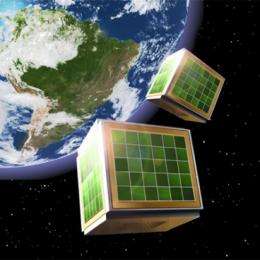
MIT reseachers' new thrusters could increase the number of CubeSats in orbit and expand the tasks they are able to complete. Graphic: Christine Daniloff

Right now, 10 to 15 Rubik's Cube-sized satellites are orbiting high above Earth. Known as cube satellites, or "CubeSats," the devices help researchers conduct simple space observations and measure characteristics of Earth’s atmosphere. One advantage is that they are relatively cheap to deploy: While launching a rocket may cost between $50 million and $300 million, a CubeSat can “piggyback” onto a large rocket platform at an additional cost of as little as $40,000. But their small size also means they lack on-board propulsion systems, which is why they generally remain locked to a particular orbit.

That could soon change, however. Paulo Lozano, the H.N. Slater Assistant Professor of Aeronautics and Astronautics at MIT, is designing a tiny propulsion system that could allow the satellites, which weigh about a kilogram and are used for tasks that don’t require precise orbit control, to travel great distances and perform more serious tasks, such as searching for planets outside our . The technology, which is based on the process of extracting and accelerating charged ions, or atoms that have gained or lost an electron, could make CubeSats much more useful for organizations or countries that until now have had limited access to space.

For decades, the only way to get objects into space from Earth — and then propel them through space — was to use chemical propulsion systems. But the systems require a lot of , or fuel, and haven’t been miniaturized to the scale appropriate for a . By changing the design from chemical to electric, and to one that relies on a simple power supply, Lozano has created a system that produces more efficient thrust — the force created when mass is accelerated in a certain direction — than that produced by a chemical-based system, which produces a low thrust per gram of propellant. About the size of a computer chip, the mini-thruster design also overcomes the size constraints of chemical propulsion and other forms of electric propulsion because it does not require a bulky chamber to burn (chemical) or extract ions from (electric) the propellant. Although other electric propulsion systems have been developed, Lozano’s is considered superior because it uses only one power supply.

With funding from the Air Force Office of Scientific Research, Lozano has been developing the technology to make the mini-thruster. The Air Force and other government agencies are interested in using CubeSats that can move between different orbits in space, and more specifically, that have the propulsion required to reenter Earth’s atmosphere and destroy themselves at the end of their mission (thereby keeping them from becoming “space junk”). The thruster design requires that the total volume of the propulsion system be less than 10 percent of the CubeSat.

“The goal is to have a space engine that leaves plenty of room for the payload, or cargo, of the CubeSat,” Lozano said. Certain missions require chemical propulsion, such as a trip to the moon, because in order to land on the moon’s surface, the amount of force from the engine must be at least equal to the weight of the lander, a value that Lozano said is generally “way too high” for electric propulsion engines. But chemical-based systems are severely limited by the fact that the vehicle mass must be made mostly of propellant, which leaves little room for the payload. Quite often the propellant must also be stored in a pressurized container with thick walls and pipes, further limiting the payload size. Although other electric propulsion systems exist, they require a pressurized container to store the propellant.

Vadim Khayms, a systems engineer at Lockheed Martin, explained that most electric propulsion systems haven’t been scaled to operate at very low power levels and are typically suitable for larger satellites that have more power available and require more thrust. He is not aware of another electric propulsion system designed for CubeSats. “You probably couldn’t use any other existing electric propulsion [systems] on these very small satellites,” Khayms said of Lozano’s design.

How the power system works

Lozano’s design relies on electrospraying, a physics process that uses electricity to extract positive and negative ions from a liquid salt that is created in a laboratory and serves as the system’s propellant. The liquid contains no solvent, such as water, and can be charged electrically with no heat involved. Whereas other electric propulsion systems charge the ions in a chamber on the satellite, the ionic liquid in Lozano’s design has already been charged on the ground, which is why his system doesn’t need a chamber.

Electricity is then converted from the main power source of the CubeSat, typically batteries or a solar panel, and applied to a tiny structure roughly the size of a postage stamp. This thin panel is made of about 1,000 porous metal structures that resemble needles and have several grams of the ionic liquid on them. By applying voltage to the needles, an electric field is created that extracts the ions from the liquid, accelerates them at very high speeds and forces them to fly away. This process creates an ionic force strong enough to produce thrust.

Whereas chemical rockets waste too much propellant to reach a net change in spacecraft velocity, electric thrusters can do exactly the same mission using just a small fraction of the propellant. The only difference is one of time: Although electric propulsion is very fuel efficient, it is slower due to power limitations.

“Eventually, you’ll run out of propellant, but that is the benefit of because it accelerates so fast that you don’t need a lot of it,” he said. “No other electric would be so compact and efficient at the same time.”

Because the mini-thrusters are scalable, thousands of them could be built into long, thin panels to produce thrust for a much larger spacecraft that requires low, but steady, acceleration. “There’s no impediment to making a whole table of them similar to a solar panel,” Lozano said. “This gives you a lot more flexibility in what you can do.”

Lozano predicts that CubeSats using this technology will become a reality in less than three years. He plans to have a prototype of the mini-thruster in four to five months and hopes to begin testing it to measure performance metrics such as the velocity of the ions and their energy to figure out the force produced by the engine. Knowing this, researchers can estimate its efficiency. After Lozano delivers a prototype this year, his team will look for additional support to turn the design into a flight version.

Explore further: Nine-year-old Mars rover passes 40-year-old record

add to favorites email to friend print save as pdf

Related Stories

Princeton wins NASA Competition to Develop Plasma Rocket

Aug 30, 2004

NASA has selected engineers at Princeton University to develop an advanced rocket thruster that could send people or robots to other planets with far less propellant than conventional engines. The National Aeronautics and Sp ...

Ceramic Materials Improve Spacecraft Insulators

Jul 07, 2005

Scientists and engineers conducting research for the Air Force Research Laboratory's Materials and Manufacturing Directorate have identified ceramic materials that could increase the life of ceramic Hall thruster insulators ...

NASA, Industry Partner Test 20-Meter Solar Sail System

Aug 03, 2005

NASA has reached a milestone in the testing of solar sails -- a unique propulsion technology that will use sunlight to propel vehicles through space. Engineers have successfully deployed a 20-meter solar sail system that ...

Recommended for you

Mars rover Opportunity examines clay clues in rock

7 hours ago

(Phys.org) —NASA's senior Mars rover, Opportunity, is driving to a new study area after a dramatic finish to 20 months on "Cape York" with examination of a rock intensely altered by water.

NASA's STEREO detects a CME from the sun

20 hours ago

On 5:24 a.m. EDT on May 17, 2013, the sun erupted with an Earth-directed coronal mass ejection or CME, a solar phenomenon that can send billions of tons of solar particles into space that can reach Earth ...

Nine-year-old Mars rover passes 40-year-old record

May 17, 2013

While Apollo 17 astronauts Eugene Cernan and Harrison Schmitt visited Earth's moon for three days in December 1972, they drove their mission's Lunar Roving Vehicle 19.3 nautical miles (22.210 statute miles ...

Bright explosion on the Moon

May 17, 2013

For the past 8 years, NASA astronomers have been monitoring the Moon for signs of explosions caused by meteoroids hitting the lunar surface. "Lunar meteor showers" have turned out to be more common than anyone ...

User comments : 11

Adjust slider to filter visible comments by rank

Display comments: newest first

codesuidae
not rated yet Feb 03, 2010
Anyone have ISP and power requirements for this gadget?
SteveL
5 / 5 (2) Feb 03, 2010
"With funding from the Air Force Office of Scientific Research"
1) Fabricate with stealth anti-radar technology to make "invisible" to land-based detection.
2) Install focusable narrow beam encrypted communication capacity.
3) Make the payload a shaped charge.
4) Include a magnetic or other coupler to latch onto its target.
5) Years to catch up with your target.

You have an undetectable capacity to destroy enemy satelites in space and cripple their economic, military and governmental communications on the cheap, and in mass quantities. No rockets to miss their targets, possibly be intercepted or to even to announce that "we" did it. What a sweet deal.
gmurphy
not rated yet Feb 03, 2010
Good point SteveL, maybe the next step will be sniffer dogs at space ports?
zevkirsh
not rated yet Feb 03, 2010
i hope and expect that the u.s. has the capacity to easily TARGET and destroy other nations sattelities in a very focussed and pinpoint manner WHILE DEFENDING OUR OWN SATTELITES.

defense is always more complex than offense.
Parsec
not rated yet Feb 03, 2010
Satellites destroyed in orbit leave enormous quantities of space junk as residue. I could see a shaped charge that could damage or destroy a satellite, but doing it in such a way that the satellite wouldn't produce a distinctive residue cloud would be quite difficult (not impossible). So while its true that we would have deniability for such damage, the consequences of massive qualities of space junk plus the inevitable political fallout( the list of suspects would be quite short) really makes this stuff pretty unlikely to be used.
solrey
5 / 5 (1) Feb 03, 2010
First, this is some clever technology and it's scalable. Good stuff. I hope they develop it.

Second, if one were to use these cubesats with this propulsion system to disable other satellites, why take steps backwards with boomboom explosives? How about using Electromagnetic Pulse instead? They could just be EMP "bombs", without the messy boom. Just glide by within a few feet of the target, set off the EMP and fry all electronics within a 50 foot radius. Passing the target on a trajectory to take the EMP "bomb" into a decaying orbit destroys all the evidence. "Ooops, sorry 'bout your luck, must have been a solar flare." wink wink

peace,
Tim
Fazer
not rated yet Feb 03, 2010
Reading this article reminded me of the efforts to devlope a way to divert a killer asteroid over a long period of time.

What if you created small chips that had a combination of a small solar panel and one of these ion drive panels. You make the back side of the chips sticky. You produce thousands of these chips and dump them on the asteroid in a swath that covers as many sides of the asteroid as possible. Some would stick, some would not, but these would propel themselves away over time.

Any chips facing the sun would convert that energy into a small ion force, back in the direction of the sun, very, very slowly pushing the asteroid away from the sun. Over a long time, this would slightly alter the orbital characteristics of the asteroid, hopefully enough to keep it from hitting the Earth.
Quantum_Conundrum
not rated yet Feb 03, 2010
If you wanted to shoot down other satellites, you would be better off with a directed energy weapon, me thinks.

"THEL" (Tactical High Energy Laser), but satellite scale...

i.e.
OTHELA (Orbiting Tactical High Energy Laser Array)

Advantages are many, as your own satellite is re-usable, and there is no "evidence"...
missile16
not rated yet Feb 04, 2010
With this technology, no explosives or lasers would be needed at all. The Cubesat could attach to an enemy sattelite and use its high efficiency engines to nudge the sattelite out of its correct orientation. The satellite would use up all of its fuel trying to keep its correct orientation and soon run out of fuel. Once the fuel is gone then turn the enemy satellite in an unusable orientation, undock, and move on. End result...no debris and one unusable enemy satellite. To ground control it would look like a simple mechanical or computer failure.
SteveL
not rated yet Feb 04, 2010
Western politicians and western societies can't stomach the visibility of modern warfare. You can't blame their advanced militaries and intelligence organizations for seeking less visible means.

Rockets shooting into space = visibility, and could potentially be destroyed with energy-based weapons. Most satellites are hardened against electromagnetism and are so far apart that EMP would require a lot of resources - and would be highly detectible.

A shaped charge need only blow a small hole in the side of a satellite - something akin to buckshot. You just need to bust up the guts inside and don't want to "blow up" the satellite because of the debris field. The pellets could even be chemically similar to meteorites or known space debris. The blast force should be more than enough to seperate the two satellites and the little killer need only propel towards earth to burn up in the atmosphere to complete its mission.
baudrunner
not rated yet Feb 04, 2010
Gee, one comment about military applications and the entire forum is focussed on destruction and warfare. What's with you people?

I foresee the future in space-based propulsion systems to be some form of hybrid ion/chemical thruster. Example - if the "needles" which make up the cathode of the ion engine were silver plated and a hydrogen peroxide propellent were used to boost thrust then we have a temporary method for bringing a craft to extreme velocities until H2O2 runs out and fuel cannisters disengaged, after which normal ion thrusting takes over. H2O2/silver has extremely high thrust to weight ratio.

More news stories

Galaxy's Ring of Fire

Johnny Cash may have preferred this galaxy's burning ring of fire to the one he sang about falling into in his popular song. The "starburst ring" seen at center in red and yellow hues is not the product of ...

Alaska volcano shoots ash 15,000 feet into the air

(AP)—One of Alaska's most restless volcanoes has shot an ash cloud 15,000 feet into the air in an ongoing eruption that has drawn attention from a nearby community but isn't expected to threaten air traffic.

Chinese, Indian airlines face EU pollution fines

Eight Chinese and two Indian airlines face fines of up to several million euros for not paying for their greenhouse gas emissions during flights within the bloc, the European Commission said on Friday.

Morocco to harness the wind in energy hunt

Morocco is ploughing ahead with a programme to boost wind energy production, particularly in the southern Tarfaya region, where Africa's largest wind farm is set to open in 2014.

New case of SARS-like virus in Saudi: ministry

A new case of the deadly coronavirus has been detected in Saudi Arabia where 15 people have already died after contracting it, the health ministry announced on Saturday on its Internet website.