Making Steel Recycling Greener
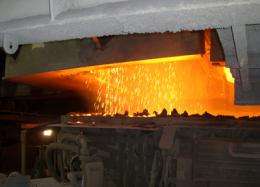
A new process developed by Siemens cuts the energy required to recycle steel and also lowers carbon dioxide (CO2) emissions.
To recycle scrap steel, it is melted down to crude steel in an arc furnace. In order to cut heat losses to a minimum, the resulting slag is foamed, thus forming a layer of insulation between the hot steel and the oven wall. The new automatic control system ensures that the foamed slag evenly coats the arc and the molten steel, thus saving energy. Using this process, the Lech Steelworks in Meitingen, Germany, has been able to reduce its power requirements for melting scrap steel by two percent and the resulting CO2 emissions by 12 percent.
Producing steel from scrap rather than pig iron is cheaper and saves energy. Recycled steel already makes up 45 percent of total steel production. Scrap steel is melted down in an arc furnace by high-voltage electric arcs at a temperature of over 3,500 °Celsius. Nutty slack (coal) and oxygen are then added. Among other things, this foams the slag that forms on the molten steel. The resulting foamed slag envelops the molten metal and the arcs, thus providing a layer of heat insulation.
Conventionally, nutty slack and oxygen are added to the arc furnace according to a predetermined formula. Too much nutty slack, and the excess simply burns off to form CO2, which is emitted with the exhaust gases; too little, and insufficient foamed slag is produced. For plant operators, it is difficult to judge whether there is a sufficient covering of foamed slag on the molten steel and arc. Engineers from Siemens Corporate Technology and Industry Solutions developed a new automatic control system that ensures an optimal coating. In order to determine precisely the thickness of the foamed slag, the arc current and the vibrations transmitted from the arc to the walls of the furnace are measured. An evaluation algorithm is then able to calculate the distribution of foamed slag. On this basis, the system regulates the amount of coal and oxygen added to the furnace so as to ensure that the arc and molten metal are always coated with just the right thickness of foamed slag.
Use of the Simelt FSM Foaming Slag Manager makes the production process both faster and more efficient. A steel plant equipped with this system uses up to 30 percent less coal, saves energy, and thereby enhances its environmental performance.
Provided by Siemens


