Human running speed of 35-40 mph may be biologically possible
Jan 22, 2010
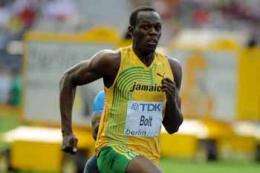
Jamaican sprinter Usain Bolt.

(PhysOrg.com) -- Jamaican sprinter Usain Bolt's record-setting performances have unleashed a wave of interest in the ultimate limits to human running speed. A new study published Jan. 21 in the Journal of Applied Physiology offers intriguing insights into the biology and perhaps even the future of human running speed.

The newly published evidence identifies the critical variable imposing the biological limit to running speed, and offers an enticing view of how the biological limits might be pushed back beyond the nearly 28 miles per hour speeds achieved by Bolt to speeds of perhaps 35 or even 40 miles per hour.

The new paper, "The biological limits to running speed are imposed from the ground up," was authored by Peter Weyand of Southern Methodist University; Rosalind Sandell and Danille Prime, both formerly of Rice University; and Matthew Bundle of the University of Wyoming.

"The prevailing view that speed is limited by the force with which the limbs can strike the running surface is an eminently reasonable one," said Weyand, associate professor of applied physiology and biomechanics at SMU in Dallas.

"If one considers that elite sprinters can apply peak forces of 800 to 1,000 pounds with a single limb during each sprinting step, it's easy to believe that runners are probably operating at or near the force limits of their muscles and limbs," he said. "However, our new data clearly show that this is not the case. Despite how large the running forces can be, we found that the limbs are capable of applying much greater ground forces than those present during top-speed forward running."

In contrast to a force limit, what the researchers found was that the critical biological limit is imposed by time — specifically, the very brief periods of time available to apply force to the ground while sprinting.
In elite sprinters, foot-ground contact times are less than one-tenth of one second, and peak ground forces occur within less than one-twentieth of one second of the first instant of foot-ground contact.

The researchers took advantage of several experimental tools to arrive at the new conclusions. They used a high-speed treadmill capable of attaining speeds greater than 40 miles per hour and of acquiring precise measurements of the forces applied to the surface with each footfall. They also had subjects' perform at high speeds in different gaits. In addition to completing traditional top-speed forward running tests, subjects hopped on one leg and ran backward to their fastest possible speeds on the treadmill.

The unconventional tests were strategically selected to test the prevailing beliefs about mechanical factors that limit human running speeds — specifically, the idea that the speed limit is imposed by how forcefully a runner's limbs can strike the ground.

However, the researchers found that the ground forces applied while hopping on one leg at top speed exceeded those applied during top-speed forward running by 30 percent or more, and that the forces generated by the active muscles within the limb were roughly 1.5 to 2 times greater in the one-legged hopping gait.

The time limit conclusion was supported by the agreement of the minimum foot-ground contact times observed during top-speed backward and forward running. Although top backward vs. forward speeds were substantially slower, as expected, the minimum periods of foot-ground contact at top backward and forward speeds were essentially identical.

According to Matthew Bundle, an assistant professor of biomechanics at the University of Wyoming, "The very close agreement in the briefest periods of foot-ground contact at top speed in these two very different gaits points to a biological limit on how quickly the active muscle fibers can generate the forces necessary to get the runner back up off the ground during each step."

The researchers said the new work shows that running speed limits are set by the contractile speed limits of the muscle fibers themselves, with fiber contractile speeds setting the limit on how quickly the runner's limb can apply force to the running surface.

The established relationship between ground forces and speed allowed the researchers to calculate how much additional speed the hopping forces would provide if they were utilized during running.

"Our simple projections indicate that contractile speeds that would allow for maximal or near-maximal forces would permit speeds of 35 to 40 miles per hour and conceivably faster," Bundle said.

Explore further: Potato may help feed Ethiopia in era of climate change

Related Stories

Study revives Olympic prospects for amputee sprinter

May 16, 2008

A world-renowned team of experts in biomechanics and physiology from six universities, led by Professor Hugh Herr of the Massachusetts Institute of Technology’s Media Lab, refute scientific claims that the prostheses worn ...

Recommended for you

Honeybees trained in Croatia to find land mines

2 hours ago

(AP)—Mirjana Filipovic is still haunted by the land mine blast that killed her boyfriend and blew off her left leg while on a fishing trip nearly a decade ago. It happened in a field that was supposedly ...

Front-row seats to climate change

May 17, 2013

By day, insects provide the white noise of the South, but the night belongs to the amphibians. In a typical year, the Southern air hangs heavy from the humidity and the sounds of wildlife.

Climate change may have little impact on tropical lizards

May 17, 2013

A new Dartmouth College study finds human-caused climate change may have little impact on many species of tropical lizards, contradicting a host of recent studies that predict their widespread extinction in a rapidly warming ...

Wetlands: value to locals matters most

May 17, 2013

A new way of valuing ecosystem services, incorporating the local perspective, is the driving force behind a project assessing aquatic ecosystems in highland areas of Asia

User comments : 9

Adjust slider to filter visible comments by rank

Display comments: newest first

fourthrocker
4.3 / 5 (4) Jan 22, 2010
In other words speed is limited by how fast we can move our legs, duh.
Corban
5 / 5 (2) Jan 22, 2010
And just how fast can we move our legs? According to brand-spanking-new research, 35-40 mph. The point wasn't to assign causation but to put a number down.
Dr_Soupie
3 / 5 (2) Jan 22, 2010
There was recently an article here at Physorg that cited fossilized human footprints on a beach that indicated man used to have the potential to run at comparable, if not faster, speeds.

"Twenty thousand years ago six male Australian Aborigines chasing prey left footprints in a muddy lake shore that became fossilized. Analysis of the footprints shows one of them was running at 37 kph (23 mph), only 5 kph slower than Usain Bolt was traveling at when he ran the 100 meters in world record time of 9.69 seconds in Beijing last year. But Bolt had been the recipient of modern training, and had the benefits of spiked running shoes and a rubberized track, whereas the Aboriginal man was running barefoot in soft mud. Given the modern conditions, the man, dubbed T8, could have reached speeds of 45 kph, according to McAllister."

Source: http://www.physor...184.html
Yellowdart
5 / 5 (1) Jan 22, 2010
There is no spoon...
otto1923
5 / 5 (3) Jan 22, 2010
I suggest the Unlimited Olympics...
A fete held in some island country largely devoid of lawyers and courts, would invite competitors from around the world and would place no restrictions on steroid, drug, or other artificial enhancements to performance. This might include artificial joints, electrical stimulation and other internal mechanical additions and upgrades. Income from various venues could be enormous and the true limits of the human machine would finally be put to test. Separate classes could include exoskeletal enhancements and amputees with springy feet, but this might defeat the purpose of the concept.
jonnyboy
1 / 5 (2) Jan 22, 2010
Yet another example of misuse of our precious resources.
ThomasS
1 / 5 (1) Jan 22, 2010
Amazing that they would draw this conclusion in the face of the huge experimental evidence on the contrary.
TegiriNenashi
not rated yet Jan 22, 2010
Did they pulled this study from the Journal of Improbable Research? There are two kinds of scientists, the one that make discoveries, and the ones that pretend to do so.
Mercury_01
not rated yet Jan 24, 2010
Now if we could just find a way to move our legs faster...

More news stories

Honeybees trained in Croatia to find land mines

(AP)—Mirjana Filipovic is still haunted by the land mine blast that killed her boyfriend and blew off her left leg while on a fishing trip nearly a decade ago. It happened in a field that was supposedly ...

Russia retrieves mice, newts from space

A Russian capsule filled with 45 mice and 15 newts along with other small animals returned from a month's mission in orbit on Sunday with data scientists hope will pave the way for a manned flight to Mars.

German energy shift faces headwinds

Tense engineers have their eyes peeled on complex colour-coded diagrams on a wall-sized screen that makes their control room look like the inside of a spaceship.