Novel zoom objective with deformable mirrors
Unmanned aerial vehicles UAVs deployed on landscape analysis missions carry optical measuring equipment that is required to operate free of chromatic aberration. Researchers have now designed an all-reflective zoom objective with deformable mirrors.
An small unmanned aerial vehicle (UAV) circles above the ground, capturing the typical green of a coniferous forest or the radiated heat from a town. The objectives in its on-board measuring equipment must function free of chromatic aberration across a wide spectral range - from the ultraviolet region through the visible band and right up to the near and medium infrared range. In such a scenario, conventional lens systems comprised of several lens elements are of limited use: when required to image a wide spectral range, the image quality drops - the image suffers from color fringing and becomes blurred. Traditionally, specific lenses have been used for each different spectral band. However, the difficulty is that UAVs can only carry a limited amount of weight.
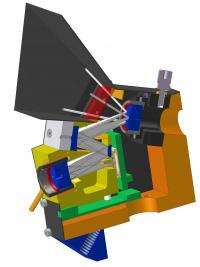
Researchers from the Fraunhofer Institute for Photonic Microsystems IPMS are currently working to make it possible to capture images free from chromatic aberration in a number of spectral ranges using a single system. This would have the advantage of prolonging the battery’s life and increasing the aircraft’s endurance. Group manager Dr. Heinrich Grüger of the IPMS says: “We’ve come up with a design for a new objective in which we’ve used mirrors instead of standard lens elements.” The objective is comprised of four mirrors, carefully arranged to avoid obscuration - this produces a higher-contrast image. Two deformable mirrors take care of the triple zoom range - with no loss of image quality. The new design eliminates the need for elaborate mechanical guides within the lens barrel.
Grüger believes the new objective is potentially highly marketable: “Both the automation technology sector and the automobile and equipment engineering sector would profit from this type of objective.” Suitable deformable mirrors will have to be created - conventional optical mirrors are rigid. Grüger says: “For the zoom function, we need mirrors that will permit flexible actuator control of the radius of curvature.” Although IPMS scientists have already developed deformable mirrors, they have not yet managed to achieve the size and degree of variability required for the mirror zoom objective. Optical simulations have shown that the mirrors would need to be at least 12 millimeters in diameter in order to produce a zoom objective with a sufficient f-number. Nevertheless, the researchers have already been able to demonstrate the optical performance of the objective: they built three identical setups with three different focal lengths in which the deformable mirrors were replaced by conventional rigid mirrors.
Provided by Fraunhofer-Gesellschaft


