Cassini Returns to Southern Hemisphere of Titan
Jan 12, 2010
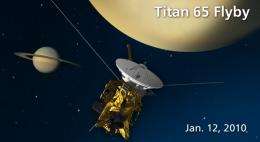
Artist's concept of Cassini's Jan. 12, 2009, flyby of Titan. Image credit: NASA/JPL

(PhysOrg.com) -- NASA'S Cassini spacecraft will return to Titan's southern hemisphere on a flyby tomorrow, Jan. 12, plunging to within about 1,050 kilometers (about 670 miles) of the hazy moon's surface.

During this pass, the onboard radar instrument will scan Ontario Lacus, the largest lake in the southern hemisphere, in a quest to learn more about the and ethane in the lake and obtain more detailed topographical information about the shoreline. Titan is the only other body in the solar system besides Earth that is known to have stable liquid on its surface.

This will also be the most southern pass in the mission for the ion and neutral instrument, which will probe the composition and density of the atmosphere near Titan's south pole. The atmospheric data collected on this pass will be paired with a similar sampling mission near Titan's north pole during the most recent flyby, 16 days earlier.

Cassini last flew by Titan on Dec. 27, 2009 California time, or Dec. 28 Universal Time. Although this latest flyby is dubbed "T65," planning changes early in the orbital tour have made this the 66th targeted flyby of Titan. This flyby also comes two days before the fifth anniversary of the landing of the Huygens probe on the surface of Titan.

The Cassini-Huygens mission is a cooperative project of NASA, the European Space Agency and the Italian Space Agency. JPL, a division of the California Institute of Technology in Pasadena, manages the for NASA's Science Mission Directorate, Washington, D.C. JPL designed, developed and assembled the Cassini orbiter. The Huygens probe, built and managed by the European Space Agency, was bolted to Cassini and rode along during its nearly seven-year journey to Saturn, before being released for its descent through Titan's atmosphere.

Explore further: Dark, massive asteroid to fly by Earth on May 31

add to favorites email to friend print save as pdf

Related Stories

NASA Salutes Successful Huygens Probe

Jan 15, 2005

NASA Administrator Sean O'Keefe today offered congratulations to the European Space Agency (ESA) on the successful touchdown of its Huygens probe on Saturn's moon Titan. The probe entered Titan's upper atmosphere at ...

Cassini Goes On

Aug 24, 2004

The Cassini spacecraft successfully completed a 51-minute engine burn that will raise its next closest approach distance to Saturn by nearly 300,000 kilometers (186,000 miles). The maneuver was necessary to keep the spacec ...

Saturn's Icy Moon Iapetus

Jan 04, 2005

NASA's Cassini spacecraft successfully flew by Saturn's moon Iapetus at a distance of 123,400 kilometers (76,700 miles) on Friday, Dec. 31. NASA's Deep Space Network tracking station in Goldstone, Calif., received ...

Titan's Purple Haze Points to a Fuzzy Past

Aug 02, 2004

Encircled in purple stratospheric haze, Saturn's largest moon, Titan, appears as a softly glowing sphere in this colorized image taken on July 3, 2004, one day after Cassini's first flyby of that moon. Titan ha ...

Cassini Radar Images Sea, Islands and Mountains

May 24, 2007

On May 12, 2007, Cassini completed its 31st flyby of Saturn's moon Titan, which the team calls T30. The radar instrument obtained this image showing the coastline and numerous island groups of a portion of ...

Recommended for you

Dark, massive asteroid to fly by Earth on May 31

8 hours ago

It's 1.7 miles long. Its surface is covered in a sticky black substance similar to the gunk at the bottom of a barbecue. If it impacted Earth it would probably result in global extinction. Good thing it is ...

Research team explains 'Lazarus' comets

12 hours ago

Astronomers from the University of Antioquia have discovered a graveyard of comets. These once-dormant comets, dubbed by astronomers as "The Lazarus comets," are now rejuvenated.

NASA ships sensors for seafaring satellite to France

12 hours ago

(Phys.org) —Three NASA-built instruments that are integral components of the next in a series of U.S./European ocean altimetry satellites have arrived in France for integration with their spacecraft in ...

Trip into space with DiCaprio costs $1.55m

13 hours ago

Leonardo DiCaprio is going to get closer to stars of a different kind as he heads into space aboard the Virgin Galactic, and a well-heeled bidder at the Cannes Film Festival has paid 1.2 million euros (1.5 million) to be ...

User comments : 0

More news stories

Galaxies fed by funnels of fuel

(Phys.org) —Computer simulations of galaxies growing over billions of years have revealed a likely scenario for how they feed: a cosmic version of swirly straws.

Dark, massive asteroid to fly by Earth on May 31

It's 1.7 miles long. Its surface is covered in a sticky black substance similar to the gunk at the bottom of a barbecue. If it impacted Earth it would probably result in global extinction. Good thing it is ...

Source of life running out: water scientists

The majority of people on Earth people will face severe water shortages within a generation or two if pollution and waste continues unabated, scientists warned at a conference in Bonn Friday.

Google eyes emerging markets networks

Google has become deeply involved in a series of projects to build and operate wireless networks in emerging markets including sub-Saharan Africa and Southeast Asia, a report said Friday.