Highlight: Quasi-Crystalline Order at Nanoscale
Jan 11, 2010
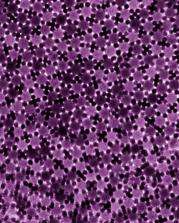
TEM showing the two-dimensional dodecagonal quasi-crystalline structure self-assembled from 5-nm Au and 13.4-nm Fe3O4 nanoparticles.

Nanoparticles have a strong tendency to form periodic structures. Mixing and matching of two different types of nanoparticles allows the formation of binary nanoparticle superlattices isostructural to ionic or intermetallic compounds. In addition to periodic superlattices, binary mixtures of nearly spherical nanoparticles could lead to the growth of quasi-crystals.

CNM staff in the Nanobio Interfaces Group, together with colleagues from the University of Chicago and the University of Pennsylvania, have found that two-dimensional dodecagonal quasi-crystals can be formed in mixtures of 3-nm Pd and 9-nm PbS, 5-nm Au and 13.4-nm Fe2O3, and 4.7-nm Au and 12.6-nm Fe3O4 .

Studies of of quasi-crystalline nanoparticle superstructures will provide insight into the formation of the quasi-crystalline phase in atomic systems. The assembly of the dodecagonal quasi-crystalline phase from different nanoparticle combinations shows that quasi-crystalline ordering can be a quite common phenomenon in nanocrystal solids.

Explore further: Antioxidant with a long shelf life

More information: "Quasi-crystalline order in self-assembled binary nanoparticle superlattices," D. V. Talapin, E. V. Shevchenko, M. I. Bodnarchuk, X. Ye, J. Chen, and C. B. Murray, Nature 461, 964-967 (15 October 2009), doi:10.1038/nature08439

add to favorites email to friend print save as pdf

Related Stories

When Nano May Not Be Nano

Sep 13, 2009

(PhysOrg.com) -- The same properties of nanoparticles that make them so appealing to manufacturers may also have negative effects on the environment and human health. However, little is known which particles ...

Shape matters in the case of cobalt nanoparticles

Jun 17, 2009

Shape is turning out to be a particularly important feature of some commercially important nanoparticles—but in subtle ways. New studies* by scientists at the National Institute for Standards and Technology ...

Recommended for you

Antioxidant with a long shelf life

17 hours ago

(Phys.org) —Scientists from ETH Zurich have developed a nanomaterial that protects other molecules from oxidation. Unlike many such active substances in the past, the ETH-Zurich researchers' antioxidant ...

Fast pollutant degradation by nanosheets

18 hours ago

(Phys.org) —Waste from textile and paint industries often contains organic dyes such as methylene blue as pollutants. Photocatalysis is an efficient means of reducing such pollution, and molybdenum trioxide ...

Unzipped nanotubes unlock potential for batteries

Jun 13, 2013

(Phys.org) —Researchers at Rice University have come up with a new way to boost the efficiency of the ubiquitous lithium ion (LI) battery by employing ribbons of graphene that start as carbon nanotubes.

Nanoparticle opens the door to clean-energy alternatives

Jun 13, 2013

(Phys.org) —Cheaper clean-energy technologies could be made possible thanks to a new discovery. Research team members led by Raymond Schaak, a professor of chemistry at Penn State University, have found ...

User comments : 0

More news stories

A breakthrough in plasmonics

EPFL scientists have discovered how optical signal transmission can be controlled, paving the way for the integration of plasmonics with conventional electronic circuits.

Fast pollutant degradation by nanosheets

(Phys.org) —Waste from textile and paint industries often contains organic dyes such as methylene blue as pollutants. Photocatalysis is an efficient means of reducing such pollution, and molybdenum trioxide ...

Antioxidant with a long shelf life

(Phys.org) —Scientists from ETH Zurich have developed a nanomaterial that protects other molecules from oxidation. Unlike many such active substances in the past, the ETH-Zurich researchers' antioxidant ...

An ultrasensitive molybdenum-based image sensor

A new material has the potential to improve the sensitivity of photographic image sensors by a factor of five. In 2011, an EPFL team led by Andras Kis discovered the amazing semi-conducting properties of ...

New language discovery reveals linguistic insights

A new language has been discovered in a remote Indigenous community in northern Australia that is generated from a unique combination of elements from other languages. Light Warlpiri has been documented by University of Michigan ...