The solution to a 200-year-old encryption
Jan 11, 2010

(PhysOrg.com) -- The mathematician who deciphered the final, encrypted page of a letter sent to President Thomas Jefferson in 1801 will visit the University of Oregon to tell how he did it.

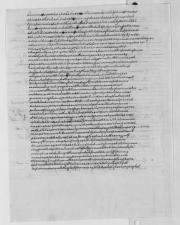
The encrypted page -- a mystery to Jefferson and everyone else -- was solved in 2007 by Smithline, then 36, an expert in code-breaking. He detailed his solution in the American Scientist.

The letter was written by Jefferson's colleague in the American Philosophical Society, Robert Patterson, a math professor at the University of Pennsylvania. The ciphered page was devoid of capital letters or spaces and scrambled in a way that left no readable segments. Preceding pages had described the nature of the code but not the specific key required to unlock this message. The code was unlike any normally used at the time. Patterson predicted it would never be broken.

"This is a fascinating topic for historians as well as puzzle enthusiasts," says UO computer scientist Eugene Luks, who met Smithline in California, where Smithline described his solution to a group of cryptanalysts. "Jefferson, an expert cryptographer himself, was enthusiastic about the code. He recommended that it be used in diplomatic correspondence, but others did not appreciate his warnings about the weakness of the codes they were already using."

The solution involved both linguistic intuition and a to find the digital key. While the required 100,000 calculations would be easy on today's computers, Smithline's method could have been done over time in Patterson's day. In his talk, Smithline will tell how he was pulled into the mystery, how he broke the code and what was written on the page.

Lawren Smithline of the Center for Communications Research in Princeton, N.J., will speak at 4 p.m., Tuesday, Jan. 26, in Room 100 of Willamette Hall, 1371 E. 13th Ave. Admission is free. The talk is part of the Distinguished Lecture Series of the UO's department of computer and and co-sponsored by the math department.

Explore further: Prehistoric rock art maps cosmological belief

Related Stories

Microsoft program will return sound

Aug 13, 2009

Q. I recently removed the Roxio Easy Media Creator program from my Toshiba laptop, but I think the process also removed my system's sound. I've updated the system drivers, but when I check properties for the sound devices, ...

Researcher finds optimal fix-free codes

Apr 03, 2009

(PhysOrg.com) -- More than 50 years after David Huffman developed Huffman coding, an entropy encoding algorithm used for lossless data compression in computer science and information theory, an electrical ...

GSM system about to be compromised

Dec 08, 2009

(PhysOrg.com) -- Research scientists in California and elsewhere are deliberately setting out to compromise the mobile phone system used by around three billion people. The system uses Global System for Mobile ...

Code breakthrough delivers safer computing

Sep 25, 2009

(PhysOrg.com) -- Computer researchers at UNSW and NICTA have achieved a breakthrough in software which will deliver significant increases in security and reliability and has the potential to be a major commercialisation success.

Recommended for you

Prehistoric rock art maps cosmological belief

5 hours ago

It is likely some of the most widespread and oldest art in the United States. Pieces of rock art dot the Appalachian Mountains, and research by University of Tennessee, Knoxville, anthropology professor Jan ...

'Ugly' finding: Unattractive workers suffer more

7 hours ago

People who are considered unattractive are more likely to be belittled and bullied in the workplace, according to a first-of-its-kind study led by a Michigan State University business scholar.

Taking stock of technology

8 hours ago

At the recent Harvard IT Summit, Anne Margulies, vice president and University chief information officer, mentioned how Harvard had been at the forefront of information technology since its inception, even to the point of ...

Gay marriage ruling unlikely to cause anti-gay backlash

9 hours ago

Concerns that a U.S. Supreme Court ruling favorable to gay marriage might produce a backlash that would impede efforts to achieve equality are unfounded, according to a study by researchers at University of California campuses ...

User comments : 0

More news stories

Prehistoric rock art maps cosmological belief

It is likely some of the most widespread and oldest art in the United States. Pieces of rock art dot the Appalachian Mountains, and research by University of Tennessee, Knoxville, anthropology professor Jan ...

'Ugly' finding: Unattractive workers suffer more

People who are considered unattractive are more likely to be belittled and bullied in the workplace, according to a first-of-its-kind study led by a Michigan State University business scholar.

Gay marriage ruling unlikely to cause anti-gay backlash

Concerns that a U.S. Supreme Court ruling favorable to gay marriage might produce a backlash that would impede efforts to achieve equality are unfounded, according to a study by researchers at University of California campuses ...