Coal from mass extinction era linked to lung cancer mystery
Jan 06, 2010
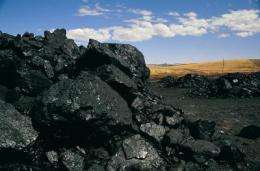
Coal from China's Xuan Wei County, widely used for cooking and heating, may contribute to unusually high rates of lung cancer among women in the region. Credit: US Department of Energy

The volcanic eruptions thought responsible for Earth's largest mass extinction — which killed more than 70 percent of plants and animals 250 million years ago — is still taking lives today. That's the conclusion of a new study showing, for the first time, that the high silica content of coal in one region of China may be interacting with volatile substances in the coal to cause unusually high rates of lung cancer. The study, which helps solve this cancer mystery, appears in ACS' Environmental Science & Technology.

David Large and colleagues note that parts of China's Xuan Wei County in Yunnan Province have the world's highest incidence of in nonsmoking women — 20 times higher than the rest of .

Women in the region heat their homes and cook on open coal-burning stoves that are not vented to the outside. Scientists believe that indoor emissions from burning cause cancer, but are unclear why the lung cancer rates in this region are so much higher than other areas. Earlier studies show a strong link between certain volatile substances, called PAHs, in coal smoke and lung cancer in the region.

The scientists found that coal used in parts of Xuan Wei County had about 10 times more silica, a suspected carcinogen, than U.S. coal. Silica may work in conjunction with PAHs to make the coal more carcinogenic, they indicate. The scientists also found that this high-silica coal was formed 250 million years ago, at a time when massive volcanic eruptions worked to deposit silica in the peat that formed Xuan Wei's coal.

Explore further: Farmers plant rice near crippled Fukushima site

More information: "Silica-Volatile Interaction and the Geological Cause of the Xuan Wei Lung Cancer Epidemic", pubs.acs.org/stoken/presspac/presspac/full/10.1021/es902033j

add to favorites email to friend print save as pdf

Related Stories

European power plants boosting coal use

Apr 24, 2008

High oil and natural gas prices, coupled with increased demand, are driving Europe's return to coal-fired power plants, an industry official says.

Pennsylvania to issue new mercury limits

Feb 22, 2006

The Pennsylvania Department of Environmental Protection reportedly plans to order a substantial cut in toxic mercury emissions from coal-burning plants.

Study: Size of U.S. coal reserves in doubt

Jun 21, 2007

U.S. scientists are calling for increased federal support to obtain a more accurate assessment of the extent and location of the nation's coal reserves.

Recommended for you

Farmers plant rice near crippled Fukushima site

2 hours ago

Farmers have resumed planting rice for market only 15 kilometres (nine miles) from Japan's crippled Fukushima Daiichi nuclear power station, a local official said Wednesday.

Meeting the 'grand challenge' of a sustainable water supply

3 hours ago

Scientists and engineers must join together in a major new effort to educate the public and decision makers on a crisis in providing Earth's people with clean water that looms ahead in the 21st century. That's the focus of ...

Could pond waste be the 'new' fertiliser?

3 hours ago

The University of Stirling is to lead a new project to develop a strategy for using nutrient-rich aquatic biomass waste – from ponds, wetlands and other water-bodies – in farming, as an environmentally ...

Eco database to map landscape projects

4 hours ago

Environmental projects which map some of the most important benefits we get from nature have been brought together for the first time in an online database, following national survey work by researchers in the University ...

Climate change and wildfire: Synthesis of recent findings

20 hours ago

Concerns continue to grow about the effects of climate change on fire. Wildfires are expected to increase 50 percent across the United States under a changing climate, over 100 percent in areas of the West by 2050 as projected ...

User comments : 0

More news stories

Volcanoes cause climate gas concentrations to vary

Trace gases and aerosols are major factors influencing the climate. With the help of highly complex installations, such as MIPAS on board of the ENVISAT satellite, researchers try to better understand the ...

Do songbirds hold key to stuttering?

A tiny Australian songbird may hold the answer to discovering the biological source of stuttering, which affects 3 million Americans and is notoriously difficult to treat.