Scientists Show How Bacteria Move Electrons Across a Membrane
Dec 29, 2009
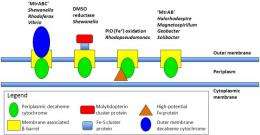
MtrAB homologues in a range of phyla and outer membrane electron transport systems. The ‘MtrAB’ electron transfer module could be a solution to electron exchange across the outer membrane in a range of respiratory systems and bacterial phyla. For example, Shewanella can respire extracellular forms of DMSO by localizing the catalytic subunits (DmsAB) to the outside of the cell. The genes encoding the catalytic subunits cluster with dmsE and dmsF that encode homologues of MtrA and MtrB, suggesting a similar mechanism for moving electrons across the outer membrane. Homologues of MtrA and MtrB (PioA and PioB) are also associated with phototropic Fe(II) oxidation in Rhodopseudomonas palustris. In this case, electrons could be moving into the cell from extracellular Fe(II).

(PhysOrg.com) -- Scientists at the University of East Anglia, Pacific Northwest National Laboratory, and Pennsylvania State University have demonstrated for the first time the mechanism by which some bacteria can transfer electrons across a membrane to the cell exterior, allowing them to "breathe" metals. These iron-respiring bacteria link the cycling of iron and carbon in subsurface and surface sediments and can catalyze the immobilization of subsurface contaminants such as uranium.

In an article published in , the researchers described the protein complex -- and its electrochemical properties -- from Shewanella oneidensis, a bacterium renowned for its diverse metabolism and ability to immobilize certain radioactive contaminants. This research demonstrated a novel outer membrane-spanning electron transfer system that enables the proteins MtrA (inward facing) and MtrC (outward facing) to embed sufficiently within a third transmembrane protein, MtrB, to allow electron transfer to take place between them.

"This is an exciting advance in our understanding of bacterial processes in the Earth's subsurfaces," said Dr. David Richardson, of UEA's School of Biological Sciences, who is leading this research effort.

Iron respiration is one of the most ancient respiratory processes for microorganisms. It is among the most common in oxygen-free habitats and therefore has wide environmental significance. In species of Shewanella and other metal-reducing bacteria, some electron transfer proteins, called cytochromes, are positioned at the extracellular face of the bacterium's outer membrane where they can interact with insoluble substrates such as iron oxides. To transfer electrons onto these substrates to gain energy for growth and metabolism, these proteins must be charged by the cell's electron transfer system much of which resides at the inner membrane.

The electron transfer reaction results in an change (reduction) in electron acceptors such as iron minerals that are external to the cell. The electron delivery to these proteins requires that electrons originating from the inner membrane be transferred across the outer membrane. The biochemical basis for this has not previously been understood.

The research team used proteoliposomes—lipid vesicles containing proteins—and the redox dye methyl viologen to demonstrate electron transfer across a membrane. They then used protein film voltammetry to measure the electrochemical properties of the proteins, individually and as a complex.

"We discovered that the bacteria can construct tiny biological wires that extend through the cell walls and allow the organism to directly contact, and conduct electrons to, a mineral," said Richardson. "This means that the bacteria can release electrical charge originating from inside the cell to materials such as iron minerals, much like the ground wire on a household plug."

According to the PNNL team, this is the first demonstration of protein complex that catalyzes such an important reaction. The authors also noted that similar MtrA-MtrB modules are present in many other types of bacteria, possibly for different reactions that require electron transfer to, or possibly from, the cell surface.

The next steps in this research involve obtaining high-resolution structures for each of the proteins as well as the entire complex to use the structural information in concert with protein interaction data to establish precisely how electrons enter, traverse, and then exit the protein complex. The discovery and functional understanding of protein modules capable of electron transfer across membranes may also be of use in synthetic biology; for example, in bioenergy applications.

Explore further: Attacking MRSA with metals from antibacterial clays

More information: Hartshorne RS, CL Reardon, DE Ross, J Nuester, TA Clarke, AJ Gates, PC Mills, JK Fredrickson, JM Zachara, L Shi, AS Beliaev, MJ Marshall, M Tien, SL Brantley, JN Butt, and D Richardson. 2009. "Characterization of an electron conduit between bacteria and the extracellular environment." Proceedings of the National Academy of Sciences of the United States of America 106 (52):22169-22174.

add to favorites email to friend print save as pdf

Related Stories

Biological electron transfer captured in real time

Mar 03, 2008

Two research teams led by Dr. Michael Verkhovsky and Prof. Mårten Wikström of the Institute of Biotechnology of the University of Helsinki have for the first time succeeded in monitoring electron transfer by Complex I in ...

Progress Toward a Biological Fuel Cell?

Dec 30, 2008

(PhysOrg.com) -- Biological fuel cells use enzymes or whole microorganisms as biocatalysts for the direct conversion of chemical energy to electrical energy. One type of microbial fuel cell uses anodes (positive electrodes) ...

Recommended for you

Attacking MRSA with metals from antibacterial clays

15 hours ago

In the race to protect society from infectious microbes, the bugs are outrunning us. The need for new therapeutic agents is acute, given the emergence of novel pathogens as well as old foes bearing heightened antibiotic resistance.

Keeping fruit, vegetables and cut flowers fresh longer

May 15, 2013

New technology offers the promise of reducing billions of dollars of losses that occur each year from the silent, invisible killer of fruits, vegetables and cut flowers—a gas whose effects are familiar to everyone who has ...

Why don't beetles freeze in the winter?

May 14, 2013

For 37 years, Queen's University Biochemistry professor Peter Davies has been unraveling the mystery of why some organisms including insects and fish don't freeze in the winter. His research into insect antifreeze protein ...

The molecular basis of strawberry aroma

May 13, 2013

You know that summer is here when juicy red strawberries start to appear on the shelves. In Germany, this seasonal fruit has never been more popular: on average 3.5 kilos per head were consumed in 2012—a ...

A new dimension for 3-D protein structures

May 13, 2013

(Phys.org) —3D structures of biological molecules like proteins directly affect the way they behave in our bodies. EPFL scientists have developed a new infrared-UV laser method to more accurately determine ...

User comments : 0

More news stories

Attacking MRSA with metals from antibacterial clays

In the race to protect society from infectious microbes, the bugs are outrunning us. The need for new therapeutic agents is acute, given the emergence of novel pathogens as well as old foes bearing heightened antibiotic resistance.

Beautiful 'flowers' self-assemble in a beaker

By simply manipulating chemical gradients in a beaker of fluid, materials scientists at Harvard have found that they can control the growth behavior of crystals to create precisely tailored structures—such ...

Making gold green: New non-toxic method for mining gold

Northwestern University scientists have struck gold in the laboratory. They have discovered an inexpensive and environmentally benign method that uses simple cornstarch—instead of cyanide—to isolate gold from raw materials ...

US seizes Bitcoin operator accounts

US authorities seized the accounts of a Bitcoin digital currency exchange operator, claiming it was functioning as an "unlicensed money service business," court documents showed Friday.

Alaska volcano shoots ash 15,000 feet into the air

(AP)—One of Alaska's most restless volcanoes has shot an ash cloud 15,000 feet into the air in an ongoing eruption that has drawn attention from a nearby community but isn't expected to threaten air traffic.

Chinese, Indian airlines face EU pollution fines

Eight Chinese and two Indian airlines face fines of up to several million euros for not paying for their greenhouse gas emissions during flights within the bloc, the European Commission said on Friday.