Highlight: California, Nevada Lakes Warming Rapidly
Dec 21, 2009
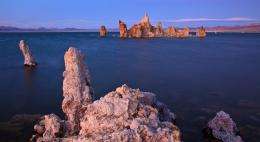
California's Mono Lake was one of the six lakes included in a new study of warming in large lakes in California and Nevada. Image credit: Philipp Schneider

(PhysOrg.com) -- A new JPL study examines the impact recent variability in climate is having on the surface temperatures of large lakes in California and Nevada.

Recent climate variability is causing a number of large lakes in California and Nevada to warm rapidly, according to a new NASA study.

Thermal infrared imagery from NASA's on board NASA’s Terra and Aqua satellites and from the European Space Agency's series of Along-Track Scanning Radiometers were used to quantify changes in the thermal behavior of six large lakes in California and Nevada (Lake Tahoe, Mono Lake, Pyramid Lake, Walker Lake, Lake Almanor, and Clear Lake).
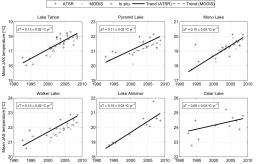
Satellite-derived annual average lake surface temperatures of the July/August/September period for the six study sites. Trend lines were computed separately for each sensor series using weighted linear regression. Image credit: NASA/JPL

The results found that between 1992 and 2008, the average nighttime temperatures of these lakes during the months of July, August and September increased at an average rate of 0.11 Kelvin (0.2 degrees Fahrenheit) per year. Results were validated against direct, ground measurements made at Lake Tahoe, on the California/Nevada border. Such rapid warming is expected to have a significant impact on ecosystems.

Explore further: Astonishing hi-resolution satellite views of the destruction from the Moore, Oklahoma tornado

More information: Satellite observations indicate rapid warming trend for lakes in California and Nevada, Geophys. Res. Lett., 36, L22402, doi:10.1029/2009GL040846

add to favorites email to friend print save as pdf

Related Stories

Lake Research That Isn't All Wet

Oct 02, 2009

(PhysOrg.com) -- The federal government may not have been able to save California from massive budget cuts, but at least a stimulus research grant will help scientists understand the biology of western lakes.

Lake Tahoe Clarity Holds Steady in 2005

Aug 09, 2006

The waters of Lake Tahoe were clear to an average depth of 72.4 feet in 2005, according to UC Davis scientists who have monitored the lake since 1968. That keeps the clarity measurement in the range where it ...

Recommended for you

Strong earthquake at exceptional depth

21 hours ago

This morning at 05:45 CEST, the earth trembled beneath the Okhotsk Sea in the Pacific Northwest. The quake, with a magnitude of 8.2, took place at an exceptional depth of 605 kilometers. Because of the great ...

Marine forecasting on the horizon for Indian Ocean Rim

21 hours ago

Nearly all of the member countries of the Indian Ocean Rim Association for Regional Cooperation (IOR-ARC) will attend the week-long workshop to further cooperation and understanding on international ocean ...

Russia evacuates drifting Arctic research station

May 23, 2013

Russia has ordered the urgent evacuation of the 16-strong crew of a drifting Arctic research station after ice floe that hosts the floating laboratory began to disintegrate, officials said Thursday.

User comments : 8

Adjust slider to filter visible comments by rank

Display comments: newest first

VeIanarris
1 / 5 (6) Dec 22, 2009
It's the UHI causing the warming!Don't scientists ever learn
Phelankell
3 / 5 (6) Dec 22, 2009
There's a reason why the southwest had to be irrigated to be a viable living space.
MikeyK_PaidAdvocate
1 / 5 (2) Dec 22, 2009
It's the UHI causing the warming!Don't scientists ever learn

You're absolutely wrong, don't you understand that oceanic acidity is causing melting of the equatorial ice flows which will in turn inundate us all with acidic endangered species?

There I got all 4 of them in. I should get a bonus from Al for this post.
Shootist
1 / 5 (1) Dec 22, 2009
"Highlight: California, Nevada Lakes Warming Rapidly"

Have the dairy farms returned to Greenland? The vineyards to Scotland?

No? It still isn't warm enough.
operator
1 / 5 (1) Dec 28, 2009
shootist, warm enough for what? for whom?

you do understand ecological niches?
you understand evolution?
you understand adaptation to environmental stimulus?

you understand that ecosystems have become adapted to their present states by a slow process, yes, and that when the climate changes beyond their capacity to adapt or migrate then they die and if its wdiespread enough then the species goes extinct.
your lifestyle is based on a complex interplay of ecosystems and how that and the reources we extract from the earth sustain us and when this life supoorting system goes into dramtic change the we as a species also have to dramtically change.
Phelankell
not rated yet Dec 28, 2009
you understand that ecosystems have become adapted to their present states by a slow process, yes, and that when the climate changes beyond their capacity to adapt or migrate then they die and if its wdiespread enough then the species goes extinct.


I'm guessing you're too young to remember all the outcry about the armadillo's habitat vanishing due to global cooling in the 70's.

Still see a bunch of them in the south, they seem rather unaffected.
operator
1 / 5 (1) Dec 28, 2009
phelankell- and what has this got to do with species range migration or adaption in the face of a changing variable climate. the subject of this particular study is about measured change. although lake ecosystems by their nature have little scope for migration, the state of the lakes also has more relevance then just the ecosystems found there but also the source of water they provide.
Phelankell
not rated yet Dec 28, 2009
and what has this got to do with species range migration or adaption in the face of a changing variable climate.


It would have everything to do with species range migration and variable climate. Do some cursory research. Your present state of alarm is old hat.

More news stories

Galaxies fed by funnels of fuel

(Phys.org) —Computer simulations of galaxies growing over billions of years have revealed a likely scenario for how they feed: a cosmic version of swirly straws.

Source of life running out: water scientists

The majority of people on Earth people will face severe water shortages within a generation or two if pollution and waste continues unabated, scientists warned at a conference in Bonn Friday.

Dark, massive asteroid to fly by Earth on May 31

It's 1.7 miles long. Its surface is covered in a sticky black substance similar to the gunk at the bottom of a barbecue. If it impacted Earth it would probably result in global extinction. Good thing it is ...

Drones may violate international law

(Phys.org) —As President Obama gives a speech on national security—including defending U.S. use of drones to combat terrorism—Leila Sadat, JD, international law expert and professor of law at Washington University in ...