Organic flash memory developed

Dec 17, 2009 by Lin Edwards weblog
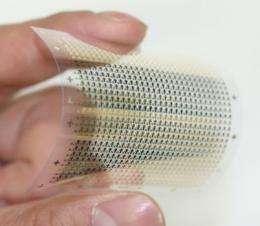
The polyethylene naphthalate resin sheet with a memory array.

(PhysOrg.com) -- Researchers at the University of Tokyo have developed a non-volatile memory that has the same basic structure as a flash memory but is made from cheap, flexible, organic materials.

Flash memory devices store data electrically in silicon transistors. The information can be written and read quickly and is retained in memory even when power is removed. This makes flash memory useful for devices such as cameras, USB drives, and MP3 players. If a flexible flash memory can be developed it could find application in large-area devices such as large area sensors, displays, or actuators with flash memory built-in.

The organic flash memory was developed by a team of scientists led by Professor Takeo Someya, of the Department of Engineering and Information Systems at the University of Tokyo. The device uses an array of 26 x 26 memory cells on a plastic polyethylene naphthalate (PEN) resin sheet substrate that is flexible enough to be curved to a radius of only 6 mm without causing electrical or mechanical problems.

The device is called an organic flash memory device because it has the same kind of floating-gate transistors as those used for silicon-based flash memories. A floating gate is a component of the transistor that is fully enclosed by a thin insulating material called a gate dielectric, which isolates it electrically and allows it to retain its charge for years (in silicon devices). If a large voltage is applied an electronic charge can be brought on to the floating gate and it remains there until the charge is erased when a voltage of opposite polarity is applied.

Professor Someya said the challenge for an organic memory device is finding a suitable insulating material to electrically isolate the floating gate in which the charges are stored. The layer has to be thin enough to allow charge to be transferred to the floating gate but must not melt during assembly. The insulating layer prevents the electrons leaking away and consequent degradation of the data.

The insulating film was made using a two nanometer thick self-assembled monolayer (SAM) and a four nanometer layer of aluminum oxide formed by oxidizing the surface of the aluminum floating gate.

The erasing voltage of the memory is around 6V, while the reading voltage is only 1 V, and these voltages are considerably lower than those of organic memories developed previously. Data can be written to and erased from the memory over one thousand times, which is much less than the 100,000 times for silicon .

The organic flash memory's disadvantage is its short memory retention time of just 24 hours, but the researchers think this could be improved by using a SAM with a longer molecular length, and reducing the size of the transistors.

The results of the research were published in the December 11 issue of the journal Science.

Explore further: Germany must spread cost of energy shift fairly: IEA

More information: Organic Nonvolatile Memory Transistors for Flexible Sensor Arrays, Tsuyoshi Sekitani et al., Science 11 December 2009:
Vol. 326. no. 5959, pp. 1516 - 1519; DOI: 10.1126/science.1179963

add to favorites email to friend print save as pdf

Related Stories

Carbon Nanotubes with a Memory

Apr 03, 2006

Carbon nanotubes have successfully been made into a variety of nanoscale circuit components, including transistors, inverters, and switches. Now, a pair of scientists has made a rough, yet promising, flash ...

Samsung Develops 40nm 32 Gb NAND Flash

Sep 11, 2006

Samsung Electronics today announced that it has developed the industry’s first 40-nanometer memory device. The new 32 Gigabit (Gb) NAND flash device is the first memory to incorporate a Charge Trap Flash ...

Recommended for you

Drones may violate international law

5 minutes ago

(Phys.org) —As President Obama gives a speech on national security—including defending U.S. use of drones to combat terrorism—Leila Sadat, JD, international law expert and professor of law at Washington University in ...

The long road to the 2000-watt society

39 minutes ago

The vision of a society in which each inhabitant of the earth manages to consume only 2000 watts has already been around for 15 years. During this time, there has been a steady increase in environmental awareness ...

Sensitive bomb detector to rove in search of danger

1 hour ago

European researchers have developed and tested a light-weight device capable of detecting extremely minute quantities of explosives from up to 20 metres away, providing an invaluable law-enforcement tool ...

Germany must spread cost of energy shift fairly: IEA

2 hours ago

The International Energy Agency said Friday that Germany must shield its consumers from paying too much of the cost of its ambitious switch from nuclear power and fossil fuels toward renewable energy.

US panel rejects Motorola bid to block Xbox imports

2 hours ago

The US International Trade Commission sided with Microsoft in a patent dispute with Google-owned Motorola Mobility that could have led to Xbox 360 videogame consoles being banned from import.

Pandora posts in-line 1Q loss, upbeat sales

14 hours ago

(AP)—Internet radio company Pandora reported higher-than-expected revenue in the latest quarter, with losses in line with analysts' forecasts, as the number of subscribers who pay for ad-free listening rose above 2.5 million.

User comments : 3

Adjust slider to filter visible comments by rank

Display comments: newest first

wiyosaya
5 / 5 (1) Dec 17, 2009
Though there is no mention of memory density (is 26 x 26 array supposed to mean a density of 676 bits??) and the lifetime is short, for an initial prototype, to me, this is an interesting development.

I'll keep an eye out for future devices. Right now, it sounds like this incarnation would not be commercializeable.
Parsec
not rated yet Dec 17, 2009
Dynamic memory has a retention time on the order of a few milliseconds or less. The memory is maintained by constantly reading it out and writing it back in. Obviously, this wouldn't work for the memory under discussion unless the rewrite was essentially infinite (which it is for dynamic memory). However, if the retention time was on the order of a few weeks or months, and it could be rewritten say 10,000 times, a refresh mechanism could still be used and the memory could be quite useful for all kinds of applications where speed and density are much less important than its physical characteristics.

I find this a very intriguing development and applaud the researchers for a very important first step.
Magnator
not rated yet Dec 19, 2009
Nice, I hope they improve their experiment and create a new tech for us all.

More news stories

The long road to the 2000-watt society

The vision of a society in which each inhabitant of the earth manages to consume only 2000 watts has already been around for 15 years. During this time, there has been a steady increase in environmental awareness ...

Sensitive bomb detector to rove in search of danger

European researchers have developed and tested a light-weight device capable of detecting extremely minute quantities of explosives from up to 20 metres away, providing an invaluable law-enforcement tool ...