A New View of Coronal Waves
Dec 11, 2009
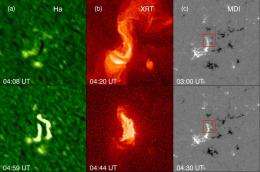
Images of a solar eruption, each seen before and after the event, in three ways: optical light, X-ray emission, and in the magnetic field strength. Credit: NASA, YNAO, HINODE, and SOHO

(PhysOrg.com) -- The corona is the hot outer region of the sun's atmosphere. The corona is threaded by magnetic fields that loop and twist upwards from the sun's surface, driven by motions of its dense atmosphere.

When one of these magnetic loops snaps open, it can produce a mass ejection and a flare whose X-rays and ejected particles can disrupt communications on earth. It has been known for about fifteen years that there are roughly circular waves rippling through the corona on a scale that spans the entire solar disk. The possible relationship between these waves and solar eruptions or other active phenomena is an active area of research because of the interest in being able to predict solar storm activity.

Coronal waves are suspected of having significant depth into the , but observations from a single orbiting telescope only obtain a two-dimensional picture of wave activity. In 2006, NASA launched the STEREO mission: two identical satellites but in different orbits, to study the three-dimensional structure of solar eruptions.

CfA astronomers Suli Ma, Meredith Wills-Davey, Ting Lin, Gemma Attrill, and Leon Golub used STEREO, together with other sun-observing spacecraft, to investigate the 3-D behavior of coronal waves. In a paper appearing in this week's , they present their analysis of a wave that appeared two years ago, on December 7, 2007, and that produced an eruption and ejection a few minutes later.

The ultraviolet images of the coronal wave obtained from each STEREO satellite are quite different at the start of the observations, but look more and more alike with time. By considering projection effects and the physics of coronal ejections, the scientists conclude that the three-dimensional structure of the waves can significantly influence their observed physical properties.

Provided by Harvard-Smithsonian Center for Astrophysics (news : web)

Explore further: Galaxy's Ring of Fire

add to favorites email to friend print save as pdf

Related Stories

NASA releases first 3-D images of the sun from STEREO

Apr 23, 2007

NASA's twin Solar Terrestrial Relations Observatory (STEREO) spacecraft have made the first three-dimensional images of the sun. The new view will greatly aid scientists' ability to understand solar physics ...

The Sun's X-file under the Spotlight

Sep 03, 2004

One of the Sun's greatest mysteries is about to be unravelled by UK solar astrophysicists hosting a major international workshop at the University of St Andrews from September 6-9th 2004. For years scientists have been baffled ...

Hinode's X-Ray Telescope Reveals the Sun's Secrets

Mar 21, 2007

Even though the sun is the closest star to Earth and has been studied for hundreds of years, it still holds surprises. The recently launched Hinode spacecraft is one of the latest observatories to probe the ...

The Spooky Sun

Oct 31, 2006

Just in time for Halloween, astronomers have taken a haunting new portrait of the sun. In this color-coded image from the Hinode spacecraft (formerly Solar-B), the sun glows eerily orange as though celebrating ...

Scientists find elusive waves in sun's corona

Aug 30, 2007

Scientists for the first time have observed elusive oscillations in the Sun's corona, known as Alfvén waves, that transport energy outward from the surface of the Sun. The discovery is expected to give researchers ...

SECCHI team obtains images of the solar wind at Earth

Dec 07, 2007

Using the Sun Earth Connection Coronal and Heliospheric Investigation (SECCHI) instruments on board NASA’s Solar Terrestrial Relations Observatory (STEREO) spacecraft, a consortium of scientists has seen, for the first ...

Recommended for you

Galaxy's Ring of Fire

May 18, 2013

Johnny Cash may have preferred this galaxy's burning ring of fire to the one he sang about falling into in his popular song. The "starburst ring" seen at center in red and yellow hues is not the product of ...

4C+29.30: Black hole powered jets plow into galaxy

May 15, 2013

(Phys.org) —This composite image of a galaxy illustrates how the intense gravity of a supermassive black hole can be tapped to generate immense power. The image contains X-ray data from NASA's Chandra X-ray ...

A space-time magnifying glass

May 15, 2013

(Phys.org) —Bright arcs are smeared around the heart of galaxy cluster Abell S1077 in this image taken by the NASA/ESA Hubble space telescope. The arcs are stretched images of distant galaxies distorted ...

User comments : 1

Adjust slider to filter visible comments by rank

Display comments: newest first

omatumr
1 / 5 (1) Dec 11, 2009
Congratulations on an important study.

Although the Coronal waves may only start at significant depths in the atmosphere, the magnetic fields themselves likely arise from far greater depths - near the solar core.

With kind regards,
Oliver K. Manuel

More news stories

Heat-related deaths in Manhattan projected to rise

Residents of Manhattan will not just sweat harder from rising temperatures in the future, says a new study; many may die. Researchers say deaths linked to warming climate may rise some 20 percent by the 2020s, ...

Mice, gerbils perish in Russia space flight

A number of mice and eight gerbils sent into space in a Russian capsule destined to find out how well organisms can withstand extended flights perished during their journey, scientists said Sunday as the ...

Kinks and curves at the nanoscale

One of the basic principles of nanotechnology is that when you make things extremely small—one nanometer is about five atoms wide, 100,000 times smaller than the diameter of a human hair—they are going ...

Honeybees trained in Croatia to find land mines

(AP)—Mirjana Filipovic is still haunted by the land mine blast that killed her boyfriend and blew off her left leg while on a fishing trip nearly a decade ago. It happened in a field that was supposedly ...