Atomic-level Snapshot Catches Protein Motor in Action (w/ Video)
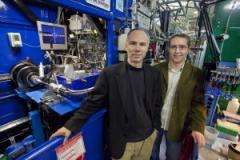
(PhysOrg.com) -- The atomic-level action of a remarkable class of ring-shaped protein motors has been uncovered by researchers with the Lawrence Berkeley National Laboratory using a state-of-the-art protein crystallography beamline at the Advanced Light Source (ALS). These protein motors play pivotal roles in gene expression and replication, and are vital to the survival of all biological cells, as well as infectious agents, such as the human papillomavirus, which has been linked to cervical cancer.
James Berger, a biochemist and structural biologist who holds joint appointments with Berkeley Lab’s Physical Biosciences Division and University of California Berkeley’s Department of Molecular and Cell Biology, and Nathan Thomsen, a graduate student in his research group, have captured a critical action shapshot of an enzyme known as the Rho transcription termination factor. In bacteria, the Rho motor protein binds to a specific region of messenger RNA and translocates along the chain to selectively terminate transcription at discrete points along the genome.
“We have shown that the Escherichia coli Rho transcription termination factor functions like a rotary engine, much like the motors found on certain classes of propeller airplanes,” says Berger. “As the motor spins, fueled by the chemical energy in ATP nucleotides, it pulls RNA strands through it’s interior, an action that enables Rho to walk along RNA chains. Interestingly, the rotary firing order of the motor is biased so that the Rho protein can walk in only one direction along the RNA chain.”
Berger and Thomsen are the co-authors of a paper reporting the results this research that has been published in the journal Cell. The paper is titled: “Running in reverse: the structural basis for translocation polarity in hexameric helicases.”
The Rho factor is a member of the hexameric helicase superfamily of enzymes - ring-shaped proteins made up of six independent subunits or “cylinders.” Hexameric helicases are found in all organisms and are involved in unwinding and moving DNA and RNA strands around the cell. There are two subfamilies of hexameric helicase enzymes: AAA+ and RecA. Rho belongs to the RecA family, which is most common in bacteria. AAA+ motors are predominantly found in eukaryotes, including humans, as well as some human pathogens, such as the papillomavirus. These motors are descended from a common ancestor far back in evolution, but have distinct properties, most notably they walk along nucleic acid tracks in opposite directions. Scientists have wanted to know why the biased movement of these motors differs, Berger explains.
“If you want to understand how an enzyme works, and perhaps eventually develop therapeutic drug that will gum up the works and stop the motor from doing its job, it helps to know what the motor looks like,” he says. “We are the first group to determine the crystal structure of a RecA class of hexamer helicase in a translocation state bound to both its nucleic acid track and ATP. In doing so, we fortuitously caught the motor in the act of tracking along an RNA chain.”
Berger and Thomsen solved the structure of this Rho protein motor using the protein crystallography capabilities of ALS Beamline 8.3.1. The ALS is an electron synchrotron designed to accelerate electrons to energies of nearly two billion electron volts (GeV) and focus them into a tight beam around a storage ring. Beams of ultraviolet and x-ray light are extracted from this electron beam through the use of either bending, wiggler or undulator magnetic devices. These light beams are a hundred million times brighter than those from the best x-ray tubes. ALS Beamline 8.3.1 is powered by a superconducting bend magnet, or “superbend,” and has experimental facilities that offer both multiple-wavelength anomalous diffraction (MAD) and monochromatic protein crystallography capabilities.
“The high brightness of the x-ray beams and the experimental capabilities at Beamline 8.3.1 were critical to our success,” says Berger, one of the scientific spokespersons for the beamline.
What Berger and Thomsen found from their structural studies was that nucleic-acid binding elements in the interior of the Rho ring spiral around six bases of RNA. When the ATP binding sites that are coupled to this RNA segment release their chemical energy through hydrolysis of the nucleotide, they do so in a sequential manner that propagates around the hexameric ring. This chemical energy is converted into mechanical motion that dictates the rotational direction of the Rho motor based on the firing order of the ATP sites.
“Think of it like the cylinders in a radial engine,” Berger says. “The fuel and intake come in from one side, leading to motions that cause the cylinders to spin around a central RNA camshaft. However, because the cylinders actually lie out of plane, they walk along the camshaft as they move.”
In their study, Berger and Thomsen found that nature has evolved a similar rotary mechanism for the papillomavirus E1 protein, an AAA+ family hexameric helicase. Their analysis showed that E1 motor moves in the opposite direction along a nucleic chain because the rotational firing order of ATP sites is actually reversed. Determining the molecular structure of protein motors and learning how they operate is critical not only to basic understanding of the molecular principles that control the cell, but also to aiding pharmaceutical drug discovery efforts.
“DNA and RNA are large and cumbersome macromolecular polymers which present a challenge to the molecular machines that need to access their genetic information,” says Berger. “There have been two other proposed models for these protein motors in addition to the rotary, one a type of putt-putt motor, in which all the active binding elements hydrolyze ATP simultaneously, and the other a stochastic model, whereby ATP sites are fired at random. We’ve shown that RecA-style motors use the rotary model.”
Provided by Lawrence Berkeley National Laboratory (news : web)


