UCSB physicists move one step closer to quantum computing
Nov 20, 2009
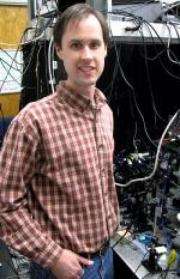
This is postdoctoral researcher Greg Fuchs in the lab of UCSB's Center for Spintronics and Quantum Computation. Credit: George Foulsham, Office of Public Affairs

Physicists at UC Santa Barbara have made an important advance in electrically controlling quantum states of electrons, a step that could help in the development of quantum computing. The work is published online today on the Science Express Web site.

The researchers have demonstrated the ability to electrically manipulate, at gigahertz rates, the quantum states of electrons trapped on individual defects in diamond crystals. This could aid in the development of quantum computers that could use electron spins to perform computations at unprecedented speed.

Using electromagnetic waveguides on diamond-based chips, the researchers were able to generate magnetic fields large enough to change the quantum state of an atomic-scale defect in less than one billionth of a second. The microwave techniques used in the experiment are analogous to those that underlie (MRI) technology.

The key achievement in the current work is that it gives a new perspective on how such resonant manipulation can be performed. "We set out to see if there is a practical limit to how fast we can manipulate these quantum states in diamond," said lead author Greg Fuchs, a postdoctoral researcher at UCSB. "Eventually, we reached the point where the standard assumptions of magnetic resonance no longer hold, but to our surprise we found that we actually gained an increase in operation speed by breaking the conventional assumptions."

While these results are unlikely to change MRI technology, they do offer hope for the nascent field of quantum computing. In this field, individual quantum states take on the role that transistors perform in classical computing.

"From an information technology standpoint, there is still a lot to learn about controlling quantum systems," said David Awschalom, principal investigator and professor of physics, electrical and computer engineering at UCSB. "Still, it's exciting to stand back and realize that we can already electrically control the of just a few atoms at gigahertz rates -- speeds comparable to what you might find in your computer at home."

More information: Gigahertz Dynamics of a Strongly Driven Single Quantum Spin, www.sciencemag.org/cgi/content/abstract/science.1181193

Source: University of California - Santa Barbara (news : web)

Explore further: A quantum simulator for magnetic materials

add to favorites email to friend print save as pdf

Related Stories

Physicists Bring Quantum Computing Closer to Reality

Mar 20, 2008

Researchers at the U. S. Department of Energy’s Ames Laboratory, the University of California, Santa Barbara, and Microsoft Station Q have made significant advancements in understanding a fundamental problem ...

Researchers light up 'dark' spins in diamond

Oct 27, 2005

Discovery could lead to room temperature quantum computing Researchers at UC Santa Barbara have potentially opened up a new avenue toward room temperature quantum information processing. By demonstrating the ability to image ...

Quantum computing: No turning back

Mar 15, 2005

The first realizations of 'cluster states' and cluster-state quantum computation are reported in Nature this week (10 March issue, pp169-176). This represents a significant move from theory to reality for an alternative approa ...

Fast quantum computer building block created

Aug 20, 2008

(PhysOrg.com) -- The fastest quantum computer bit that exploits the main advantage of the qubit over the conventional bit has been demonstrated by researchers at University of Michigan, U.S. Naval Research Laboratory and ...

Recommended for you

A quantum simulator for magnetic materials

17 hours ago

Physicists understand perfectly well why a fridge magnet sticks to certain metallic surfaces. But there are more exotic forms of magnetism whose properties remain unclear, despite decades of intense research. ...

Researchers forward quest for quantum computing

23 hours ago

Research teams from UW-Milwaukee and the University of York investigating the properties of ultra-thin films of new materials are helping bring quantum computing one step closer to reality.

Hydrogen atoms under the magnifying glass

May 22, 2013

To describe the microscopic properties of matter and its interaction with the external world, quantum mechanics uses wave functions, whose structure and time dependence is governed by the Schrödinger equation. ...

Making quantum encryption practical

May 21, 2013

One of the many promising applications of quantum mechanics in the information sciences is quantum key distribution (QKD), in which the counterintuitive behavior of quantum particles guarantees that no one can eavesdrop on ...

Lab sets a new record for creating heralded photons

May 20, 2013

(Phys.org) —Entanglement, by general consensus of physicists, is the weirdest part of quantum science. To say that two particles, A and B, are entangled means that they are actually two parts of an inseparable ...

Competition in the quantum world

May 20, 2013

Innsbruck physicists led by Rainer Blatt and Peter Zoller experimentally gained a deep insight into the nature of quantum mechanical phase transitions. They are the first scientists that simulated the competition ...

User comments : 0

More news stories

Spheres can form squares

Everybody who has tried to stack oranges in a box knows that a regular packing of spheres in a flat layer naturally leads to a hexagonal pattern, where each sphere is surrounded by six neighbours in a honeycomb-like ...

A quantum simulator for magnetic materials

Physicists understand perfectly well why a fridge magnet sticks to certain metallic surfaces. But there are more exotic forms of magnetism whose properties remain unclear, despite decades of intense research. ...

Engineers pioneer flat spray-on optical lens

A University of British Columbia engineer and a team of U.S. researchers have made a breakthrough utilizing spray-on technology that could revolutionize the way optical lenses are made and used.

Researchers forward quest for quantum computing

Research teams from UW-Milwaukee and the University of York investigating the properties of ultra-thin films of new materials are helping bring quantum computing one step closer to reality.

The long road to the 2000-watt society

The vision of a society in which each inhabitant of the earth manages to consume only 2000 watts has already been around for 15 years. During this time, there has been a steady increase in environmental awareness ...