Cyber laws must punish individuals not society: specialist
Nov 17, 2009
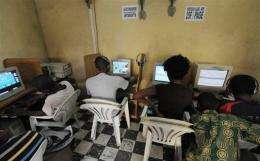
Young people browse the Internet in a cybercafe in Abidjan in August 2009. Laws regulating cybercrimes must target individuals and not society as a whole, an IT specialist told an Internet governance forum at the Egyptian resort of Sharm el-Sheikh on Tuesday.

Laws regulating cybercrimes must target individuals and not society as a whole, an IT specialist told an Internet governance forum at the Egyptian resort of Sharm el-Sheikh on Tuesday.

Gisele Da Silva Craveiro from the University of Sao Paolo in Brazil said the broad nature of cyberlegislation leaves it open to abuse by authorities.

"Definitions for cybercrimes can be so broad as to fit everything... leaving the laws open to inappropriate use by authorities such as monitoring citizens," Craveiro told AFP on the sidelines of the Fourth Meeting of the Internet Governance Forum in Egypt.

"Technicians need to communicate with lawyers to come up with more efficient legislation so that society doesn't end up paying the price for too broad a legislation," she said.

Craveiro was speaking at a session entitled Developing Comprehensive Cybercrime Legislation organised by the Council of Europe at the Red Sea meeting.

"Legal frameworks should take into acount the rights of users and the role of the private sector on the one hand, and security concerns on the other," the Council of Europe said in a statement.

While broad can mean the potential for misuse, targeting specific offences means having to regularly update laws to catch up with the meteoric evolution of cybercrimes, some said.

"You need to have a mix and match addressing specific offences but also taking into account new technologies and cybercrimes," said Pavan Duggal, Chairman of Cyber Law and IT Act. Committee in India, where data theft and unauthorised data use is posing the biggest challenge in cyberspace.

The Council of Europe Convention on Cybercrime is currently the only binding legal document designed to criminalise computer-related offences, content-related offences and offences relating to infringement of copyright and associated rights.

The IGF forum in Egypt has grouped more than 1,500 representatives of government, civil society, advocacy groups and the private sector from more than 100 countries to discuss the future of the Internet.

(c) 2009 AFP

Explore further: Internet in 'coma' as Iran election looms

add to favorites email to friend print save as pdf

Related Stories

Legislation restricting Internet access

Aug 15, 2009

Laws aimed at tackling illegal use of wireless internet connections are restricting attempts to increase broadband access, according to research published today.

Microsoft calls for federal privacy law

Nov 04, 2005

Microsoft Corp. on Thursday called for uniform federal legislation to replace an inconsistent "patchwork of laws" currently in place to protect the privacy of Internet users.

Legislation on privacy laws a sticky issue

May 18, 2006

Though the federal government's current use of spying techniques has irked many Americans, statistics from polls show many citizens are willing to give up some privacy for increased security.

Female sex offenders often have mental problems

May 14, 2008

Women who commit sexual offences are just as likely to have mental problems or drug addictions as other violent female criminals. This according to the largest study ever conducted of women convicted of sexual offences in ...

UN demands removal of China poster at Net event

Nov 16, 2009

(AP) -- United Nations officials forced free-speech advocates to take down a poster over its reference to China's Web restrictions at an Internet conference focused on freedom, saying Monday that it violated a ban on posters ...

Recommended for you

Internet in 'coma' as Iran election looms

23 hours ago

Iran is tightening control of the Internet ahead of next month's presidential election, mindful of violent street protests that social networkers inspired last time around over claims of fraud, users and ...

Bernanke forecasts gains from computer technology

May 18, 2013

(AP)—Federal Reserve Chairman Ben Bernanke says pessimists who are forecasting that the economy will not reap sizable benefits from the computer revolution are likely to be proven wrong.

Yahoo Japan suspects 22 million IDs stolen

May 18, 2013

Yahoo Japan Corp. has said it suspects up to 22 million user IDs may have been stolen during an unauthorised attempt to access the administrative system of its Yahoo! Japan portal.

US seizes Bitcoin operator accounts

May 18, 2013

US authorities seized the accounts of a Bitcoin digital currency exchange operator, claiming it was functioning as an "unlicensed money service business," court documents showed Friday.

Italian police raid hackers who took on Vatican

May 17, 2013

Italian police on Friday arrested four alleged hackers believed to belong to the activist group Anonymous for attacking websites, including those of the Vatican and the parliament in Rome.

User comments : 0

More news stories

German energy shift faces headwinds

Tense engineers have their eyes peeled on complex colour-coded diagrams on a wall-sized screen that makes their control room look like the inside of a spaceship.

Internet in 'coma' as Iran election looms

Iran is tightening control of the Internet ahead of next month's presidential election, mindful of violent street protests that social networkers inspired last time around over claims of fraud, users and ...

Engineers' nanoantennas improve infrared sensing

(Phys.org) —A team of University of Pennsylvania engineers has used a pattern of nanoantennas to develop a new way of turning infrared light into mechanical action, opening the door to more sensitive infrared ...

Mapping a route to stem cell therapies

Monash University researchers are shedding light on the complex processes that underpin the creation and differentiation of stem cells, bringing closer the promise of 'miracle' therapies.

Lymphatic fluid takes detour

When tumours metastasise, they can block lymphatic vessels, as researchers from ETH Zurich have discovered using a new method. The lymphatic fluid subsequently has to find a new path through the tissue. Such ...

Tiny ancient bandicoot shines light on future

(Phys.org) —A 20 million-year-old fossil skull identified as a 'pocket-sized' ancestor of the bandicoot will give insights into the future of Australia's modern endangered animals.