Quantum gas microscope offers glimpse of quirky ultracold atoms
Nov 04, 2009
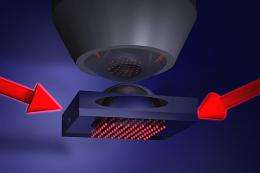
A sketch of a quantum gas microscope that images individual ultracold atoms in an optical lattice. It’s part of scientists’ efforts to use ultracold quantum gases to understand and develop novel quantum materials. Markus Greiner/Harvard University

(PhysOrg.com) -- Physicists at Harvard University have created a quantum gas microscope that can be used to observe single atoms at temperatures so low the particles follow the rules of quantum mechanics, behaving in bizarre ways.

The work, published this week in the journal Nature, represents the first time scientists have detected single atoms in a made solely of light, called a Bose Hubbard . It's part of scientists' efforts to use ultracold quantum gases to understand and develop novel quantum materials.

"Ultracold atoms in optical lattices can be used as a model to help understand the physics behind superconductivity or quantum magnetism, for example," says senior author Markus Greiner, an assistant professor of physics at Harvard and an affiliate of the Harvard-MIT Center for . "We expect that our technique, which bridges the gap between earlier microscopic and macroscopic approaches to the study of quantum systems, will help in quantum simulations of condensed matter systems, and also find applications in quantum information processing."

The microscope developed by Greiner and his colleagues is a high-resolution device capable of viewing single atoms -- in this case, atoms of rubidium -- occupying individual, closely spaced lattice sites. The rubidium atoms are cooled to just 5 billionths of a degree above (-273 degrees Celsius).

"At such low temperatures, atoms follow the rules of , causing them to behave in very unexpected ways," explains first author Waseem S. Bakr, a graduate student in Harvard's Department of Physics. "Quantum mechanics allows atoms to quickly tunnel around within the lattice, move around with no resistance, and even be 'delocalized' over the entire lattice. With our microscope we can individually observe tens of thousands of atoms working together to perform these amazing feats."

In their paper, Bakr, Greiner, and colleagues present images of single rubidium atoms confined to an optical lattice created through projections of a laser-generated holographic pattern. The neighboring atoms are just 640 nanometers apart, allowing them to quickly tunnel their way through the lattice.

Confining a quantum gas -- such as a Bose-Einstein condensate -- in such an optically generated lattice creates a system that can be used to model complex phenomena in condensed-matter physics, such as superfluidity. Until now, only the bulk properties of such systems could be studied, but the new microscope's ability to detect arrays of thousands of single gives scientists what amounts to a new workshop for tinkering with the fundamental properties of matter, making it possible to study these simulated systems in much more detail, and possibly also forming the basis of a single-site readout system for quantum computation.

"There are many unsolved questions regarding quantum materials, such as high-temperature superconductors that lose all electrical resistance if they are cooled to moderate temperatures," Greiner says. "We hope this ultracold atom model system can provide answers to some of these important questions, paving the way for creating novel quantum materials with as-yet unknown properties."

Source: Harvard University (news : web)

Explore further: Experiment investigates how classical physics may emerge from quantum physics

add to favorites email to friend print save as pdf

Related Stories

Atom 'noise' may help design quantum computers

Mar 02, 2007

As if building a computer out of rubidium atoms and laser beams weren't difficult enough, scientists sometimes have to work as if blindfolded: The quirks of quantum physics can cause correlations between the ...

Investigating new materials with ultracold atoms

Dec 04, 2008

The investigation of complex materials such as high-temperature superconductors is problematic because of the presence of disorder and many competing interactions in real crystalline materials. "This makes ...

Microscopic structure of quantum gases made visible

Oct 20, 2008

Scientists at the Johannes Gutenberg University Mainz, Germany, have, for the first time, succeeded in rendering the spatial distribution of individual atoms in a Bose-Einstein condensate visible.

Cross-Dressing Rubidium May Reveal Clues for Exotic Computing

Feb 25, 2009

(PhysOrg.com) -- Neutral atoms--having no net electric charge--usually don't act very dramatically around a magnetic field. But by “dressing them up” with light, researchers at the Joint Quantum Institute, a collaborative ...

NIST atom interferometry displays new quantum tricks

May 25, 2007

Physicists at the National Institute of Standards and Technology (NIST) have demonstrated a novel way of making atoms interfere with each other, recreating a famous experiment originally done with light while ...

Recommended for you

A quantum simulator for magnetic materials

May 23, 2013

Physicists understand perfectly well why a fridge magnet sticks to certain metallic surfaces. But there are more exotic forms of magnetism whose properties remain unclear, despite decades of intense research. ...

Researchers forward quest for quantum computing

May 23, 2013

Research teams from UW-Milwaukee and the University of York investigating the properties of ultra-thin films of new materials are helping bring quantum computing one step closer to reality.

Hydrogen atoms under the magnifying glass

May 22, 2013

To describe the microscopic properties of matter and its interaction with the external world, quantum mechanics uses wave functions, whose structure and time dependence is governed by the Schrödinger equation. ...

Making quantum encryption practical

May 21, 2013

One of the many promising applications of quantum mechanics in the information sciences is quantum key distribution (QKD), in which the counterintuitive behavior of quantum particles guarantees that no one can eavesdrop on ...

Lab sets a new record for creating heralded photons

May 20, 2013

(Phys.org) —Entanglement, by general consensus of physicists, is the weirdest part of quantum science. To say that two particles, A and B, are entangled means that they are actually two parts of an inseparable ...

User comments : 4

Adjust slider to filter visible comments by rank

Display comments: newest first

Question
not rated yet Nov 04, 2009
Quote from article:
"With our microscope we can individually observe tens of thousands of atoms working together to perform these amazing feats."

Why no pictures for us?
Alexa
not rated yet Nov 05, 2009
Because editors are lazy to search the web:

http://cuaweb.mit...Id=10243
Alexa
not rated yet Nov 05, 2009
On the other hand, I can imagine, it's quite risky business to repost images from non-authorized sites both from copyright, both from pure factual reasons. For example, you can be never sure, picture borrowed in nonofficial way illustrates article subject at all, until you're not really an expert in given area.
Tachyon8491
1 / 5 (1) Nov 05, 2009
A brilliant invention as culmination of consistent scientific pursuit of the desired outcomes. Well done to this research team. Without doubt such instrumentation heralds a new phase in empirical observation in the micro-domain and will result in new modelling of processes and their dynamics there.

More news stories

Galaxies fed by funnels of fuel

(Phys.org) —Computer simulations of galaxies growing over billions of years have revealed a likely scenario for how they feed: a cosmic version of swirly straws.

Google eyes emerging markets networks

Google has become deeply involved in a series of projects to build and operate wireless networks in emerging markets including sub-Saharan Africa and Southeast Asia, a report said Friday.