Carbon capture shows major potential in China
Oct 14, 2009
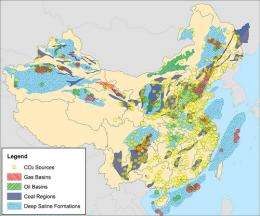
China's 2,300 billion metric tons of potential deep geologic carbon dioxide storage capacity is widely distributed throughout the country. An additional 780 billion metric tons of offshore storage capacity may also be available to the industrialized coastal areas.

(PhysOrg.com) -- Carbon dioxide capture and storage technologies may represent a cost-effective, viable option to help China continue to meet its growing energy demands while also delivering deep and sustained reductions in industrial greenhouse gas emissions, according to a study announced today.

Carbon dioxide capture and storage technologies may represent a cost-effective, viable option to help China continue to meet its growing energy demands while also delivering deep and sustained reductions in industrial greenhouse gas emissions, according to a study announced today.

Much of the discussion around China's options for significantly limiting carbon dioxide emissions has been all or nothing - that the country either continue increasing its domestic use of coal with parallel increases in greenhouse gas emissions or that it stop using coal completely and endure the economic consequences.

The new study shows there is a much-needed third option for addressing these twin challenges — large-scale deployment of carbon dioxide (CO2) capture and storage technologies. The study identifies enormous and widely distributed deep geologic CO2 storage formations in China that could allow for cost-effective, large-scale deployment of capture and storage technologies for at least 100 years.

Click here to view of summary of the report's findings.

"For the first time ever, we have quantified the potential for future large-scale carbon capture and storage deployment within China," said Bob Dahowski, lead scientist for this research at the Department of Energy's Pacific Northwest National Laboratory. "Our work suggests that CO2 capture and storage can provide a key element of China's portfolio of options for cost effectively reducing greenhouse gas emissions."

Until now, the scientific community had a limited understanding of the potential magnitude for large-scale deployment of CO2 storage in China. PNNL teamed with scientists from the Chinese Academy of Sciences' Institute of Rock and Soil Mechanics (IRSM) in this five-year study. The team's key findings include:

• China has enough deep geologic CO2 storage capacity to meet anticipated demand for up to 100 years and potentially more - specifically, the capacity to store as much as 2,300 billion metric tons of CO2;
• There are more than 1,620 large stationary CO2 emission sources in China. They include coal-fired power plants, cement kilns, steel mills, refineries and other industrial facilities.
• These sources collectively emit more than 3.8 billion metric tons of CO2 each year — 70 percent of these large point source emissions are from coal-fired power plants.
• More than 90 percent of these power plants and CO2-emitting facilities are located within 100 miles of a potential carbon storage reservoir. This close proximity means that CO2 capture and storage technologies could be widely deployed across most regions of China with little need to build extensive long-distance CO2 pipelines.
• The close proximity also means that the expense of transporting, storing and ensuring the long-term fate of the injected CO2 within these storage reservoirs should be less than $10 per ton for most projects. These estimates are exclusive of the costs of capture, compression and dehydration, which will be considered in future iterations of this work.
• An initial evaluation of potential offshore storage options suggests that offshore basins may be able to safely store as much as 780 billion metric tons of CO2.

The team surveyed China's candidate deep geological storage reserves onshore and offshore; mapped locations of the largest stationary CO2 emissions sources; assessed CO2 pipeline infrastructure needs; and evaluated the economics of deploying CO2 transport and storage technologies to China's large and well-distributed deep geologic CO2 storage formations.

These findings are important as the international community looks for ways to balance economic growth and the resulting demands for energy with the need to reduce and mitigate emissions globally.

Provided by Pacific Northwest National Laboratory (news : web)

Explore further: Unexpected effects of ocean acidification on deep-sea organisms

add to favorites email to friend print save as pdf

Related Stories

Carbon study could help reduce harmful emissions

Feb 14, 2008

Earth scientists at The University of Manchester have found that carbon dioxide has been naturally stored for more than a million years in several gas fields in the Colorado Plateau and Rocky Mountains of the United States.

Underground CO2 storage study to begin

Oct 25, 2007

The University of Texas has received a $38 million subcontract to conduct the first U.S. long-term study of underground carbon dioxide storage.

Pricing can cut CO2 emissions from electric generators

Apr 28, 2008

Levying a price on carbon dioxide released by electric generators could considerably reduce greenhouse gas emissions — even before the deployment of any environmentally friendly technology — according to scientists in ...

Cutting carbon: New tech traps, stores airborne emissions

Oct 08, 2007

In a finding that could shrink the massive carbon footprint of cars worldwide, a New York scientist has proposed an industrial technology that captures CO2 directly from the atmosphere. The study is scheduled ...

Near Zero Emissions Coal study launched in Beijing

Nov 20, 2007

China’s CO2 emissions from using coal are set to double by 2030, the scale of which is significant in the context of mitigating global climate change. In view of the essential role of coal in China’s energy system, it ...

Recommended for you

US House sends message on Keystone pipeline

13 minutes ago

US lawmakers agreed to a bill that would speed construction of a Canada-US oil pipeline and circumvent the need for President Barack Obama's approval for the $5 billion project.

New EU climate policy unlikely before 2015: Poland

23 minutes ago

The European Union is unlikely to hammer out its new policy on global warming ahead of a global climate deal that could be clinched in 2015, Poland's environment minister said Wednesday.

Farmers plant rice near crippled Fukushima site

21 hours ago

Farmers have resumed planting rice for market only 15 kilometres (nine miles) from Japan's crippled Fukushima Daiichi nuclear power station, a local official said Wednesday.

Meeting the 'grand challenge' of a sustainable water supply

21 hours ago

Scientists and engineers must join together in a major new effort to educate the public and decision makers on a crisis in providing Earth's people with clean water that looms ahead in the 21st century. That's the focus of ...

Could pond waste be the 'new' fertiliser?

22 hours ago

The University of Stirling is to lead a new project to develop a strategy for using nutrient-rich aquatic biomass waste – from ponds, wetlands and other water-bodies – in farming, as an environmentally ...

User comments : 1

Adjust slider to filter visible comments by rank

Display comments: newest first

GrayMouser
not rated yet Oct 20, 2009
lead scientist for this research at the Department of Energy's Pacific Northwest National Laboratory

Is somebody researching how China could make money by sequestering other countries' CO2?
Could they make major money selling carbon credits?
Why is the DoE doing research on China's options in solving this non-issue?

More news stories

Forecast for Titan: Wild weather could be ahead

(Phys.org) —Saturn's moon Titan might be in for some wild weather as it heads into its spring and summer, if two new models are correct. Scientists think that as the seasons change in Titan's northern hemisphere, ...

Submerged structure stumps Israeli archaeologists

The massive circular structure appears to be an archaeologists dream: a recently discovered antiquity that could reveal secrets of ancient life in the Middle East and is just waiting to be excavated.

Solar plane sets distance record on US tour

The first manned aircraft that can fly day and night powered only by solar energy set a new distance record Thursday when it landed after the second leg of a cross-country US tour.