NASA Ice Satellite Maps Profound Polar Thinning
Sep 24, 2009 by Kathryn Hansen
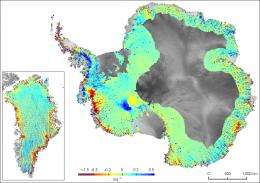
A web of satellite tracks, from NASA's Ice, Cloud, and land Elevation Satellite, reveal areas of dynamic thinning (red) in Antarctica and Greenland. Credit: British Antarctic Survey/NASA

(PhysOrg.com) -- Researchers have used NASA’s Ice, Cloud and Land Elevation Satellite (ICESat) to compose the most comprehensive picture of changing glaciers along the coast of the Greenland and Antarctic ice sheets.

The new elevation maps show that all latitudes of the Greenland ice sheet are affected by dynamic thinning -- the loss of ice due to accelerated ice flow to the ocean. The maps also show surprising, extensive thinning in Antarctica, affecting the far inland. The study, led by Hamish Pritchard of the British Antarctic Survey in Cambridge, England, was published September 24 in Nature.
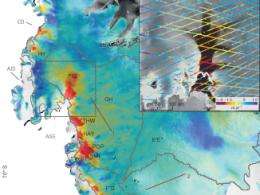
Satellite data shows fast ice thinning (red) along the coast of West Antarctica. The inset shows satellite tracks over Pine Island Glacier, from NASA's Ice, Cloud, and land Elevation Satellite, which reveal dynamic thinning concentrated on the fast-flowing areas. Credit: British Antarctic Survey/NASA

ICESat’s precise laser altimetry instrument, launched in 2003, has provided a high-density web of elevation measurements repeated year after year across the Greenland and Antarctic ice sheets. With the dense coverage, the research team could distinguish which changes were caused by fast-flowing ice and which had other causes, such as melt.

The maps confirm that the profound thinning of recent years stems from fast-flowing glaciers that empty into the sea. This was particularly the case in West Antarctica, where the Pine Island Glacier was found to be thinning between 2003 and 2007 by as much as 6 meters per year. In , fast-flowing were shown to thin by an average of nearly 0.9 meters per year.

More information: www.nature.com/nature/journal/vaop/ncurrent/full/nature08471.html

Provided by JPL/NASA (news : web)

Explore further: Astonishing hi-resolution satellite views of the destruction from the Moore, Oklahoma tornado

add to favorites email to friend print save as pdf

Related Stories

West Antarctic Glaciers Are Increasinly Thinning

Sep 25, 2004

Glaciers in West Antarctica are shrinking at a rate substantially higher than observed in the 1990s. They are losing 60 percent more ice into the Amundsen Sea than they accumulate from inland snowfall. The study was conducted ...

First evidence of under-ice volcanic eruption in Antarctica

Jan 20, 2008

The first evidence of a volcanic eruption from beneath Antarctica’s most rapidly changing ice sheet is reported this week in the journal Nature Geosciences. The volcano on the West Antarctic Ice Sheet erupted 2000 years ...

Recommended for you

Strong earthquake at exceptional depth

4 hours ago

This morning at 05:45 CEST, the earth trembled beneath the Okhotsk Sea in the Pacific Northwest. The quake, with a magnitude of 8.2, took place at an exceptional depth of 605 kilometers. Because of the great ...

Marine forecasting on the horizon for Indian Ocean Rim

5 hours ago

Nearly all of the member countries of the Indian Ocean Rim Association for Regional Cooperation (IOR-ARC) will attend the week-long workshop to further cooperation and understanding on international ocean ...

Russia evacuates drifting Arctic research station

May 23, 2013

Russia has ordered the urgent evacuation of the 16-strong crew of a drifting Arctic research station after ice floe that hosts the floating laboratory began to disintegrate, officials said Thursday.

User comments : 3

Adjust slider to filter visible comments by rank

Display comments: newest first

omatumr
2 / 5 (4) Sep 27, 2009
I am suspicious when NASA discovers what it is looking for . . .

Like the past decades of NASA discoveries of evidence that the Sun is a ball of Hydrogen and the standard solar model is exactly right.

With kind regards,
Oliver K Manuel
Former NASA PI for Apollo
lengould100
2.5 / 5 (2) Sep 28, 2009
So you only believe scientific discoveries which were not predicted, eh? Wierd proposition.
TegiriNenashi
3 / 5 (2) Sep 29, 2009
Temperature and sea ice extend measurements are less complicated (and therefore more reliable). Both demonstrate antarctic cooling (Steig fraud notwithstanding). So what is this fuzz about?

More news stories

Dark, massive asteroid to fly by Earth on May 31

It's 1.7 miles long. Its surface is covered in a sticky black substance similar to the gunk at the bottom of a barbecue. If it impacted Earth it would probably result in global extinction. Good thing it is ...

Source of life running out: water scientists

The majority of people on Earth people will face severe water shortages within a generation or two if pollution and waste continues unabated, scientists warned at a conference in Bonn Friday.

ACOG: Hormone therapy not recommended to prevent CHD

(HealthDay)—Menopausal hormone therapy should not be used for prevention of coronary heart disease, according to a Committee Opinion from the American College of Obstetricians and Gynecologists (ACOG) published ...

Storm chasers: born to be wild?

(HealthDay)—We've all seen them: the surfers who race to the beach when a hurricane hits, the guy who decides to ride out the storm in his overmatched boat, the tornado chasers who fearlessly steer their ...