SMOS arrives safely at Russian launch site
Sep 18, 2009
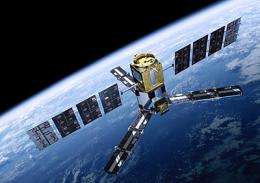
The Soil Moisture and Ocean Salinity (SMOS) mission will make global observations of soil moisture over Earth’s landmasses and salinity over the oceans. Variations in soil moisture and ocean salinity are a consequence of the continuous exchange of water between the oceans, the atmosphere and the land - Earth’s water cycle. Credits: ESA - AOES Medialab

After leaving Thales Alenia Space in the south of France on 15 September, ESA’s SMOS Earth Explorer has arrived safely at the Plesetsk Cosmodrome in northern Russia, where it will be prepared for launch on 2 November.

The Antonov aircraft carrying the and Ocean Salinity (SMOS) satellite, along with seven containers of support equipment, arrived at Arkhangelsk early in the morning of 16 September. Once unloaded from the aircraft, the precious cargo was transported by truck to the train station and then loaded onto wagons for the 12-hour ride to the launch site.  

The train arrived at the yesterday morning and the containers have now all been placed in the integration facilities where they are being unpacked today. The long journey seems to have gone well, and the signs are that satellite and equipment have arrived in good shape.

The SMOS team will now spend the next six weeks testing the satellite and preparing for launch. SMOS will be encapsulated, along with ESA’s Proba-2 satellite, in the fairing of the Rockot launcher in preparation for liftoff at 02.50 CET on 2 November. 
 
The Proba-2 team have already carried out their initial preparations and will return to Plesetsk later this month to resume the campaign.

The arrival of SMOS at the launch site marks a significant milestone for ESA’s next Earth Explorer mission. Also known as ESA’s Water Mission, it is the first dedicated to providing global measurements of soil moisture and ocean salinity. By regularly and consistently mapping these two variables, the mission will improve our understanding of the .
 
ESA’s Project Manager for the SMOS mission, Achim Hahne, commented, “I am really excited that the end is getting close, and so is the team.”

Provided by European Space Agency (news : web)

Explore further: Communications satellite launched into space

add to favorites email to friend print save as pdf

Related Stories

SMOS water mission on track for launch

Feb 12, 2009

Following word from Eurockot that launch of the Earth Explorer SMOS satellite can take place between July and October this year, ESA, CNES and the prime contractor Thales Alenia Space are now making detailed preparations ...

SMOS ready to ship to launch site

May 28, 2009

ESA's next Earth Explorer, SMOS, has just passed the all-important Flight Acceptance Review, signifying that all the elements that make up the mission are in place for launch later this year. The satellite ...

CryoSat arrives safely at launch site in Russia

Sep 02, 2005

After leaving the Space Test Centre in Germany on 29 August, CryoSat has safely arrived at the Plesetsk Cosmodrome, about 800 km north of Moscow, Russia. CryoSat is scheduled for launch on 8 October 2005 at ...

Proba-2 satellite flies into its Russian launch site

Sep 07, 2009

(PhysOrg.com) -- Proba-2 has reached Plesetsk Cosmodrome in northern Russia, where it is being prepared for launch this November. Among the smallest satellites ever built by ESA, it was transported there aboard ...

GOCE begins its journey to launch site

Jul 29, 2008

(PhysOrg.com) -- GOCE, the first of a series of Earth Explorer satellites to be launched into orbit, has taken off aboard an Antonov-124 cargo aircraft for its flight to the Arkhangelsk Airport in Russia, ...

Recommended for you

Dark, massive asteroid to fly by Earth on May 31

May 24, 2013

It's 1.7 miles long. Its surface is covered in a sticky black substance similar to the gunk at the bottom of a barbecue. If it impacted Earth it would probably result in global extinction. Good thing it is ...

Research team explains 'Lazarus' comets

May 24, 2013

Astronomers from the University of Antioquia have discovered a graveyard of comets. These once-dormant comets, dubbed by astronomers as "The Lazarus comets," are now rejuvenated.

NASA ships sensors for seafaring satellite to France

May 24, 2013

(Phys.org) —Three NASA-built instruments that are integral components of the next in a series of U.S./European ocean altimetry satellites have arrived in France for integration with their spacecraft in ...

Trip into space with DiCaprio costs $1.55m

May 24, 2013

Leonardo DiCaprio is going to get closer to stars of a different kind as he heads into space aboard the Virgin Galactic, and a well-heeled bidder at the Cannes Film Festival has paid 1.2 million euros (1.5 million) to be ...

User comments : 0

More news stories

Galaxies fed by funnels of fuel

(Phys.org) —Computer simulations of galaxies growing over billions of years have revealed a likely scenario for how they feed: a cosmic version of swirly straws.

Yahoo, pay-TV operators among Hulu bidders

Online video site Hulu is again up for sale, with Yahoo and pay TV operators DirecTV and Time Warner Cable among the seven bidders, according to a person with direct knowledge of the matter.