Planck first light yields promising results (w/ Video)
Sep 17, 2009
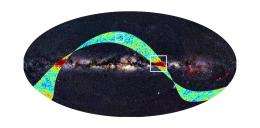
A map of the sky at optical wavelengths shows a prominent horizontal band which is the light shining from our own Milky Way. The superimposed strip shows the area of the sky mapped by Planck during the First Light Survey. The colour scale indicates the magnitude of the deviations of the temperature of the Cosmic Microwave Background from its average value, as measured by Planck at a frequency close to the peak of the CMB spectrum (red is hotter and blue is colder). The large red strips trace radio emission from the Milky Way, whereas the small bright spots high above the galactic plane correspond to emission from the Cosmic Microwave Background itself. Credits: ESA, LFI & HFI Consortia. Background optical image: Axel Mellinger

(PhysOrg.com) -- Planck, ESA's mission to study the early Universe, started surveying the sky regularly from its vantage point at L2 on 13 August. The instruments of ESA's 'time machine' were fine-tuned for optimum performance in the period preceding this date. In preparation for routine scientific operations, their long-term stability has been verified by conducting a first 'trial' survey.

ESA's Planck microwave observatory is the first European mission designed to study the - the relic radiation from the Big Bang.

Following launch on 14 May, check-outs of the satellite's subsystems were started in parallel with the cool-down of its instruments' detectors. The detectors are looking for variations in the temperature of the Cosmic Microwave Background that are about a million times smaller than one degree - this is comparable to measuring from Earth the body heat of a rabbit sitting on the Moon. To achieve this, Planck's detectors must be cooled to extremely low temperatures, some of them being very close to absolute zero (-273.15.15°C, or zero Kelvin, 0K).

This video is not supported by your browser at this time.
Planck will scan the entire sky to build the most accurate map ever of the Cosmic Microwave Background (CMB), the relic radiation from the Big Bang. The spacecraft will spin at 1 rotation per minute around an axis offset by about 85° so that the observed sky region will trace a large circle on the sky. As the spin axis follows the Sun the circle observed by the instruments sweeps through the sky at a rate of 1° per day. Planck will take about 6 months to complete a full scan of the sky, allowing the creation of two complete sky maps during the nominal mission lifetime (about 15 months). Credits: ESA (animation by C. Carreau)

With check-outs of the subsystems finished, instrument commissioning, optimisation, and initial calibration was completed by the second week of August.

The 'first light' survey, which began on 13 August, is a two-week period during which Planck surveyed the sky continuously. It was carried out to verify the stability of the instruments and the ability to calibrate them over long periods to the exquisite accuracy needed.

The first light survey was completed on 27 August, yielding maps of a strip of the sky, one for each of Planck's nine frequencies. Each map is a ring, about 15 degrees wide, stretching across the full sky. Preliminary analysis indicates that the quality of the data is excellent.

Routine operations started as soon as the First Light Survey was completed, and surveying will now continue for at least 15 months without a break. In approximately 6 month's time, the first all-sky map will be assembled.

Within its allotted operational life of 15 months, Planck will be able to gather data for two full independent all-sky maps. To fully exploit the high sensitivity of Planck, the data will require a great deal of delicate adjustments and careful analysis. It promises to contain a treasure trove of data that will keep both cosmologists and astrophysicists busy for decades to come.

Source: European Space Agency (news : web)

Explore further: Russia fetes 50th anniversary of first woman in space

add to favorites email to friend print save as pdf

Related Stories

Coolest spacecraft ever in orbit around L2

Jul 03, 2009

(PhysOrg.com) -- Last night, the detectors of Planck's High Frequency Instrument reached their amazingly low operational temperature of -273°C, making them the coldest known objects in space. The spacecraft ...

Planck instruments ready for integration

Nov 16, 2006

Engineers are ready to begin integrating the scientific instruments into ESA's Planck satellite. The pair of instruments will allow the spacecraft to make the most precise map yet of the relic radiation left ...

Introducing the 'coolest' spacecraft in the universe

Feb 09, 2007

The European Space Agency's Planck mission, which will study the conditions present in our Universe shortly after the Big Bang, is reaching an important milestone with the integration of instruments into the satellite at ...

Planck Satellite ready to measure the Big Bang

May 11, 2009

(PhysOrg.com) -- The last tests of the Ariane 5 rocket system have been finished and ESA's Planck satellite is sitting ready for launch at the Guiana Space Centre in Kourou. Together with ESA's space telescope ...

Recommended for you

Earth-passing asteroid is 'an entirely new beast'

18 hours ago

On the last day of May 2013 asteroid 1998 QE2 passed relatively closely by our planet, coming within 6 million kilometers… about 15 times the distance to the Moon. While there was never any chance of an ...

Details of Yuri Gagarin's tragic death revealed

18 hours ago

On the morning of April 12, 1961, Soviet cosmonaut Yuri Gagarin lifted off aboard Vostok 1 to become the first human in space, spending 108 minutes in orbit before landing via parachute in the Saratov region ...

Russia fetes 50th anniversary of first woman in space

Jun 16, 2013

Russia celebrated Sunday the 50th anniversary of the maiden flight of the first woman in space—a Soviet national hero who went by the call name "Seagull" and captured the imaginations of girls around the ...

Europe's space truck docks with ISS

Jun 15, 2013

A robot freighter bearing 6.6 tonnes of cargo docked with the International Space Station (ISS) on Saturday, the European Space Agency (ESA) said.

User comments : 0

More news stories

Predators affect the carbon cycle, researchers show

A new study shows that the predator-prey relationship can affect the flow of carbon through an ecosystem. This previously unmeasured influence on the environment may offer a new way of looking at biodiversity management and ...

Final curtain for Europe's deep-space telescope

The deep-space telescope Herschel took its final bow on Monday, climaxing a successful four-year mission to observe the birth of stars and galaxies, the European Space Agency (ESA) said.

New language discovery reveals linguistic insights

A new language has been discovered in a remote Indigenous community in northern Australia that is generated from a unique combination of elements from other languages. Light Warlpiri has been documented by University of Michigan ...