Smoke From Station Fire Blankets Southern California
Sep 01, 2009
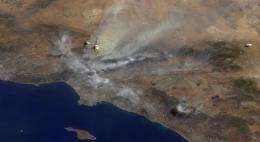
The station fire in La Canada/Flintridge. Image Credit: NASA/GSFC/LaRC/JPL, MISR Team

Triple-digit temperatures, extremely low relative humidities, dense vegetation that has not burned in decades, and years of extended drought are all contributing to the explosive growth of wildfires throughout Southern California.

The Station fire, which began Aug. 26, 2009, in La Canada/Flintridge, not far from NASA's Jet Propulsion Laboratory, had reportedly burned 105,000 acres (164 square miles) of the Angeles National Forest by mid-day Aug. 31, destroying at least 21 homes and threatening more than 12,000 others. It is one of four major fires burning in Southern California at the present time.

This image was acquired mid-morning on Aug. 30 by the backward (northward)-viewing camera of the Multi-angle Imaging SpectroRadiometer (MISR) instrument on NASA's Terra satellite. The image is shown in an approximate perspective view at an angle of 46 degrees off of vertical.

The area covered by the image is 245 kilometers (152 miles) wide. Several pyrocumulus clouds, created by the Station Fire, are visible above the smoke plumes rising from the San Gabriel Mountains north of Los Angeles in the left-center of the image. Smoke from the Station fire is seen covering the interior valleys along the south side of the San Gabriel Mountains, along with parts of the City of Los Angeles and Orange County, and can be seen drifting for hundreds of kilometers to the east over the Mojave Desert.

MISR observes the daylit Earth continuously and every 9 days views the entire globe between 82 degrees north and 82 degrees south latitude. This image was generated from a portion of the imagery acquired during Terra orbit 51601.

Provided by JPL/NASA (news : web)

Explore further: Professor argues Earth's mantle affects long-term sea-level rise estimates

add to favorites email to friend print save as pdf

Related Stories

Frances, Ivan Contribute to Hurricane Studies

Sep 16, 2004

Seen through the eyes of the Multi-angle Imaging SpectroRadiometer aboard NASA's Terra satellite, the menacing clouds of Hurricanes Frances and Ivan provide a wealth of information that can help improve hurricane ...

New Image of Raging California Wildfires

Oct 23, 2007

NASA satellites continue to capture remarkable new images of the wildfires raging in Southern California. At least 14 massive fires are reported to have scorched about 425 square miles from north of Los Angeles ...

NASA Sees Santa Barbara Wildfires

Aug 08, 2007

This image shows the Zaca fire, which continues to burn in the Los Padres National Forest near Santa Barbara, Calif. The image was acquired by ASTER on Aug. 7, 2007.

Satellite Imagery of Watertown Tire Fire

Jul 22, 2005

UW-Madison researchers are using satellite imagery to measure the extent of a massive smoke plume rising from a fire at a tire recycling facility in Watertown, Wis.

Fires Burning Near Big Sur, California

Jul 01, 2008

Fires near Big Sur, Calif., continued to burn unchecked when the Advanced Spaceborne Thermal Emission and Reflection Radiometer (ASTER) instrument on NASA's Terra satellite captured this image on Sunday, June ...

Recommended for you

Russia evacuates drifting Arctic research station

20 hours ago

Russia has ordered the urgent evacuation of the 16-strong crew of a drifting Arctic research station after ice floe that hosts the floating laboratory began to disintegrate, officials said Thursday.

Bacterium from Canadian High Arctic and life on Mars

23 hours ago

(Phys.org) —The temperature in the permafrost on Ellesmere Island in the Canadian high Arctic is nearly as cold as that of the surface of Mars. So the recent discovery by a McGill University led team of ...

User comments : 1

Adjust slider to filter visible comments by rank

Display comments: newest first

defunctdiety
not rated yet Sep 01, 2009
I wonder how much CO2, water vapor, and hydrocarbon chains are emitted here, every day, and in wildfires like this all over the world every year all the time.

More news stories

A hidden population of exotic neutron stars

(Phys.org) —Magnetars – the dense remains of dead stars that erupt sporadically with bursts of high-energy radiation - are some of the most extreme objects known in the Universe. A major campaign using ...

Century-old science helps confirm global warming

(Phys.org) —Ocean measurements taken more than 135 years ago during the scientific expedition of HMS Challenger have provided further confirmation of human-produced global warming over the past century.

Hubble reveals the ring nebula's true shape

(Phys.org) —The Ring Nebula's distinctive shape makes it a popular illustration for astronomy books. But new observations by NASA's Hubble Space Telescope of the glowing gas shroud around an old, dying, ...

The long road to the 2000-watt society

The vision of a society in which each inhabitant of the earth manages to consume only 2000 watts has already been around for 15 years. During this time, there has been a steady increase in environmental awareness ...