Aurora B answers an XIST-ential question
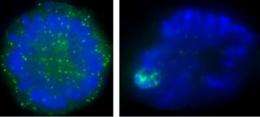
Early in development, mammalian female cells counteract their double dose of X chromosomes by coating one of them with a large RNA named XIST. The RNA binds to the same X chromosome from which it is transcribed and initiates a series of events leading to the chromosome's permanent silencing. In the August 24, 2009 issue of the Journal of Cell Biology, Hall et al. exploit the fact that XIST temporarily dissociates from the X chromosome during mitosis and find that Aurora B kinase helps regulate the RNA's chromatin binding.
Although more than 10 years have passed since XIST was shown to paint the inactivated X (Xi) chromosome, little is known of how the 14-kb, noncoding transcript binds its target. "We know it doesn't just bind the DNA, but no specific binding proteins have been identified," says lead author Lisa Hall. Biochemical approaches to finding protein partners may have been hampered by XIST's large size and tight association with the X chromosome, making it hard to extract the RNA complex and study it in vitro. So Hall, together with colleagues in Jeanne Lawrence's laboratory at the University of Massachusetts Medical School, took an in vivo approach—mimicking the events that cause XIST to drop off the Xi in early prophase.
Hall and colleagues found that treating cells with an inhibitor of protein phosphatase 1 (PP1) caused XIST to be released from the Xi in interphase cells. PP1 usually keeps the kinase Aurora B in check until the start of mitosis, so the team wondered whether XIST's premature release was driven by increased Aurora B activity. XIST was no longer released in interphase cells if PP1 and Aurora B were both inhibited. Moreover, inhibiting Aurora B with either drugs or a specific siRNA caused XIST to be retained on the Xi even in mitotic cells.
Lawrence says that the team was excited to identify Aurora B as a regulator of XIST. Their previous studies had suggested that a broader chromatin organizer might control XIST binding, particularly during cancer when the regulation of XIST and the Xi often goes awry. Aurora B fits the bill perfectly as it localizes to the chromosome arms at prophase, phosphorylates several chromatin proteins including histone H3, and is frequently activated in cancer cells.
It remains unclear exactly how Aurora B promotes XIST's loss from the Xi. "There are probably multiple places that XIST anchors to chromatin," says Lawrence. "In order to release it, you have to modify multiple points." Further studies on the mitotic loss of XIST should help identify these different anchor points and determine how they are modified to promote or block RNA binding.
XIST may, in fact, represent a broader class of noncoding RNAs that associate with and regulate heterochromatin. "We hope that manipulating binding in vivo provides a new way to study RNA-chromatin interactions that other labs will build on," says Lawrence. "It will be interesting to determine if these other RNAs mirror the behavior of XIST and are controlled by the same mechanism."
More information: Hall, L.L., et al. 2009. J. Cell Biol. doi:10.1083/jcb.200811143
Source: Rockefeller University (news : web)


