Romantic, candle-lit dinners: An unrecognized source of indoor air pollution
August 19, 2009

Romantic, candle-lit dinners:  An unrecognized source of indoor air pollution

Enlarge

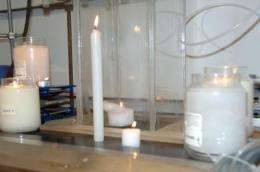
These candles are tested for pollutants. Credit: Elizabeth Mosley

Burning candles made from paraffin wax -- the most common kind used to infuse rooms with romantic ambiance, warmth, light, and fragrance -- is an unrecognized source of exposure to indoor air pollution, including the known human carcinogens, scientists reported here today. Levels can build up in closed rooms, and be reduced by ventilation, they indicated in a study presented at the 238th National Meeting of the American Chemical Society (ACS).

In the study, R. Massoudi Ph.D., and Amid Hamidi, his undergraduate student, said that that candles made from bee's wax or soy, although more expensive, apparently are healthier. They do not release potentially harmful amounts of indoor air pollutants while retaining all of the warmth, ambience and of paraffin candles (which are made from petroleum).

"An occasional paraffin candle and its emissions will not likely affect you," Hamidi said. "But lighting many paraffin candles every day for years or lighting them frequently in an un-ventilated bathroom around a tub, for example, may cause problems." Besides the more serious risks, he also suggested that some people who believe they have an indoor allergy or respiratory irritation may in fact actually be reacting to air pollutants from burning candles.

Source: American Chemical Society (news : web)

3.2 /5 (5 votes)  

Filter


Move the slider to adjust rank threshold, so that you can hide some of the comments.


Display comments: newest first

Ausjin
Aug 19, 2009

Rank: 4 / 5 (1)
Oh come on. Is this really unrecognized? That burning things causes pollution and that burning things indoors causes indoor pollution? Sure, the alternatives were unexpected, but I am sure they still produce polution in other forms.

Let's just assume this: Inhaling smoke is probably not good for you.
Nartoon
Aug 20, 2009

Rank: 1.5 / 5 (2)
So, when the greenies turn off our electricity they'll be on our ass for burning candles, do we have to go back to whale oil lanterns now?
jimmc
Aug 20, 2009

Rank: not rated yet
I notice many candle wicks are reinforced with a metal core. I wonder what that metal might be. The metal disappears as the candle burns. Seems to be vaporized. That must add to the air pollution as well as chemicals in the waxes.
Rawley
Aug 20, 2009

Rank: not rated yet
jimmc:
They use mostly zinc in those types of candle wicks. Don't burn any made before the 70s though, they probably contain lead.
Velanarris
Aug 20, 2009

Rank: not rated yet
So, when the greenies turn off our electricity they'll be on our ass for burning candles, do we have to go back to whale oil lanterns now?

Where are you going to get the whale oil from? It's illegal to harvest whales for the vast majority of the population.
VOR
Aug 20, 2009

Rank: 5 / 5 (1)
So, when the greenies turn off our electricity they'll be on our ass for burning candles, do we have to go back to whale oil lanterns now?

the 'greenies', really? lol, so what does that make you, and oilie? and these so-called greenies want to turn off electricity? ha-ha what a joke. So when do you finish you paranoid, delusional manefesto? [Where are you going to get the whale oil from?] Guess he'll get that oil from killing baby whales, lol.
Rank 3.2 /5 (5 votes)
Relevant PhysicsForums posts

More news stories

Land and sea species differ in climate change response: study

(Phys.org) -- Marine and terrestrial species will likely differ in their responses to climate warming, new research by Simon Fraser University and Australia’s University of Tasmania has found.

Space & Earth / Environment

created 7 hours ago | popularity 4 / 5 (5) | comments 6 | with audio podcast

Yale study concludes public apathy over climate change unrelated to science literacy

Are members of the public divided about climate change because they don't understand the science behind it? If Americans knew more basic science and were more proficient in technical reasoning, would public consensus match ...

Space & Earth / Environment

created 9 hours ago | popularity 4.8 / 5 (6) | comments 23 | with audio podcast

10 million years needed to recover from mass extinction

It took some 10 million years for Earth to recover from the greatest mass extinction of all time, latest research has revealed.

Space & Earth / Earth Sciences

created 9 hours ago | popularity 4 / 5 (4) | comments 1 | with audio podcast

Sophisticated simulations predict future warming

The chances of our planet being hit by a global warming of 3 degrees Celsius by 2050 is as likely as it being hit by an increase of 1.4 degrees, new research shows. Presented in the journal Nature Geoscience, the British study ...

Space & Earth / Earth Sciences

created May 22, 2012 | popularity 3.8 / 5 (11) | comments 51

Aliens don't want to eat us, says former SETI director

Alien life probably isn’t interested in having us for dinner, enslaving us or laying eggs in our bellies, according to a recent statement by former SETI director Jill Tarter.

Space & Earth / Space Exploration

created May 25, 2012 | popularity 4.4 / 5 (15) | comments 41


'Unzipped' carbon nanotubes could help energize fuel cells, batteries

Multi-walled carbon nanotubes riddled with defects and impurities on the outside could replace some of the expensive platinum catalysts used in fuel cells and metal-air batteries, according to scientists at ...

Change in developmental timing was crucial in the evolutionary shift from dinosaurs to birds: study

At first glance, it's hard to see how a common house sparrow and a Tyrannosaurus Rex might have anything in common. After all, one is a bird that weighs less than an ounce, and the other is a dinosaur that ...

Stunning image of smallest possible five-ringed structure

Scientists have created and imaged the smallest possible five-ringed structure – about 100,000 times thinner than a human hair – and you'll probably recognise its shape.

Computer model used to pinpoint prime materials for efficient carbon capture

When power plants begin capturing their carbon emissions to reduce greenhouse gases – and to most in the electric power industry, it's a question of when, not if – it will be an expensive undertaking.

T cells 'hunt' parasites like animal predators seek prey, study shows

By pairing an intimate knowledge of immune-system function with a deep understanding of statistical physics, a cross-disciplinary team at the University of Pennsylvania has arrived at a surprising finding: T cells use a movement ...

Scientists develop ultra-sensitive test that detects diseases in their earliest stages

Scientists have developed an ultra-sensitive test that should enable them to detect signs of a disease in its earliest stages, in research published today in the journal Nature Materials.