Rainfall to decrease over Iberian Peninsula
Jul 23, 2009
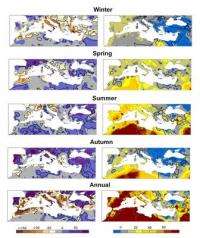
Evolución estacional y anual del clima en el Mediterráneo entre 1950 y 2002. Los colores muestran la magnitud de los cambios en la precipitación (izquierda); y la evapotranspiración en mm (derecha). Mapas: Juan Ignacio López-Moreno et al.

Scientists have recorded a decline in winter precipitation over the past 60 years in Spain, and they now forecast that precipitation will also decrease in spring and summer. A team from the Pyrenean Institute of Ecology (CSIC) has studied rainfall data from 1950 to 2006 and the climate projections for coming decades, showing that less rain will fall in future over the Iberian Peninsula. However, precipitation will continue to be more frequent in winter than in spring-summer.

Have there been any changes to the monthly contributions to total annual precipitation within the Mediterranean basin? Researchers from the Pyrenean Institute of Ecology (CSIC) have assessed the changes observed in patterns since 1950, and are predicting contributions to be lower by the middle of the 21st Century, against a backdrop of increasing .

"We have used the data reported (1950-2006) and simulated various climate models (2040-2060) to look at whether the monthly contribution to the annual total has changed over recent decades, and whether such changes are likely to happen over the medium term", Juan Ignacio López-Moreno, lead author of the study, tells SINC.

The research, published recently in the journal Geophysical Research Letters, studied variability and climate change in the Mediterranean region. According to the scientists, significant changes have taken place over this area, with disparate effects being noted over the course of the year, and "uniform patterns" identified in the evolution of rain over time. In addition to the changes in the amounts of precipitation falling, López-Moreno says "the climate models suggest new changes will take place over the coming decades".

Rainy December?

One of the most significant patterns revealed by the study is that precipitation in March in the western part of the Mediterranean basin, specifically the Iberian Peninsula, fell by 8% from 1950 to 2002, and increased by 3% in April and May over the same period. The researchers also point to a slight increase in rainfall between August and December.

Scientists are predicting a significant decline in rainfall throughout the entire Mediterranean basin, above all in spring and summer. However, observations from the past 50 years and predictions for coming decades do not show up any changes in seasonal rain distribution patterns. The research team says "while the changes observed have now been identified, they are not great enough to alter the general pattern of rainfall distribution throughout the year".

López-Moreno says the uncertainties associated with and the way in which hydrological systems will respond to climate changes make it hard to draw any immediate conclusions.

Source: Plataforma SINC (news : web)

Explore further: Professor argues Earth's mantle affects long-term sea-level rise estimates

add to favorites email to friend print save as pdf

Related Stories

Heavy rainfall on the increase

Feb 14, 2008

Scientists at the University of East Anglia (UEA) have found that winter precipitation – such as rain and snow - became more intense in the UK during the last 100 years.

Warmer Future Could Bring Droughts

Feb 12, 2007

NASA scientists may have discovered how a warmer climate in the future could increase droughts in certain parts of the world, including the southwest United States.

Understanding autumn rain decline in SE Australia

May 23, 2008

According to a report from a CSIRO Wealth From Oceans Flagship study – published this week in the science journal Geophysical Research Letters – since 1950 Victoria has suffered a 40 per cent decline in aut ...

Recommended for you

Strong earthquake at exceptional depth

4 hours ago

This morning at 05:45 CEST, the earth trembled beneath the Okhotsk Sea in the Pacific Northwest. The quake, with a magnitude of 8.2, took place at an exceptional depth of 605 kilometers. Because of the great ...

Marine forecasting on the horizon for Indian Ocean Rim

5 hours ago

Nearly all of the member countries of the Indian Ocean Rim Association for Regional Cooperation (IOR-ARC) will attend the week-long workshop to further cooperation and understanding on international ocean ...

Russia evacuates drifting Arctic research station

May 23, 2013

Russia has ordered the urgent evacuation of the 16-strong crew of a drifting Arctic research station after ice floe that hosts the floating laboratory began to disintegrate, officials said Thursday.

User comments : 1

Adjust slider to filter visible comments by rank

Display comments: newest first

RayCherry
not rated yet Jul 24, 2009
You want da sun? Bring da water!

More news stories

Dark, massive asteroid to fly by Earth on May 31

It's 1.7 miles long. Its surface is covered in a sticky black substance similar to the gunk at the bottom of a barbecue. If it impacted Earth it would probably result in global extinction. Good thing it is ...

Source of life running out: water scientists

The majority of people on Earth people will face severe water shortages within a generation or two if pollution and waste continues unabated, scientists warned at a conference in Bonn Friday.

ACOG: Hormone therapy not recommended to prevent CHD

(HealthDay)—Menopausal hormone therapy should not be used for prevention of coronary heart disease, according to a Committee Opinion from the American College of Obstetricians and Gynecologists (ACOG) published ...

Storm chasers: born to be wild?

(HealthDay)—We've all seen them: the surfers who race to the beach when a hurricane hits, the guy who decides to ride out the storm in his overmatched boat, the tornado chasers who fearlessly steer their ...