2010 species pledge set to fail: conservationists
Jul 02, 2009
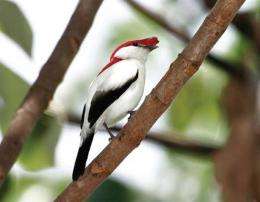
A soldadinho-do-araripe, a bird from the family of Manakins is seen in Brasilia. The soldadinho-do-araripe is one of the species in critical danger of extinction. The world's paramount authority on species loss has warned that pledges to roll back the threat to biodiversity by 2010 were running into the sand.

The world's paramount authority on species loss has warned that pledges to roll back the threat to biodiversity by 2010 were running into the sand.

The goal set by UN parties under the Convention on Biological Diversity (CBD) to reduce biodiversity loss by 2010 "clearly will not be met," Jean-Christophe Vie of the International Union for of Nature (IUCN) told AFP.

In its new report, issued on Thursday, the Swiss-based IUCN said Earth was hurtling towards a mass extinction.

Out of 44,838 on the IUCN's famous "Red List", 869 are considered to be extinct or extinct in the wild, it said.

This tally rises to 1,159 if 290 critically endangered species that are tagged as possibly extinct are included.

Nearly one third of amphibians are at risk of being wiped out through , and other risks.

More than one in eight birds are threatened with extinction, with Brazil, Indonesia and oceanic islands spearheading the peril. Nearly a quarter of , especially hunted species in Asia, face a similar threat.

"Overall, a minimum of 16,928 species are threatened with extinction," IUCN said in a press release.

"Considering that only 2.7 percent of the 1.8 million described species have been analysed, this number is a gross underestimate, but it does provide a useful snapshot of what is happening to all forms of life on Earth."

The IUCN analysis, Wildlife in a Changing World, was issued just before a deadline governments set themselves to evaluate their success in achieving the 2010 target.

Vie, deputy head of the IUCN's species programme, called on governments to tackle the biodiversity crisis with the same urgency with which they tackled its economic crisis.

"Economies are utterly dependent on . We need them all, in large numbers. We quite literally cannot afford to lose them."

He added: "Governments should put as much effort, if not more, into saving nature as they do into addressing the economic and financial sectors."

(c) 2009 AFP

Explore further: Bay Area thrushes nest together, winter together, and face change together

add to favorites email to friend print save as pdf

Related Stories

Extinction alert issued for 800 species

Dec 13, 2005

Conservation and environmental groups have compiled a list of nearly 800 species they say face imminent extinction. Most of the threatened species are found mainly in tropical areas, the BBC reported Tuesday.

Researchers document world's mammals in crisis

Oct 06, 2008

From majestic African elephants to tiny and often unappreciated rodents, mammals on Earth are in a state of crisis. One in four mammal species on Earth is being pushed to extinction, according to the Global Mammal Assessment, ...

Global plan prepared to save amphibians

Sep 20, 2005

A plan approved by a recent environmental meeting in Washington, D.C., to save the world's amphibians from extinction may cost more than $400 million.

Recommended for you

Hong Kong dolphin numbers dwindling quickly

17 hours ago

Conservationists Tuesday warned that the number of rare Chinese white dolphins in Hong Kong waters has fallen to its lowest level in a decade of monitoring, and urged the government to immediately create more protected areas.

WWF urges Romania, Bulgaria to protect wild sturgeon

20 hours ago

Conservationist group WWF on Tuesday urged Romania and Bulgaria, home to the last viable wild sturgeon populations in the European Union, to protect the species, threatened by illegal fishing and caviar trade.

New resource to record Britain's trees launched

22 hours ago

Treezilla, the monster map of trees, was launched by The Open University and partners on 14 June 2013. The citizen science project aims to map every tree in Britain through Treezilla.org and the related apps.

Study reveals disease-causing parasites in dead otters

Jun 18, 2013

Research undertaken by the Cardiff University Otter Project has revealed a number of disease-causing parasites in the bodies of dead otters. The findings were revealed at the BBC Summer of Wildlife event ...

User comments : 0

More news stories

Origins of 'The Hoff' crab revealed (w/ Video)

The history of a new type of crab, nicknamed 'The Hoff' because of its hairy chest, which lives around hydrothermal vents deep beneath the Southern Ocean and Indian Ocean, has been revealed for the first ...

Dish won't submit revised bid for Sprint

Satellite TV operator Dish Network Corp. said Tuesday it would not submit a revised bid for Sprint, leaving the path open for the wireless carrier to accept what it already considers a superior offer from Japan's Softbank.

Cape Wind gets $200M investment from Danish fund

The Cape Wind offshore wind project has secured a $200 million investment from a Danish pension fund in what the wind farm's president said Tuesday is a milestone for the long-delayed project.