New, light-driven nanomotor is simpler, more promising, scientists say
Jun 04, 2009
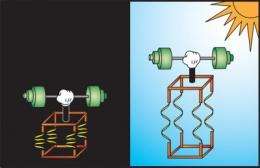
Sunlight prompts a newly developed molecular nanomotor to unclasp in this artist’s illustration. In a paper expected to appear soon in the online edition of the journal Nano Letters, a team of researchers from the University of Florida reports building a new type of “molecular nanomotor” driven only by photons, or particles of light. While it is not the first photon-driven nanomotor, the almost infinitesimal device is the first built entirely with a single molecule of DNA - giving it a simplicity that increases its potential for development, manufacture and real-world applications in areas ranging from medicine to manufacturing, the scientists say. (Yan Chen/University of Florida)

(PhysOrg.com) -- Sunflowers track the sun as it moves from east to west. But people usually have to convert sunlight into electricity or heat to put its power to use.

Now, a team of University of Florida chemists is the latest to report a new mechanism to transform light straight into motion - albeit at a very, very, very tiny scale.

In a paper expected to appear soon in the online edition of the journal , the UF team reports building a new type of "molecular nanomotor" driven only by photons, or particles of light. While it is not the first photon-driven nanomotor, the almost infinitesimal device is the first built entirely with a single molecule of DNA — giving it a simplicity that increases its potential for development, manufacture and real-world applications in areas ranging from medicine to manufacturing, the scientists say.

"It is easy to assemble, has fewer parts and theoretically should be more efficient," said Huaizhi Kang, a doctoral student in chemistry at UF and the first author of the paper.

The scale of the nanomotor is almost vanishingly small.

In its clasped, or closed, form, the nanomotor measures 2 to 5 — 2 to 5 billionths of a meter. In its unclasped form, it extends as long as 10 to 12 nanometers. Although the scientists say their calculations show it uses considerably more of the energy in light than traditional solar cells, the amount of force it exerts is proportional to its small size.

But that won't necessarily limit its potential.

In coming years, the nanomotor could become a component of microscopic devices that repair individual cells or fight viruses or . Although in the conceptual stage, those devices, like much larger ones, will require a power source to function. Because it is made of DNA, the nanomotor is biocompatible. Unlike traditional energy systems, the nanomotor also produces no waste when it converts light energy into motion.

"Preparation of is relatively easy and reproducible, and the material is very safe," said Yan Chen, a UF chemistry doctoral student and one of the authors of the paper.

Applications in the larger world are more distant. Powering a vehicle, running an assembly line or otherwise replacing traditional electricity or fossil fuels would require untold trillions of nanomotors, all working together in tandem — a difficult challenge by any measure.

"The major difficulty lies ahead," said Weihong Tan, a UF professor of chemistry and physiology, author of the paper and the leader of the research group reporting the findings. "That is how to collect the molecular level force into a coherent accumulated force that can do real work when the motor absorbs sunlight."

Tan added that the group has already begun working on the problem.

"Some prototype DNA nanostructures incorporating single photo-switchable motors are in the making which will synchronize molecular motions to accumulate forces," he said.

To make the nanomotor, the researchers combined a DNA molecule they created in the lab with azobenzene, a chemical compound that responds to light. A high-energy photon prompts one response; lower energy another.

To demonstrate the movement, the researchers attached a fluorophore, or light-emitter, to one end of the nanomotor and a quencher, which can quench the emitting light, to the other end. Their instruments recorded emitted light intensity that corresponded to the motor movement.

"Radiation does cause things to move from the spinning of radiometer wheels to the turning of sunflowers and other plants toward the sun," said Richard Zare, distinguished professor and chairman of chemistry at Stanford University. "What Professor Tan and co-workers have done is to create a clever light-actuated nanomotor involving a single DNA molecule. I believe it is the first of its type."

Source: University of Florida (news : web)

Explore further: Single-cell transfection tool enables added control for biological studies

add to favorites email to friend print save as pdf

Related Stories

Researchers create the first thermal nanomotor in the world

Apr 15, 2008

Researchers from the UAB Research Park have created the first nanomotor that is propelled by changes in temperature. A carbon nanotube is capable of transporting cargo and rotating like a conventional motor, but is a million ...

Nano World: First solar-powered nano motor

Jan 24, 2006

An international team of scientists has created the first molecular motor powered solely by sunlight. By acting like pistons that move back and forth, these motors, which are only nanometers or billionths of ...

Molecular Tools Make the Cut

Mar 25, 2007

Researchers in Japan have developed a pair of molecular-scale scissors that open and close in response to light. The tiny scissors are the first example of a molecular machine capable of mechanically manipulating ...

Single molecule is in driver's seat of molecular machine

Jul 30, 2005

While the human body has plenty of specialized molecular motors and machines powering the mechanical work necessary for cells to function properly, scientists themselves face many hurdles as they try to create their own molecular ...

Recommended for you

Radioactive nanoparticles target cancer cells

May 21, 2013

Cancers of all types become most deadly when they metastasize and spread tumors throughout the body. Once cancer has reached this stage, it becomes very difficult for doctors to locate and treat the numerous tumors that can ...

How gold nanoparticles can help fight ovarian cancer

May 21, 2013

Positively charged gold nanoparticles are usually toxic to cells, but cancer cells somehow manage to avoid nanoparticle toxicity. Mayo Clinic researchers found out why, and determined how to make the nanoparticles effective ...

Advance in nanotech gene sequencing technique

May 20, 2013

(Phys.org) —The allure of personalized medicine has made new, more efficient ways of sequencing genes a top research priority. One promising technique involves reading DNA bases using changes in electrical ...

User comments : 1

Adjust slider to filter visible comments by rank

Display comments: newest first

xanthian
not rated yet Jun 05, 2009
Besides potential uses in generating energy, this might be a dandy component of a fluidics computer.

xanthian.

More news stories

Scientists develop cheaper, more efficient fuel cells

(Phys.org) —Using the Canadian Light Source (CLS) synchrotron, researchers have discovered a way to create cheaper fuel cells by dividing normally expensive platinum metal into nanoparticles (or even single ...

Weird science: Crystals melt when they're cooled

(Phys.org) —Growing thin films out of nanoparticles in ordered, crystalline sheets, to make anything from microelectronic components to solar cells, would be a boon for materials researchers, but the physics ...

Controlling mood through the motions of mitochondria

(Medical Xpress)—Regulating the distribution of power in neurons is done by a system that makes the national electric grid look simple by comparison. Each neuron has several thousand mitochondria confined ...

A hidden population of exotic neutron stars

(Phys.org) —Magnetars – the dense remains of dead stars that erupt sporadically with bursts of high-energy radiation - are some of the most extreme objects known in the Universe. A major campaign using ...

A quantum simulator for magnetic materials

Physicists understand perfectly well why a fridge magnet sticks to certain metallic surfaces. But there are more exotic forms of magnetism whose properties remain unclear, despite decades of intense research. ...