Using your mood to operate a computer game
May 28, 2009
Using your mood to operate a computer game

(PhysOrg.com) -- Brain Computer Interfaces measure electrical signals from the brain and convert them into data that can be used by a computer. You can move a cursor on your screen, for example, simply by thinking about it. Now, researchers at the University of Twente have succeeded in measuring a person’s frame of mind in order to create a game environment. In World of Warcraft, a friendly elf can change into an aggressive bear without any physical action being necessary.

Thanks to Interfaces (BCI), you can operate a machine such as a computer or wheelchair with signals from your brain. Concentrating on a particular movement will cause that movement to be actually carried out. Research is currently underway at the University of Twente into how BCI can be integrated into computer games. It is being conducted in the Human Media Interaction department of Prof. Anton Nijholt of the Centre for Telematics and Information Technology research institute.

World of Warcraft

Previously, BCI used to focus on brain signals that prompted movements. Now, it is also possible to measure the mood of the player and to include that as part of the game. For example, researchers have developed an application for World of Warcraft (WoW): alpha-WoW. As soon as a player becomes unsettled, or is in danger, the character can change shape. A friendly elf can be transformed into an aggressive bear. Under those circumstances, the player is much less vulnerable to other enemies. What is remarkable about this is that no physical action, such as using a joystick or mouse, is needed: it is all done through brain signals! As soon as a player relaxes, he returns to being an elf.

Electrodes cap

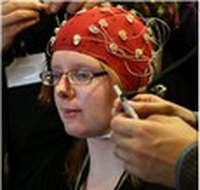
Brain activity is measured using electroencephalography (EEG). Electrical signals from the brain can be measured and localized by placing electrodes on a cap - a sort of bathing cap - which is worn on the head. The disadvantage of EEG is that it can only measure signals that originate from near the surface of the skull, although they are precisely the signals that are of interest for the purpose of this research. With the help of BCI, the electrical signals from the brain are converted into data that the computer can use.

The electrode caps that are currently being used are not really practicable for the average player, as gel first has to be rubbed onto those parts of the head where the electrodes are placed. Nevertheless, developments are progressing positively and should mean that it will be possible to use a so-called ‘dry cap’ with fewer . A helmet of this kind could also have other functions, by being fitted with a music player or telephone, for example.

Provided by University of Twente (news : web)

Explore further: New database tracks 11,000 global rendition flights

add to favorites email to friend print save as pdf

Related Stories

Brain-Computer Interface

Mar 02, 2005

A research group led by Academy Professor Mikko Sams is developing a brain-computer interface, a device that transforms electrical or magnetic brain signals into commands a computer can understand. Equipment of this kind ...

Towards zero training for brain-computer interfacing

Aug 13, 2008

While invasive electrode recordings in humans show long-term promise, non-invasive techniques can also provide effective brain-computer interfacing (BCI) and localization of motor activity in the brain for paralyzed patients ...

Brain2Robot

Nov 12, 2007

People who suffer from paralysis are confronted with many situations in which they need a helping hand.

A baseball cap that reads your mind

May 16, 2008

It looks like an ordinary baseball cap. But when you put it on, the cap detects and analyzes the electroencephalogram (EEG) signals from your brain. It can even tell you if you’re getting too sleepy when ...

An unbeatable computer game?

Aug 30, 2007

Researchers have come up with an idea to design a computer game that knows a player’s move about two seconds before the move is made. Using measurements of players’ skin conductance, the computer’s sensors ...

Thinking about moving? Let brain waves do the walking

Dec 05, 2004

Using brain waves to control screen cursor movements, rather than moving a mouse by hand, seems like science fiction! Yet such direct control over our environment is an integral part of the development work being undertaken ...

Recommended for you

Text in on smarter phones

May 22, 2013

Alternative input methods for smart phones, such as Swype and SwiftKey, offer substantial benefits to users and are comparable with common typing speeds found on computer keyboards, according to a report published by researchers ...

AP probe further strains Obama, press rapport

May 20, 2013

Reports emerged last week that the Department of Justice had secretly obtained two months' worth of phone records of journalists at The Associated Press as part of a larger investigation into a failed al-Qaida ...

Pakistan adopts Chinese rival GPS satellite system

May 18, 2013

Pakistan is set to become the fifth Asian country to use China's domestic satellite navigation system which was launched as a rival to the US global positioning system, a report said Saturday.

User comments : 1

Adjust slider to filter visible comments by rank

Display comments: newest first

OBSL33t
not rated yet May 28, 2009
The possibilities of a commercially available interface like this are astounding.
Imagine getting really peeved at a difficult portion of a game and your character gets stronger due to your anger thus making the game less frustrating.
Are you reading this Nintendo?
I can't wait for the WiiMood peripheral.

More news stories

Review: Google music plan solid, serendipitous

Google's new music service offers a lot of eye candy to go with the tunes. The song selection of around 18 million tracks is comparable to popular services such as Spotify and Rhapsody, and a myriad of playlists ...

A hidden population of exotic neutron stars

(Phys.org) —Magnetars – the dense remains of dead stars that erupt sporadically with bursts of high-energy radiation - are some of the most extreme objects known in the Universe. A major campaign using ...