Frozen helium-4 may be an unusual 'superglass'
May 01, 2009 By Bill Steele
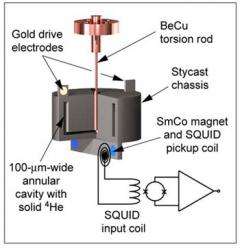
A torsion oscillator shakes a sample of frozen helium back and forth like a washing machine agitator, and gives experimenters information about the state of the matter inside. At temperatures near absolute zero some of the helium goes into a frictionless "supermatter" state and offers less resistance to being pushed back and forth. The entire apparatus is about the diameter of a quarter. Image: Davis Lab

(PhysOrg.com) -- When helium is cooled to around 4 degrees above absolute zero, it turns liquid. Make it a couple of degrees cooler, and it becomes a "superfluid" that flows without resistance from its container, just as electrons flow without resistance in a superconductor.

Now pressurize the helium to about 50 atmospheres until it solidifies, and then cool it a lot more to about two-tenths of a degree above , and it becomes -- well, there's a lot of argument about what it is. Perhaps a supersolid, or a solid with some superfluid moving through it.

In fact, it may be a superglass, report J.C. Séamus Davis, the James Gilbert White Distinguished Professor in the Physical Sciences at Cornell and colleagues in the May 1 issue of the journal Science.

The researchers are cautious in their conclusions, not insisting that the material is a glass but presenting evidence to support that idea, which was proposed by theorists about two years ago.

(All this refers to helium-4, the common variety you see in balloons. Helium-3, an isotope with two protons and only one neutron in its nucleus, has parallel but different properties. Cornell researchers Robert Richardson, David Lee and Douglas Osheroff earned a Nobel Prize for discovering the superfluid state of helium-3.)

In a solid, as scientists define it, atoms bond to one another in an orderly crystal lattice. In a liquid, the atoms freely move around. A glass is really a liquid flowing so slowly that it appears to be solid. Look out your window for a few hundred years, and you might notice it starting to sag.

Although the theory that frozen helium might be a supersolid has been around for years, the first evidence that it was at least a super-something was provided in a 2004 experiment by Moses Chan at Penn State. Researchers there placed a tiny cylinder of frozen helium in a torsion oscillator, which rotates rapidly forward and back, like a washing machine agitator. The resonant frequency of the oscillator -- the one it naturally settles into -- depends on the mass it's trying to move around and back. The researchers found that below a critical temperature, some of the mass of the helium seemed to disappear.

Imagine holding an egg upright in your hand and twisting your wrist back and forth. There isn't much resistance because the inside is liquid and slides around. Hard-boil the egg and you feel all of its mass pushing back. Now suppose a hard-boiled egg decided not to push back: odd. That won't happen with eggs, but it does happen with solid helium near absolute zero.

One way to explain this is in terms of the famous Heisenberg uncertainty principle: We can't know both the position and velocity of a particle with great precision; the more we know about one, the less we know about the other. Near absolute zero atoms aren't moving very fast, so their position becomes very loose. The many atoms of overlap so much that they behave as a single atom -- a state of matter known as a Bose-Einstein condensate -- which is unaffected by anything around it and essentially frictionless.

Davis' group used an apparatus similar to Chan's, but "heated" the sample to a range of temperatures from near absolute zero up to about 300 milliKelvins (thousandths of a degree above absolute zero). After each heating they watched how the resonant frequency of the oscillator changed over a period of many hours, essentially measuring how long it took for the material to "refreeze." What they found was consistent with a material that becomes more and more glass-like as the temperature increases, rather than something that responds like a crystalline solid.

Davis likens the effect to a glass-blowing demonstration. At room temperature glass seems pretty solid. At around 1,500 degrees Celsius it begins to melt and flow at speeds visible to humans. As the temperature rises it flows more freely. The dependence of these ultraslow flow properties on temperature can be used to distinguish a glass from a crystal, Davis explained. He compares heating glass to heating a diamond, which remains an ordered crystal no matter how hot it gets, until it reaches its melting point (3550 degrees Celsius). Below the melting point no slow changes would be seen over time after heating.

The second surprise was that only when the glasslike properties freeze out does the frictionless superflow signal discovered by Chan appear. "This is interesting not just because it appears glass-like and not just because it shows the Chan signal but because it shows a relationship between the two," Davis said. "We think that when this glass freezes, the begins to move, and such a state could be called a superglass."

Provided by Cornell University (news : web)

Explore further: The better to see you with: Scientists build record-setting metamaterial flat lens

add to favorites email to friend print save as pdf

Related Stories

High-quality helium crystals show supersolid behavior

Feb 18, 2007

High-quality, single-crystal, ultra-cold solid helium exhibits supersolid behavior, suggesting that this frictionless solid flow is not a consequence of defects and grain boundaries in poor-quality, polycrystalline, solid ...

Probable observation of a supersolid helium phase

Apr 21, 2004

Just last year we have seen a Nobel Prize in physics awarded to Abrikosov, Ginzburg and Leggett for "pioneering contributions to the theory of superconductors and superfluids" And now Nature publishes an article by E. Kim ...

Probing Question: What is a supersolid?

May 13, 2005

"Imagine you have an orchestra together, but everyone is playing their own tune, until they begin to follow a conductor. In a normal solid, every atom has its own behavior until very close to absolute zero. ...

When is a supersolid not quite so super?

Oct 24, 2006

A deceptively simple experiment, recently published in the journal Science, has moved physics one step closer to explaining the odd behavior of supersolid helium. The unusual state of matter – in which a port ...

Recommended for you

Engineers pioneer flat spray-on optical lens

May 23, 2013

A team of researchers, including a University of British Columbia engineer have made a breakthrough utilizing spray-on technology that could revolutionize the way optical lenses are made and used.

User comments : 11

Adjust slider to filter visible comments by rank

Display comments: newest first

sender
1 / 5 (1) May 01, 2009
i'd liek to see diamond and ferrous dopants in this helium-4 superglass pulse modulated for a video demonstration :F *drool*
physpuppy
3 / 5 (4) May 01, 2009
Interesting article, but I cringe:


Look out your window for a few hundred years, and you might notice it starting to sag.


No you wouldn't - glass is an amorphous solid, it does not flow on a macroscopic scale. Very old glass panes tend to be a little distorted and thicker on the bottom because of method of manufacture and the reason that they are mostly found thicker at the bottom is that it just makes sense when putting the window together to put the heavier side down. You will find some old panes where the glass is thicker at the top.


If glass flows, you should see some small effect after 30 years, right? Look out of the glass in a building from the 70's and note if there is any distortion in the glass.
Bob_Kob
1 / 5 (1) May 01, 2009
If glass flows, you should see some small effect after 30 years, right? Look out of the glass in a building from the 70's and note if there is any distortion in the glass.


Thats completely subjective. You're suggesting a visible change after 30 years when it seems at least a century is required for any real visible difference. Glass is a very slow liquid, in fact all solids are liquids in some way - just think of any solid and give it say a million years, there will be no doubt migration of atoms to the bottom.
vos
5 / 5 (1) May 02, 2009
glass flows, you can measure it. I wonder what use this super glass would be, if any.
physpuppy
5 / 5 (2) May 02, 2009
OK, decide for yourself. Here are some references concerning glass.

First is a very nice link concerning glass flow from UC Riverside:
http://math.ucr.e...ass.html

Nice short and sweet explanation from "infoplease.com" web site:
http://www.infopl...ows.html

and for goodness sakes, even Corning Museum of Glass calls it a myth
http://www.cmog.o...x?id=294
Ricochet
5 / 5 (1) May 02, 2009
Keep in mind that everything is made of energy. The perception of solids and liquids is an illusion, when it comes down to it. How it all works and fits together for the masses to stay seperate is something that probably has yet to be discovered.
Alizee
1 / 5 (1) May 03, 2009
By AWT the supersolidity is a sort of ice regelation. Did you notice, how fresh cold snow crunches and squeeks under your feet? A quantum supersolidity takes place here - just in quite limited extent, indeed.

http://blog.scien...ur-feet/

The trick is, the surface of helium-4 crystals isn't dry in certain range of low temperatures, as it's being covered by thin layer of molten superfluid helium, which lubricates them by the same way, like surface of snowflakes.
Alizee
1 / 5 (1) May 03, 2009
Glass flows rather quickly at nanoscales, which can be documented by experiments with healing of thin holes formed by ion bombardment.

But I don't think, such mechanism is responsible for regelation of helium-3 crystals, because it doesn't explain, why the supersolidity phenomena is so sensitive to:

1) range of temperatures (too low temperatures are killing the effect)
2) anealing of helium-3 crystals (prolonged standing at 2K kills the effect)
3) impurities (tiny addition of helium-4 kills the effect)
RolfRomeo
not rated yet May 04, 2009
Alizee:

And what mechanism produces the creaking sound in the absence of friction?
Alizee
1 / 5 (1) May 04, 2009
In thin a few nanometers thick layers so called balistic transport mechanism takes place. It can be called a "low distance superconductivity" of "low distance superfluidity". We can observe this in thin layers of graphene or semiconductors even at room temperature: the electrons aren't movin' continuously here, but in small jumps, during which they're behaving like boson condensate. This is a result of geometric degeneration of quantum wave, which is constrained in thin layer like particle in 1D box - so called quantum tunelling can take place here.

The same mechanism occurs in thin surface layers of snow or ice, where it is magnified by large number of crystalline particles involved. The fluid moves in thin quantum vortices along surface of crystals, simmilar to domino effect. And of course, it occurs in solid hellium, too - just in much more pronounced way. It means, the fluid / solid mixture of crystals is not completelly superfluous, but it responds to small deformations freely. We can observe it even in another systems, for example the crying tin is the effect of the same cathegory.

http://en.wikiped.../Tin_cry

These subtle quantum mechanic phenomena can become quite significant even at large scales, as they can promote for example the formation of avalanches in mountain areas. It means, a subtle quantum surface effect, which applies to nanometer distances only can kill people here due its cummulative effect and large number of particles involved....
Alizee
1 / 5 (1) May 04, 2009
The hellium-4 differs from hellium-3 in scope of supersolidity. Atoms of hellium-3 are nonsymmetric due the odd numbers of nucleons, which effectivelly means, ballistic transport remains constrained to surface of crystals and dislocations inside of frozen helium. The symmetrical atoms of hellium-4 are adsorbed to these surfaces, so they're killing the effect here like every other impurity, which prohibits a free motion along surface of crystalline domains.

The supersolidity of hellium-4 is much more subtle phenomena, which occurs at lowest temperatures only, because of high degree of symmetry of atom nuclei. It manifests only at the moment, when number of crystalline domains becomes very high - it means inside of glass phase of hellium, prepared by fast cooling. Such glass can be considered as amorphous phase with large amount of tiny dislocations, where the surface quantum phenomena become more pronounced due the large number of surfaces involved. Because dislocations inside of glass phase are very small in size, the scope of ballistic transport is quite limited here, which results into "quantum jelly" behavior, rather then "quantum crunching".

More news stories

Lab sets a new record for creating heralded photons

(Phys.org) —Entanglement, by general consensus of physicists, is the weirdest part of quantum science. To say that two particles, A and B, are entangled means that they are actually two parts of an inseparable ...

Theorists weigh in on where to hunt dark matter

(Phys.org) —Now that it looks like the hunt for the Higgs boson is over, particles of dark matter are at the top of the physics "Most Wanted" list. Dozens of experiments have been searching for them, but ...

Yahoo, pay-TV operators among Hulu bidders

Online video site Hulu is again up for sale, with Yahoo and pay TV operators DirecTV and Time Warner Cable among the seven bidders, according to a person with direct knowledge of the matter.