April 24, 2009 feature
Scientists Fabricate Organic Transistor with Improved Performance
(PhysOrg.com) -- Organic semiconductors are promising building blocks for many devices, from LEDs to transistors, offering potential advantages such as cost-effectiveness, flexibility, and high performance. Currently, most research in organic semiconductors has focused on p-channel semiconductors, which transport positively charged holes, rather than n-channel semiconductors, which transport negatively charged electrons. The choice of semiconductor depends on the application, and many applications require a combination of both types. However, the few n-channel semiconductors that exist today have performance that lags considerably behind their p-channel counterparts.
To address this issue, a team of researchers from Stanford University in the US, the Samsung Advanced Institute of Technology in Korea, and Sungkyunkwan University in Korea, has greatly improved the performance of n-channel organic semiconductors in transistors. They demonstrate that their transistor achieves the highest mobility for n-channel organic wire transistors known to date, and is comparable with the best p-channel organic wire transistors. Their fabrication method offers controlled alignment and density of the wires, which helps improve the overall device performance. The results are published in a recent issue of PNAS.
“N-channel transistors are needed for complimentary circuits consisting of both p- and n-channel transistors,” coauthor Zhenan Bao of Stanford University told PhysOrg.com. “Such circuits consume less power and are easier to design then the ones with p-channel transistors only. They are less common because electrons flowing in these transistors are easily trapped by ambient oxygen and moisture. Therefore, special molecular design and synthesis is needed and only a few classes of molecules show good air-stable n-channel performance.”
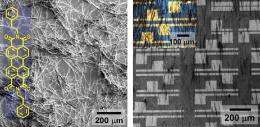
In their fabrication approach, the researchers used a solution fabrication method to assemble the organic microwires. Certain organic conjugated molecules, when placed in a hot concentrated solution, readily assemble into wires upon cooling or addition of a “bad” solvent (a solvent that the molecule is not readily soluble in). By controlling the cooling speed and solvent mixing ratio, the researchers could tune the diameter of the wire (in the range of tens of nanometers) and the length of the wire (from several millimeters to several tens of micrometers). Upon completion, the microwires exhibited a structurally perfect single-crystalline nature, with different locations of the same wire showing the same diffraction pattern geometry. In addition, the orientation of the molecules (pi-stacking) along the long axis of the microwires improved the wires’ charge transport efficiency, and overall wire performance.
Next, the researchers used a filtration-and-transfer (FAT) alignment method to control the alignment and density of the microwires being deposited on the transistors. In general, organic microwires are difficult to work with due to their fragility, and they’re easily damaged by handling. In the FAT method, the microwires are aligned by fluid flow through a mask in a simple vacuum filtration setup. The method could successfully produce dense films of aligned and undamaged microwires, which is important for achieving a high and uniform current. Unlike most other assembly methods, the FAT method could also create multiple microwire patterns in different directions, simply by using an appropriate mask.
As the researchers explained, the high mobility of the new n-channel organic transistors can be attributed to the high level of structural perfection of the microwires, along with good alignment and high density of the microwires on the transistors. Hopefully, this approach will lead to the fabrication of high-performance organic electronic devices, in addition to the transistors shown here. Zhenan added that solar cells and sensors are potential devices, and that the method should be applicable to inorganic nano- and microwire alignment, as well.
More information: Joon Hak Oh, et al. “Solution-processed, high-performance n-channel organic microwire transistors.” PNAS, April 14, 2009, vol. 106, no. 15, 6065-6070.
Copyright 2009 PhysOrg.com.
All rights reserved. This material may not be published, broadcast, rewritten or redistributed in whole or part without the express written permission of PhysOrg.com.


