'Natural' nitrogen-fixing bacteria protect soybeans from aphids
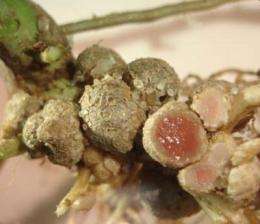
Colonizing bacteria that supply nitrogen to legumes, reside in protective nodules formed by the plant, rhizobia, a type of root. The bright red color of the opened nodule is an indication of healthy rhizobia inside. Rhizobia, a type of nitrogen fixing bacteria that supply nitrogen to legumes, reside in protective nodules formed by the plant. The bright red color of the opened nodule is an indication of healthy rhizobia inside. Credit: Jennifer Dean
An invasion of soybean aphids poses a problem for soybean farmers requiring application of pesticides, but a team of Penn State entomologists thinks a careful choice of nitrogen-fixing bacteria may provide protection against the sucking insects.
Soybeans are legumes, plants that can have a symbiotic relationship with nitrogen-fixing bacteria -- rhizobia -- and therefore do not need additional nitrogen fertilizer. Each type of legume -- peas, beans, lentils, alfalfa -- have their own rhizobia.
"Soybeans are from Asia and so there were originally no nitrogen-fixing bacteria that would colonize soybeans in U.S. soils," said Consuelo De Moraes, associate professor of entomology. "The rhizobia had to be transferred here."
The soybean aphid is also not native to North America. This pest only began to infest soybean fields about 10 years ago but are now fully established pests requiring pesticide applications to avoid the loss of as much as 40 percent of the crop. The researchers investigated the relationship between the type of rhizobia colonizing soybean plants and the plants' infestation with the aphids.
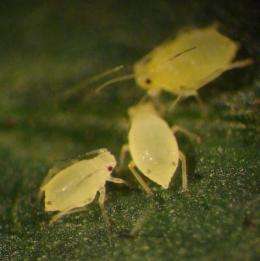
Soybean aphids are a recently introduced pest to the US, causing yield losses and increased insecticide sprays. The aphids feed on the sap of soybean plants. Credit: Jennifer Dean
"Our results demonstrate that plant-rhizobia interactions influence plant resistance to insect herbivores and that some rhizobia strains confer greater resistance to their mutualist partners than do others," the researchers report in the journal Plant and Soil online.They looked at soybean plants inoculated with the rhizobia provided by the inoculant company; without rhizobia, but with added nitrogen fertilizer, and by existing rhizobia in the soil.
"The bacteria that were used initially to inoculate the first crops of soybeans are growing wild in the soil now," said Mark C. Mescher. "They are now considered "naturally occurring" and are different from the inoculants purchased with the soybean seeds."
They become natural because they change through generations of contact with other rhizobia. While they may not provide as much nitrogen to the plant as commercial types, the trade off between optimal growth and heavy insect damage may still be worthwhile.
"In most cases, the inoculant companies provide rhizobia for inoculation that gives plants the maximum yield," said Jennifer M. Dean, postdoctoral fellow in entomology. "Their rhizobia are highly competitive against naturally occurring nitrogen-fixing bacteria. The inoculant companies treat the natural rhizobia almost as a pest."
Because of this, soybeans almost uniformly incorporate the specially developed rhizobia rather than the natural ones. However, the researchers found that the plants associated with the naturally occurring rhizobia had lower aphid densities than either the artificially fertilized plants or the plants inoculated with commercial rhizobia. They also found the same level of nitrogen in both soybean plants inoculated with natural rhizobia and those inoculated with commercial varieties.
"This is the first time anyone has shown how different strains of rhizobia can effect herbivory," said De Moraes. "This may be another tool to use to protect plants from insect herbivory. It may also be applicable to other legumes."
The researchers do not yet know what the natural nitrogen-fixing bacteria do to repel aphids.
"It is really exciting to see that the nitrogen producing rhizobia can be protective," said Dean. "Next we want to isolate rhizobia strains from the fields and look for the specific mechanism of how they repel the aphids."
Source: Penn State
-
From lemons to lemonade: Reaction uses carbon dioxide to make carbon-based semiconductor,
32 comments
-
Thioridazine kills cancer stem cells in human while avoiding toxic side-effects of conventional cancer treatments,
3 comments
-
SpaceX private rocket blasts off for space station (Update),
42 comments
-
Climate scientists say they have solved riddle of rising sea,
31 comments
-
SpaceX capsule has 'new car' smell, astronauts say (Update),
4 comments
-
osmotic pressure vs diffusion
2 hours ago
-
What would stain as translucent on light-coloured fabric?
May 26, 2012
-
How do I identify different bacteria on culture plates?
May 26, 2012
-
Why Do Dogs do Strange things...
May 25, 2012
-
What does exophillic and endophillic mean in terms of mosquito and their control?
May 24, 2012
-
Semen stains glows under black lights (uv light)?
May 23, 2012
- More from Physics Forums - Biology
More news stories
Manufacturing genes to attack flu virus
An international research team has manufactured a new protein that can combat deadly flu epidemics.
9 hours ago |
not rated yet |
0
|
Scientist: Evolution debate will soon be history
(AP) -- Richard Leakey predicts skepticism over evolution will soon be history. Not that the avowed atheist has any doubts himself.
May 26, 2012 |
3.4 / 5 (21) |
98
More plant species responding to global warming than previously thought
(Phys.org) -- Far more wild plant species may be responding to global warming than previous large-scale estimates have suggested.
May 22, 2012 |
4.6 / 5 (14) |
18
|
For monogamous sparrows, it doesn't pay to stray (but they do it anyway)
It's quite common for a female song sparrow to stray from her breeding partner and mate with the male next door, but a new study shows that sleeping around can be costly.
May 22, 2012 |
5 / 5 (2) |
8
|
Thousands of shellfish found dead in Peru
Thousands of crustaceans were found dead off the coast of Lima following the mystery mass death of dolphins and pelicans, the Peruvian Navy said Friday.
May 26, 2012 |
4.7 / 5 (7) |
7
'Unzipped' carbon nanotubes could help energize fuel cells, batteries
Multi-walled carbon nanotubes riddled with defects and impurities on the outside could replace some of the expensive platinum catalysts used in fuel cells and metal-air batteries, according to scientists at ...
Change in developmental timing was crucial in the evolutionary shift from dinosaurs to birds: study
At first glance, it's hard to see how a common house sparrow and a Tyrannosaurus Rex might have anything in common. After all, one is a bird that weighs less than an ounce, and the other is a dinosaur that ...
Stunning image of smallest possible five-ringed structure
Scientists have created and imaged the smallest possible five-ringed structure about 100,000 times thinner than a human hair and you'll probably recognise its shape.
Computer model used to pinpoint prime materials for efficient carbon capture
When power plants begin capturing their carbon emissions to reduce greenhouse gases and to most in the electric power industry, it's a question of when, not if it will be an expensive undertaking.
T cells 'hunt' parasites like animal predators seek prey, study shows
By pairing an intimate knowledge of immune-system function with a deep understanding of statistical physics, a cross-disciplinary team at the University of Pennsylvania has arrived at a surprising finding: T cells use a movement ...
Land and sea species differ in climate change response: study
(Phys.org) -- Marine and terrestrial species will likely differ in their responses to climate warming, new research by Simon Fraser University and Australia’s University of Tasmania has found.
